Université Paris-Saclay, INRAE, CNRS, AgroParisTech, GQE - Le Moulon, 91190, Gif-sur-Yvette, France.
MIA, INRAE, AgroParisTech, Université Paris-Saclay, 75005, Paris, France.
PLoS Genet. 2020 Mar 4;16(3):e1008241. doi: 10.1371/journal.pgen.1008241. eCollection 2020 Mar.
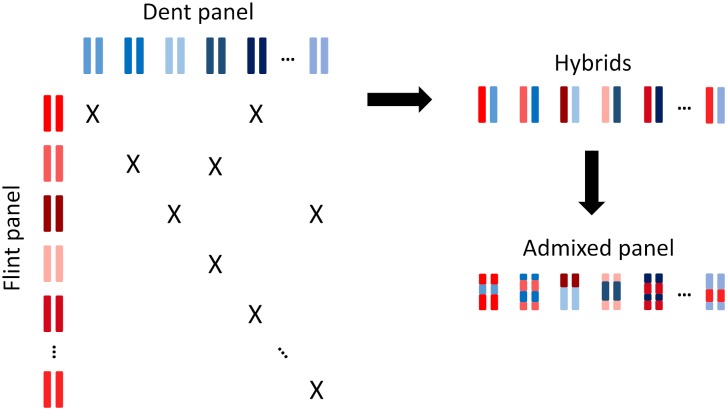
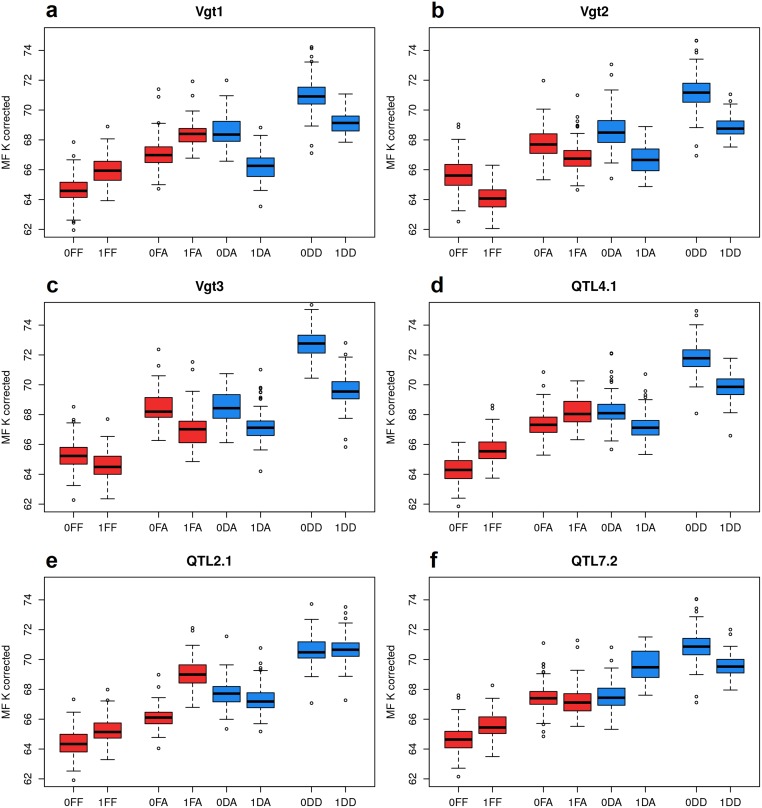
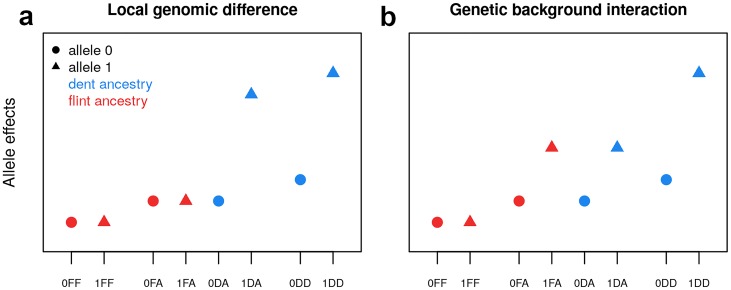
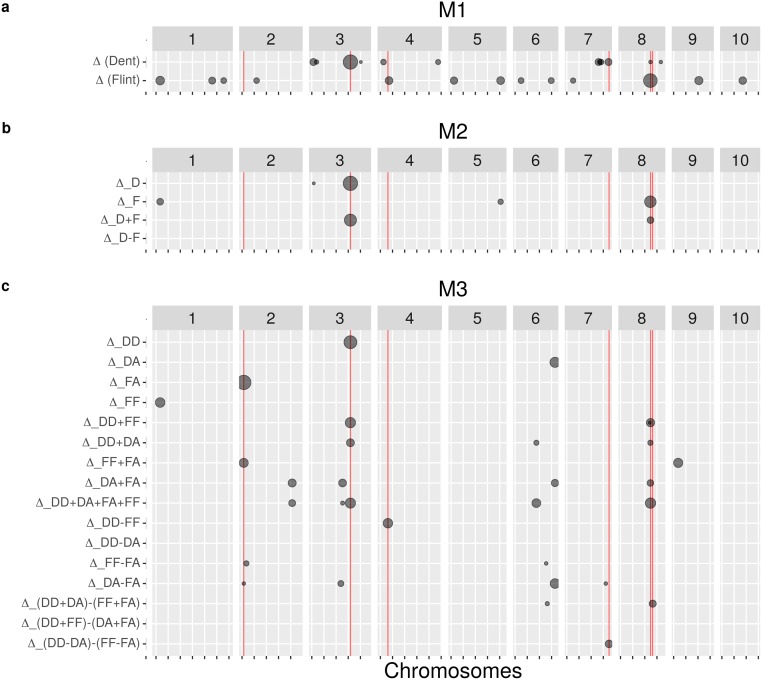
When handling a structured population in association mapping, group-specific allele effects may be observed at quantitative trait loci (QTLs) for several reasons: (i) a different linkage disequilibrium (LD) between SNPs and QTLs across groups, (ii) group-specific genetic mutations in QTL regions, and/or (iii) epistatic interactions between QTLs and other loci that have differentiated allele frequencies between groups. We present here a new genome-wide association (GWAS) approach to identify QTLs exhibiting such group-specific allele effects. We developed genetic materials including admixed progeny from different genetic groups with known genome-wide ancestries (local admixture). A dedicated statistical methodology was developed to analyze pure and admixed individuals jointly, allowing one to disentangle the factors causing the heterogeneity of allele effects across groups. This approach was applied to maize by developing an inbred "Flint-Dent" panel including admixed individuals that was evaluated for flowering time. Several associations were detected revealing a wide range of configurations of allele effects, both at known flowering QTLs (Vgt1, Vgt2 and Vgt3) and new loci. We found several QTLs whose effect depended on the group ancestry of alleles while others interacted with the genetic background. Our GWAS approach provides useful information on the stability of QTL effects across genetic groups and can be applied to a wide range of species.
在关联映射中处理结构群体时,由于以下原因,在数量性状基因座 (QTL) 处可能会观察到群体特异性等位基因效应:(i) 不同群体之间 SNP 和 QTL 之间的连锁不平衡 (LD) 不同,(ii) QTL 区域的群体特异性遗传突变,和/或 (iii) QTL 与其他导致群体间等位基因频率分化的位点之间的上位性相互作用。我们在这里提出了一种新的全基因组关联 (GWAS) 方法来鉴定表现出这种群体特异性等位基因效应的 QTL。我们开发了包括具有已知全基因组祖先的不同遗传群体的杂种后代在内的遗传材料(局部杂种)。开发了一种专门的统计方法来联合分析纯合和杂种个体,允许人们分解导致群体间等位基因效应异质性的因素。通过开发包括杂种个体的自交系“Flint-Dent”面板并对开花时间进行评估,应用该方法对玉米进行了研究。检测到多个关联,揭示了广泛的等位基因效应配置,包括已知的开花 QTL(Vgt1、Vgt2 和 Vgt3)和新的位点。我们发现了几个 QTL,其效应取决于等位基因的群体祖先,而其他 QTL 则与遗传背景相互作用。我们的 GWAS 方法提供了有关 QTL 效应在遗传群体中稳定性的有用信息,并且可以应用于广泛的物种。