Pharmacy Department, Sir Charles Gairdner Hospital, Perth, Australia.
Institute for Respiratory Health, University of Western Australia, Perth, Australia.
PLoS One. 2021 Apr 26;16(4):e0250628. doi: 10.1371/journal.pone.0250628. eCollection 2021.
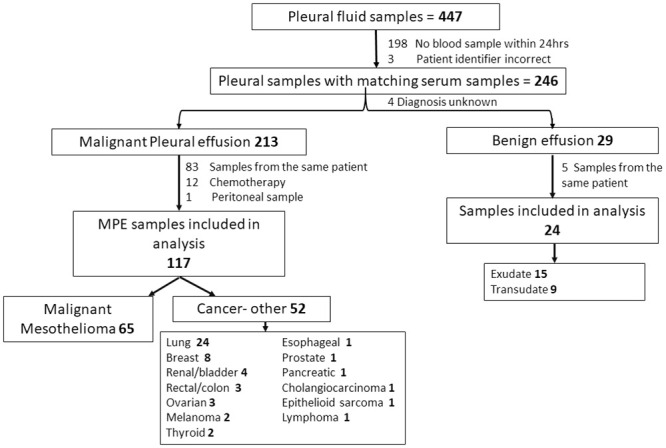
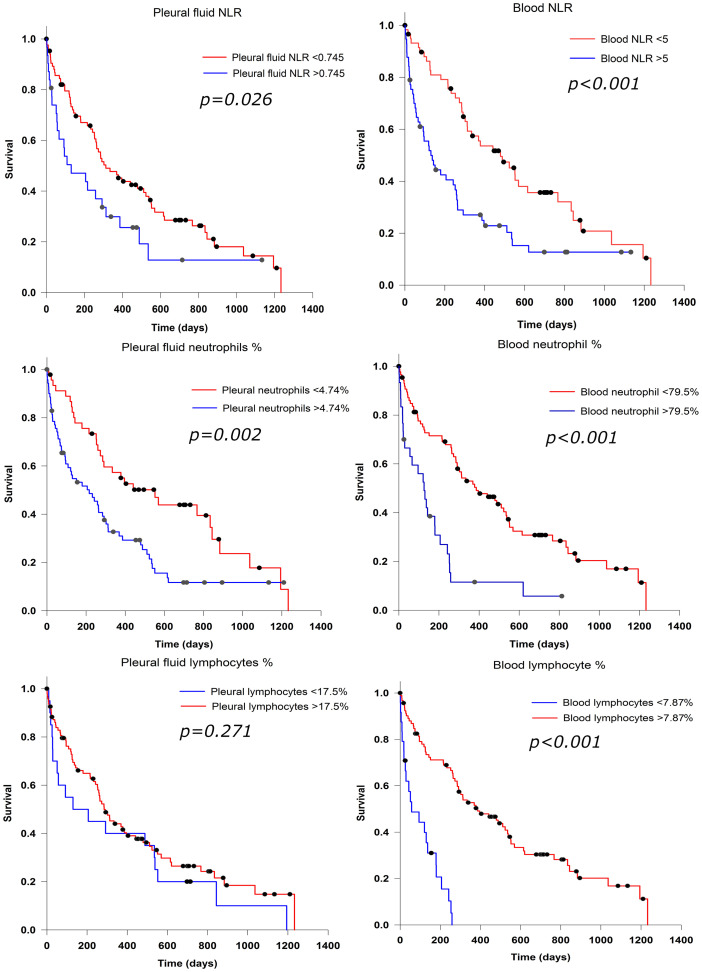
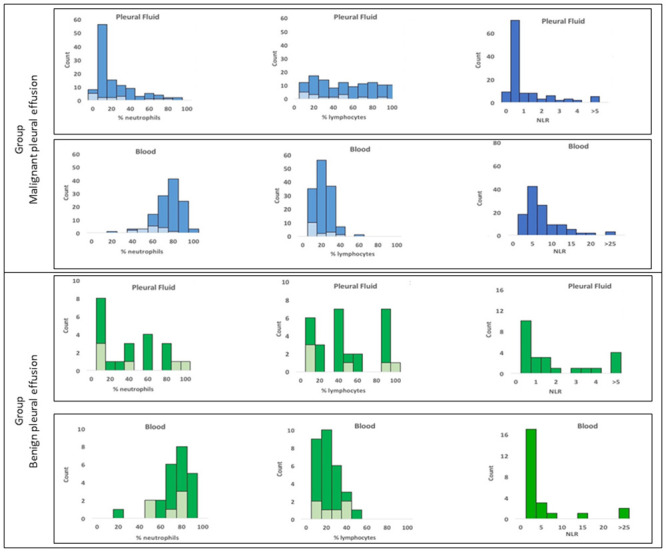
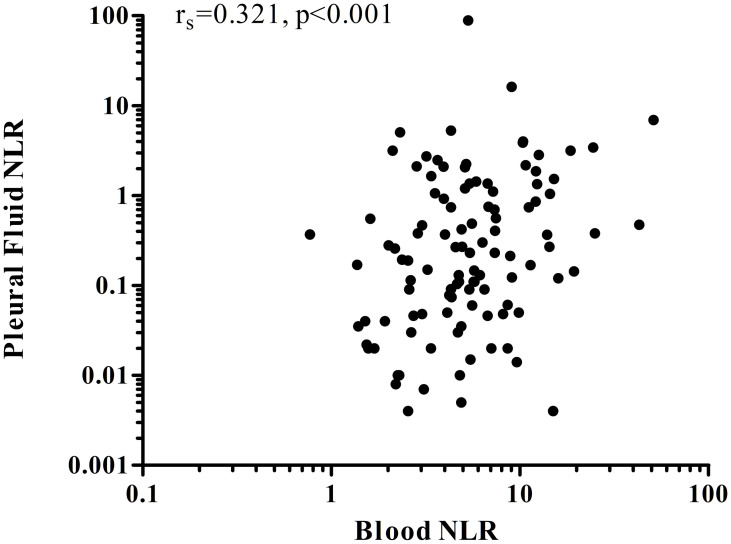
Predicting survival of patients with malignant pleural effusions (MPEs) is notoriously difficult. A robust prognostic marker can guide clinical decision making. The neutrophil-to-lymphocyte ratio (NLR) in blood has been shown to predict survival in many cancers. Pleural fluid bathes the malignant pleural tissues, thus the NLR of the pleural fluid may reflect more closely the local tumour environment. The objective of this study was to explore the prognostic significance of pleural effusion NLR for MPE. We analysed matched effusion and blood from 117 patients with malignant and 24 with benign pleural effusions. Those who had received recent chemotherapy or had a pleurodesis were excluded. Neutrophil and lymphocyte counts in effusions were performed by manual review of cytospin cell preparations by trained observers. Clinical data were extracted from a state-wide hospital database. We found significantly fewer neutrophils (expressed as percentage of total leukocyte count) in pleural fluid than in corresponding blood (9% vs 73%; p<0.001). The NLR was an order of magnitude lower in pleural fluid than in corresponding blood: median [IQR] = 0.20 [0.04-1.18] vs 4.9 [3.0-8.3], p<0.001. Correlation between blood and pleural fluid NLR in MPE patients was moderate (rs = 0.321, p<0.001). In univariate analysis, NLR (>0.745)) in malignant pleural fluid was predictive of poorer survival (HR = 1.698 [1.0054-2.736]; p = 0.030), and remained significant after adjustment for age, sex, presence of a chest drain, cancer type, concurrent infection and subsequent treatment with chemotherapy (HR = 1.786 [1.089-2.928]; p = 0.022). Patients with pleural fluid NLR > 0.745 had a significantly shorter median survival of 130 (95% CI 0-282) days compared to 312 (95% CI 195-428) days for pleural NLR < 0.745, p = 0.026. The NLR in blood was also predictive of poorer survival in MPE patients (HR = 1.959 [1.019-3.096]; p<0.001). The proportion of neutrophils in pleural fluid was predictive of prognosis more strongly than lymphocytes. This study provides evidence that NLR in malignant effusions can predict survival, and therefore may provide prognostic information for this cohort. This prognostic association in the fluid is driven by the presence of neutrophils.
预测恶性胸腔积液 (MPE) 患者的生存率非常困难。一个可靠的预后标志物可以指导临床决策。血液中的中性粒细胞与淋巴细胞比值 (NLR) 已被证明可以预测许多癌症的生存率。胸腔积液浸润恶性胸膜组织,因此胸腔积液中的 NLR 可能更能反映局部肿瘤环境。本研究旨在探讨胸腔积液 NLR 对 MPE 的预后意义。我们分析了 117 例恶性胸腔积液和 24 例良性胸腔积液患者的配对胸腔积液和血液。排除了近期接受化疗或行胸膜固定术的患者。通过训练有素的观察者手动检查细胞离心涂片来检测胸腔积液中的中性粒细胞和淋巴细胞计数。临床数据从全州医院数据库中提取。我们发现胸腔积液中的中性粒细胞(以白细胞总数的百分比表示)明显少于相应血液中的中性粒细胞(9%比 73%;p<0.001)。胸腔积液中的 NLR 比相应血液中的 NLR 低一个数量级:中位数[IQR] = 0.20 [0.04-1.18] 比 4.9 [3.0-8.3],p<0.001。MPE 患者血液和胸腔积液 NLR 之间存在中度相关性(rs = 0.321,p<0.001)。在单因素分析中,恶性胸腔积液 NLR(>0.745)预测生存率较差(HR = 1.698 [1.0054-2.736];p = 0.030),并且在调整年龄、性别、胸腔引流管的存在、癌症类型、合并感染和随后化疗治疗后仍然具有统计学意义(HR = 1.786 [1.089-2.928];p = 0.022)。胸腔积液 NLR > 0.745 的患者中位生存期明显缩短,为 130(95%CI 0-282)天,而胸腔积液 NLR < 0.745 的患者中位生存期为 312(95%CI 195-428)天,p = 0.026。血液 NLR 也可预测 MPE 患者生存率较差(HR = 1.959 [1.019-3.096];p<0.001)。胸腔积液中中性粒细胞的比例比淋巴细胞更能预测预后。这项研究提供了证据表明恶性胸腔积液中的 NLR 可以预测生存率,因此可能为该患者群体提供预后信息。这种在液体中的预后相关性是由中性粒细胞的存在驱动的。