Department of Obstetrics and Gynecology, The Catholic University of Korea, Seoul, 06591, South Korea.
Division of Pulmonology, Department of Internal Medicine, Inha University Hospital, Inha University School of Medicine, 27, Inhang-ro, Jung-gu, Incheon, 22332, South Korea.
BMC Cancer. 2017 Aug 22;17(1):557. doi: 10.1186/s12885-017-3550-8.
Various studies have reported that the neutrophil-to-lymphocyte ratio in the serum (sNLR) may serve as a cost-effective and useful prognostic factor in patients with various cancer types. However, no study has reported the prognostic impact of the NLR in malignant pleural effusion (MPE). To address this gap, we investigated the clinical impact of NLR as a prognostic factor in MPE (mNLR) and a new scoring system that use NLRs in the serum and MPE (smNLR score) in lung cancer patients.
We retrospectively reviewed all of the patients who were diagnosed with lung cancer and who presented with pleural effusion. To maintain the quality of the study, only patients with malignant cells in the pleural fluid or tissue were included. The patients were classified into three smNLR score groups, and clinical variables were investigated for their correlation with survival.
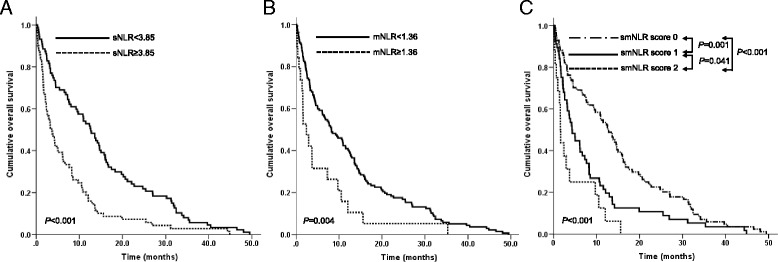
In all, 158 patients were classified into three smNLR score groups as follows: 84 (53.2%) had a score of 0, 58 (36.7%) had a score of 1, and 16 (10.1%) had a score of 2. In a univariate analysis, high sNLR, mNLR, and increments of the smNLR score were associated with shorter overall survival (p < 0.001, p = 0.004, and p < 0.001, respectively); moreover, age, Eastern Cooperative Oncology Group performance status (ECOG PS), histology, M stage, hemoglobin level, albumin level, and calcium level were significant prognostic factors. A multivariable analysis confirmed that ECOG PS (p < 0.001), histology (p = 0.001), and smNLR score (p < 0.012) were independent predictors of overall survival.
The new smNLR score is a useful and cost-effective prognostic factor in lung cancer patients with MPE. Although further studies are required to generalize our results, this information will benefit clinicians and patients in determining the most appropriate therapy for patients with MPE.
多项研究表明,血清中性粒细胞与淋巴细胞比值(sNLR)可能是多种癌症类型患者具有成本效益且有用的预后因素。然而,尚无研究报道 NLR 在恶性胸腔积液(MPE)中的预后影响。为了填补这一空白,我们研究了 NLR 作为 MPE 预后因素(mNLR)以及一种新的评分系统的临床影响,该系统使用血清和胸腔积液中的 NLR(smNLR 评分)对肺癌患者进行评估。
我们回顾性分析了所有被诊断患有肺癌且伴有胸腔积液的患者。为了保证研究质量,仅纳入胸腔积液或组织中存在恶性细胞的患者。将患者分为三组 smNLR 评分,分析临床变量与生存的相关性。
共有 158 例患者被分为三组 smNLR 评分:0 分 84 例(53.2%),1 分 58 例(36.7%),2 分 16 例(10.1%)。单因素分析显示,高 sNLR、mNLR 和 smNLR 评分升高与总生存期缩短相关(p<0.001、p=0.004 和 p<0.001);此外,年龄、东部肿瘤协作组体能状态(ECOG PS)、组织学、M 分期、血红蛋白水平、白蛋白水平和钙水平是重要的预后因素。多因素分析证实 ECOG PS(p<0.001)、组织学(p=0.001)和 smNLR 评分(p<0.012)是总生存期的独立预测因素。
新型 smNLR 评分是一种有用且具有成本效益的肺癌伴 MPE 患者的预后因素。尽管需要进一步的研究来推广我们的结果,但这些信息将有助于临床医生和患者为 MPE 患者选择最合适的治疗方法。