Milella Michele Stanislaw, Boldrini Paolo, Vivino Gabriella, Grassi Maria Caterina
Poison Control Center Unit, Department of Emergency, Anesthesia and Critical Care, Policlinico Umberto I Hospital-Sapienza University of Rome, Viale del Policlinico 155, 00161, Rome, Italy.
Department of Physiology and Pharmacology "V. Erspamer", Sapienza University of Rome, Piazzale Aldo Moro 5, 00185, Rome, Italy.
J Med Toxicol. 2021 Jul;17(3):250-256. doi: 10.1007/s13181-021-00839-2. Epub 2021 Apr 27.
Between early March 2020 and the end of May 2020, Italy issued strict measures to limit further spread of coronavirus disease 2019 (COVID-19) and became the first European country that imposed a lockdown on the population. The aim of this study was to assess the impact of these restricted conditions on the activity of the Poison Control Center (PCC) of Policlinico Umberto I Hospital-Sapienza University of Rome.
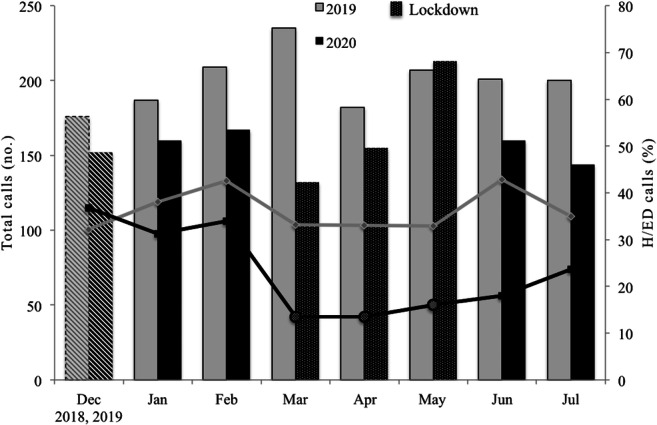
This was a retrospective analysis of calls received by the PCC during the lockdown period March 9, 2020 through May 31, 2020 compared to the same time period in year 2019 (reference).
We observed a reduction in calls from hospitals and emergency departments and an increase in calls from private citizens about exposures to products or intoxications during the lockdown. There were increases in unintentional exposures and exposures to hand and surface sanitizers among household and cleaning products. There was a decrease in calls concerning medications, which were mostly from hospitals and emergency departments. We observed increases in exposures requiring clinical observations among adults and referral to the emergency department among pre-school children.
Public health protection measures against COVID-19 to improve hygiene and maintain clean environments can increase exposures to hazardous products in the domestic environment. We observed an increase in unintentional exposures to household and cleaning products during the lockdown and an increase in ED referrals for pre-school children compared to the previous year. Our data suggest the need for improvements in public campaigns that promote safer handling of household products and prevent unnecessary exposures during a lockdown. The public health promotion activity can benefit the community after the pandemic and prepare the community for lockdowns in the future.
在2020年3月初至2020年5月底期间,意大利发布了严格措施以限制2019冠状病毒病(COVID-19)的进一步传播,并成为首个对民众实施封锁的欧洲国家。本研究的目的是评估这些限制措施对罗马萨皮恩扎大学翁贝托一世综合医院中毒控制中心(PCC)活动的影响。
这是一项对中毒控制中心在2020年3月9日至2020年5月31日封锁期间接到的电话进行的回顾性分析,并与2019年同期(参照)进行比较。
我们观察到,在封锁期间,来自医院和急诊科的电话减少,而来自普通民众关于接触产品或中毒的电话增加。家用和清洁产品中无意接触及接触手部和表面消毒剂的情况有所增加。关于药物的电话减少,这些电话大多来自医院和急诊科。我们观察到,需要临床观察的成人接触情况增加,学龄前儿童被转诊至急诊科的情况增加。
针对COVID-19的公共卫生防护措施,以改善卫生状况和保持环境清洁,可能会增加家庭环境中接触危险产品的情况。我们观察到,与上一年相比,封锁期间家用和清洁产品的无意接触有所增加,学龄前儿童被转诊至急诊科的情况也有所增加。我们的数据表明,需要改进公共宣传活动,以促进更安全地处理家用产品,并防止在封锁期间发生不必要的接触。公共卫生促进活动可在疫情后使社区受益,并为社区应对未来的封锁做好准备。