Department of Neurosurgery, Rhode Island Hospital, The Warren Alpert Medical School at Brown University, Providence, Rhode Island, USA.
Department of Neurosurgery, Rhode Island Hospital, The Warren Alpert Medical School at Brown University, Providence, Rhode Island, USA.
World Neurosurg. 2021 Jul;151:e523-e532. doi: 10.1016/j.wneu.2021.04.080. Epub 2021 Apr 24.
In times of health resource reallocation, capacities must remain able to meet a continued demand for essential, nonambulatory neurosurgical acute care. This study sought to characterize the demand for and provision of neurosurgical acute care during the coronavirus disease 2019 (COVID-19) pandemic.
This single-center cross-sectional observational analysis compared nonambulatory neurosurgical consult encounters during the peri-surge period (March 9 to May 31, 2020) with those during an analogous period in 2019. Outcomes included consult volume, distribution of problem types, disease severity, and rate of acute operative intervention.
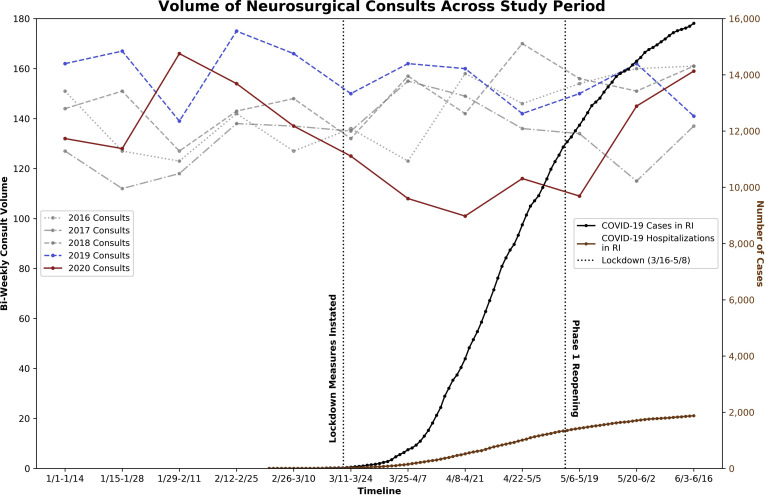
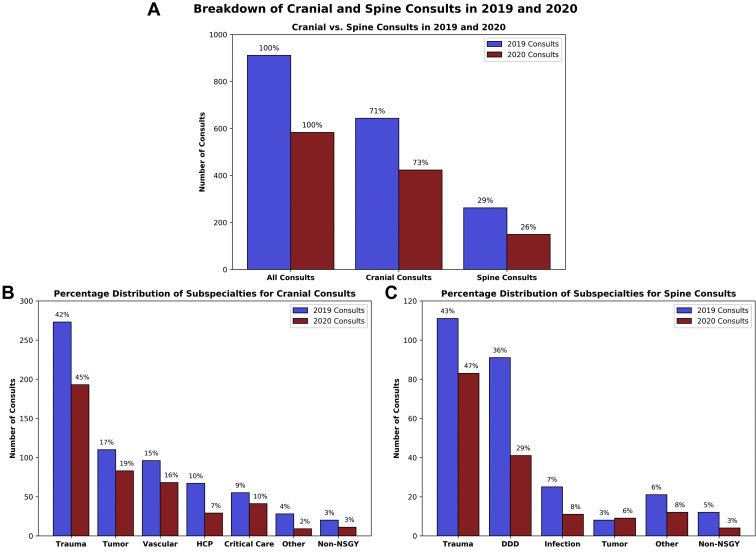
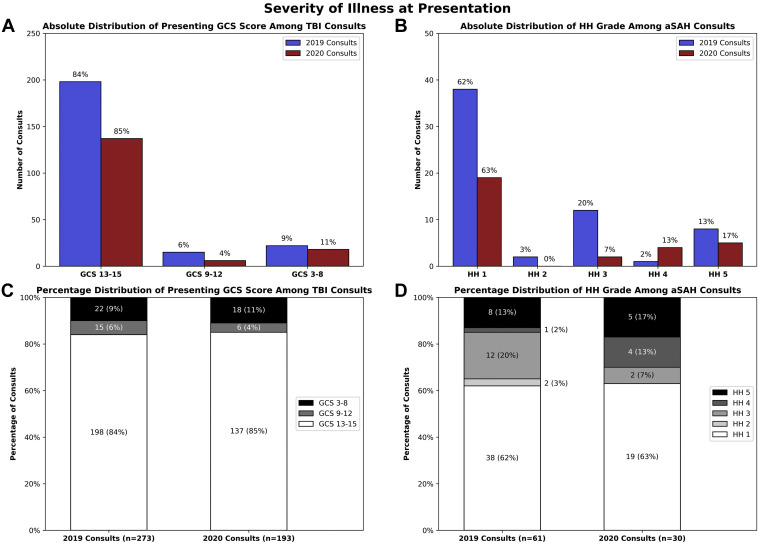
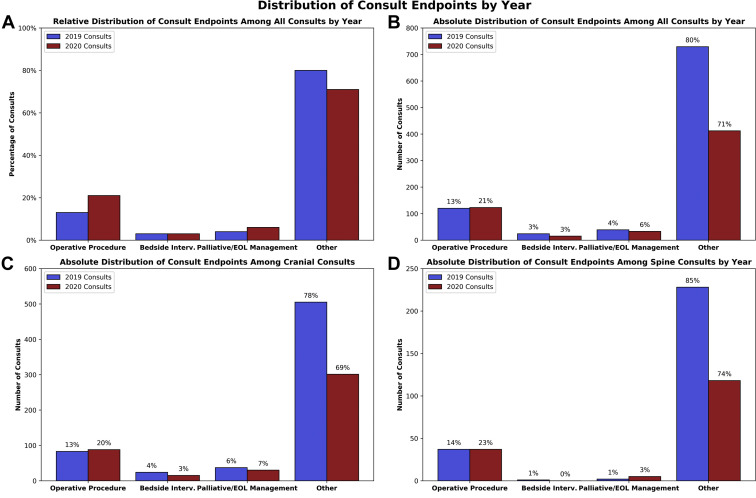
A total of 1494 neurosurgical consults were analyzed. Amidst the pandemic surge, 583 consults were seen, which was 6.4 standard deviations below the mean among analogous 2016-2019 periods (mean 873; standard deviation 45, P = 0.001). Between 2019 and 2020, the proportion of degenerative spine consults decreased in favor of spinal trauma (25.6% vs. 34% and 51.9% vs. 41.4%, P = 0.088). Among aneurysmal subarachnoid hemorrhage cases, poor-grade (Hunt and Hess grades 4-5) presentations were more common (30% vs. 14.8%, P = 0.086). A greater proportion of pandemic era consults resulted in acute operative management, with an unchanged absolute frequency of acutely operative consults (123/583 [21.1%] vs. 120/911 [13.2%], P < 0.001).
Neurosurgical consult volume during the pandemic surge hit a 5-year institutional low. Amidst vast reallocation of health care resources, demand for high-acuity nonambulatory neurosurgical care continued and proportionally increased for greater-acuity pathologies. In our continued current pandemic as well as any future situations of mass health resource reallocation, neurosurgical acute care capacities must be preserved.
在医疗资源重新分配的时期,医疗能力必须能够满足持续的基本非卧床神经外科急性护理需求。本研究旨在描述 2019 冠状病毒病(COVID-19)大流行期间神经外科急性护理的需求和提供情况。
本单中心横断面观察性分析比较了大流行高峰期(2020 年 3 月 9 日至 5 月 31 日)与 2019 年同期的非卧床神经外科咨询就诊情况。结果包括咨询量、问题类型分布、疾病严重程度和急性手术干预率。
共分析了 1494 例神经外科咨询。在疫情高峰期,共进行了 583 次咨询,比 2016-2019 年同期的平均水平低 6.4 个标准差(平均 873,标准差 45,P=0.001)。与 2019 年相比,2020 年退行性脊柱咨询的比例下降,而脊柱创伤的比例上升(25.6%比 34%和 51.9%比 41.4%,P=0.088)。在颅内动脉瘤性蛛网膜下腔出血病例中,较差的分级(Hunt 和 Hess 分级 4-5)更为常见(30%比 14.8%,P=0.086)。大流行时期更多的咨询导致急性手术治疗,急性手术咨询的绝对频率不变(583 例中有 123 例[21.1%]比 911 例中有 120 例[13.2%],P<0.001)。
大流行高峰期的神经外科咨询量达到了 5 年来的最低点。在大量重新分配医疗资源的情况下,对高难度非卧床神经外科护理的需求持续存在,且高难度疾病的比例也相应增加。在我们当前的大流行以及未来任何大规模医疗资源重新分配的情况下,神经外科急性护理能力必须得到保留。