Experimental and Clinical Research Center, a joint cooperation of Max-Delbrück-Center for Molecular Medicine and Charité-Universitätsmedizin Berlin, Germany (S.G., H.B., V.M., A. Maifeld, A. Mähler, N.W., L.M., S.K.F., R.D., D.N.M.).
Integrative Proteomics and Metabolomics, Berlin Institute for Medical Systems Biology, Max-Delbrück-Center for Molecular Medicine in the Helmholtz Association, Germany (S.G., C.Z., S.K.).
Circulation. 2021 Jul 13;144(2):144-158. doi: 10.1161/CIRCULATIONAHA.120.052788. Epub 2021 Apr 28.
Dietary high salt (HS) is a leading risk factor for mortality and morbidity. Serum sodium transiently increases postprandially but can also accumulate at sites of inflammation affecting differentiation and function of innate and adaptive immune cells. Here, we focus on how changes in extracellular sodium, mimicking alterations in the circulation and tissues, affect the early metabolic, transcriptional, and functional adaption of human and murine mononuclear phagocytes.
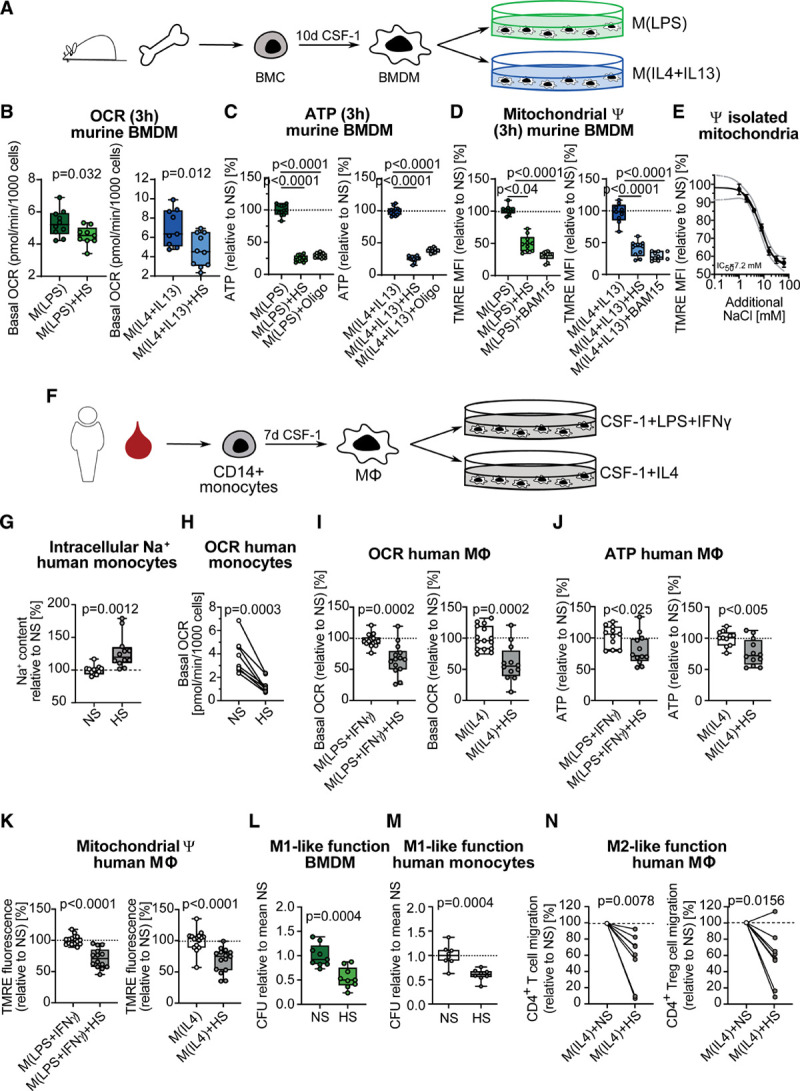
Using Seahorse technology, pulsed stable isotope-resolved metabolomics, and enzyme activity assays, we characterize the central carbon metabolism and mitochondrial function of human and murine mononuclear phagocytes under HS in vitro. HS as well as pharmacological uncoupling of the electron transport chain under normal salt is used to analyze mitochondrial function on immune cell activation and function (as determined by killing and CD4 T cell migration capacity). In 2 independent clinical studies, we analyze the effect of a HS diet during 2 weeks (URL: http://www.clinicaltrials.gov. Unique identifier: NCT02509962) and short-term salt challenge by a single meal (URL: http://www.clinicaltrials.gov. Unique identifier: NCT04175249) on mitochondrial function of human monocytes in vivo.
Extracellular sodium was taken up into the intracellular compartment, followed by the inhibition of mitochondrial respiration in murine and human macrophages. Mechanistically, HS reduces mitochondrial membrane potential, electron transport chain complex II activity, oxygen consumption, and ATP production independently of the polarization status of macrophages. Subsequently, cell activation is altered with improved bactericidal function in HS-treated M1-like macrophages and diminished CD4 T cell migration in HS-treated M2-like macrophages. Pharmacological uncoupling of the electron transport chain under normal salt phenocopies HS-induced transcriptional changes and bactericidal function of human and murine mononuclear phagocytes. Clinically, also in vivo, rise in plasma sodium concentration within the physiological range reversibly reduces mitochondrial function in human monocytes. In both a 14-day and single meal HS challenge, healthy volunteers displayed a plasma sodium increase of [Formula: see text] and [Formula: see text] respectively, that correlated with decreased monocytic mitochondrial oxygen consumption.
Our data identify the disturbance of mitochondrial respiration as the initial step by which HS mechanistically influences immune cell function. Although these functional changes might help to resolve bacterial infections, a shift toward proinflammation could accelerate inflammatory cardiovascular disease.
高盐饮食(HS)是导致死亡率和发病率的主要危险因素。血清钠在餐后会短暂升高,但也会在炎症部位积累,影响先天和适应性免疫细胞的分化和功能。在这里,我们重点研究细胞外钠的变化,模拟循环和组织中的变化,如何影响人类和鼠单核吞噬细胞的早期代谢、转录和功能适应。
使用 Seahorse 技术、脉冲稳定同位素分辨代谢组学和酶活性测定,我们在体外研究 HS 条件下人类和鼠单核吞噬细胞的中心碳代谢和线粒体功能。HS 以及在正常盐条件下解耦电子传递链的药理学方法,用于分析线粒体功能对免疫细胞激活和功能的影响(通过杀伤和 CD4 T 细胞迁移能力来确定)。在 2 项独立的临床研究中,我们分析了在 2 周内进行 HS 饮食(URL:http://www.clinicaltrials.gov. 唯一标识符:NCT02509962)和通过单次进餐进行短期盐挑战(URL:http://www.clinicaltrials.gov. 唯一标识符:NCT04175249)对人类单核细胞体内线粒体功能的影响。
细胞外钠被摄取到细胞内,随后抑制了鼠类和人类巨噬细胞中的线粒体呼吸。从机制上讲,HS 独立于巨噬细胞的极化状态,降低了线粒体膜电位、电子传递链复合物 II 活性、耗氧量和 ATP 产生。随后,细胞激活发生改变,HS 处理的 M1 样巨噬细胞的杀菌功能增强,而 HS 处理的 M2 样巨噬细胞的 CD4 T 细胞迁移能力减弱。在正常盐条件下解耦电子传递链的药理学方法可模拟 HS 诱导的人类和鼠单核吞噬细胞的转录变化和杀菌功能。临床上,在体内,生理范围内血浆钠浓度的升高可使人类单核细胞的线粒体功能可逆性降低。在 14 天和单次进餐 HS 挑战中,健康志愿者的血浆钠分别增加了[Formula: see text]和[Formula: see text],这与单核细胞线粒体耗氧量的减少相关。
我们的数据确定了线粒体呼吸的紊乱是 HS 机械地影响免疫细胞功能的初始步骤。尽管这些功能变化可能有助于解决细菌感染,但向促炎的转变可能会加速炎症性心血管疾病。