Fontcuberta Amaranta, De Gasperin Ornela, Avril Amaury, Dind Sagane, Chapuisat Michel
Department of Ecology and Evolution, University of Lausanne, 1015 Lausanne, Switzerland.
Proc Biol Sci. 2021 Apr 28;288(1949):20210118. doi: 10.1098/rspb.2021.0118.
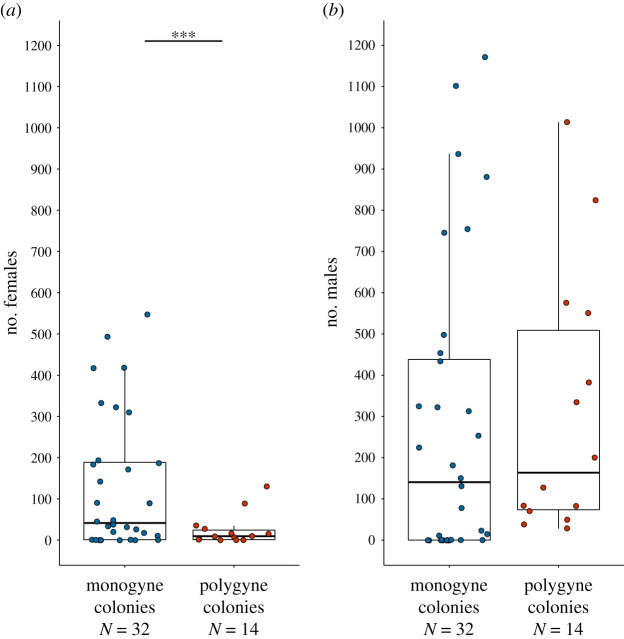
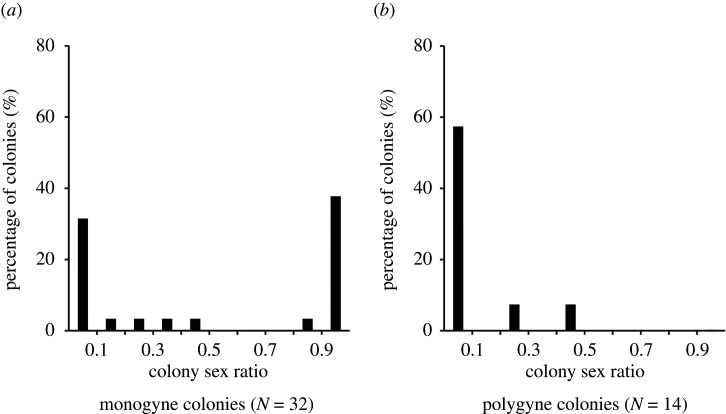
The coevolution between dispersal and sociality can lead to linked polymorphisms in both traits, which may favour the emergence of supergenes. Supergenes have recently been found to control social organization in several ant lineages. Whether and how these 'social supergenes' also control traits related to dispersal is yet unknown. Our goal here was to get a comprehensive view of the dispersal mechanisms associated with supergene-controlled alternative social forms in the ant We measured the production and emission of young females and males by single-queen (monogyne) and multiple-queen (polygyne) colonies, the composition of mating aggregations, and the frequency of crosses within and between social forms in the wild. We found that males and females from alternative social forms did not display strong differences in their propensity to leave the nest and disperse, nor in their mating behaviour. Instead, the social forms differed substantially in sex allocation. Monogyne colonies produced 90% of the females flying to swarms, whereas 57% of the males in swarms originated from polygyne colonies. Most crosses were assortative with respect to social form. However, 20% of the monogyne females did mate with polygyne males, which is surprising as this cross has never been found in mature monogyne colonies. We suggest that the polygyny-determining haplotype free rides on monogyne females, who establish independent colonies that later become polygyne. By identifying the steps in dispersal where the social forms differ, this study sheds light on the behavioural and colony-level traits linking dispersal and sociality through supergenes.
扩散与社会性之间的协同进化会导致这两种性状出现连锁多态性,这可能有利于超级基因的出现。最近发现超级基因控制着几个蚂蚁谱系中的社会组织。这些“社会超级基因”是否以及如何控制与扩散相关的性状尚不清楚。我们的目标是全面了解与超级基因控制的蚂蚁替代社会形式相关的扩散机制。我们测量了单蚁后(单后型)和多蚁后(多后型)蚁群中雌雄幼蚁的产生和释放、交配聚集的组成,以及野外不同社会形式内部和之间杂交的频率。我们发现,来自不同社会形式的雌雄蚁在离开巢穴并扩散的倾向以及交配行为方面没有表现出强烈差异。相反,不同社会形式在性别分配上有很大差异。单后型蚁群产生了90%飞向蜂群的雌蚁,而蜂群中57%的雄蚁来自多后型蚁群。大多数杂交在社会形式上是同型交配的。然而,20%的单后型雌蚁确实与多后型雄蚁交配,这很令人惊讶,因为这种杂交在成熟的单后型蚁群中从未被发现过。我们认为,决定多雌蚁制的单倍型搭了单后型雌蚁的便车,单后型雌蚁建立独立蚁群,这些蚁群后来变成多后型。通过确定不同社会形式在扩散过程中存在差异的步骤,本研究揭示了通过超级基因将扩散与社会性联系起来的行为和蚁群水平的性状。