Department of Zoology and Biodiversity Research Centre, University of British Columbia, Vancouver, British Columbia, Canada V6T 1Z4.
Department of Ecology and Evolution, University of Lausanne, 1015 Lausanne, Switzerland.
Philos Trans R Soc Lond B Biol Sci. 2022 Aug;377(1856):20210197. doi: 10.1098/rstb.2021.0197. Epub 2022 Jun 13.
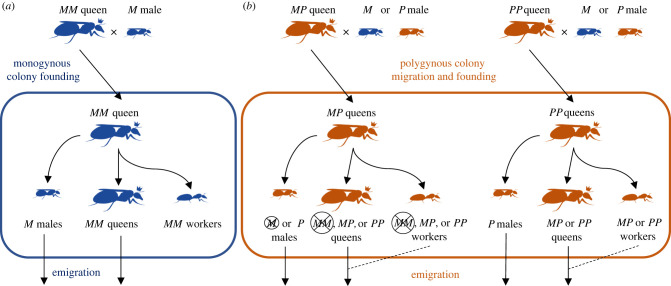
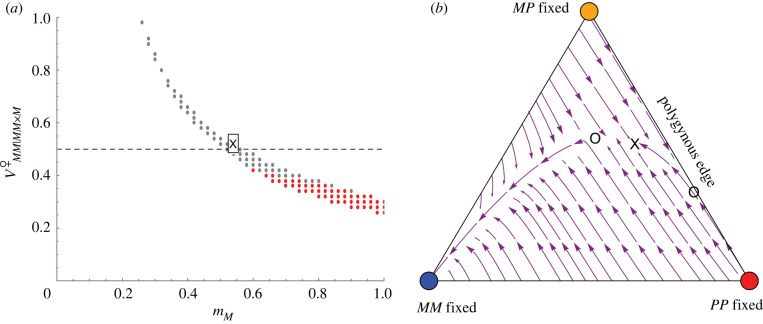
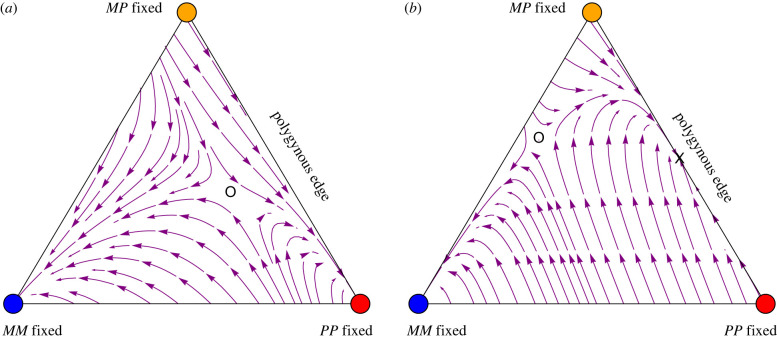
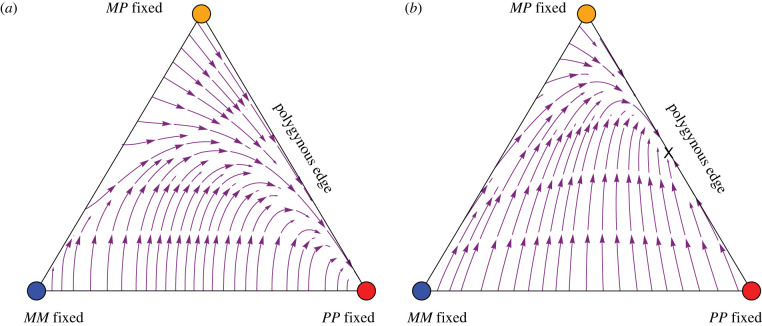
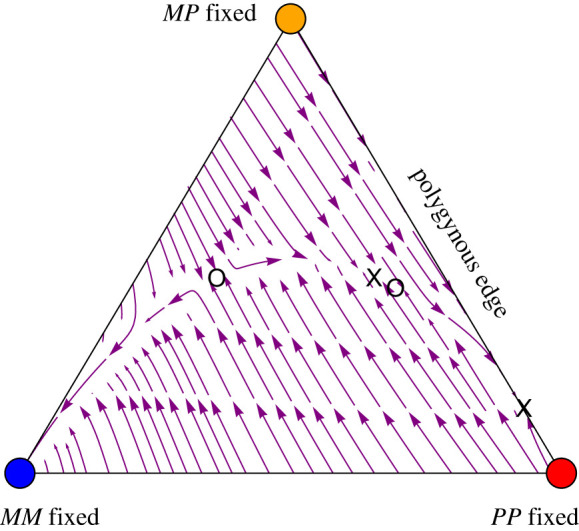
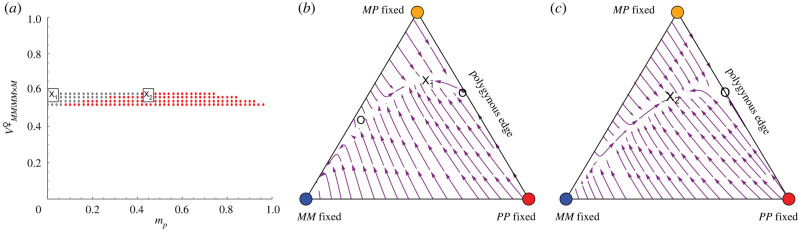
Supergenes often have multiple phenotypic effects, including unexpected detrimental ones, because recombination suppression maintains associations among co-adapted alleles but also allows the accumulation of recessive deleterious mutations and selfish genetic elements. Yet, supergenes often persist over long evolutionary periods. How are such polymorphisms maintained in the face of selection, drive and drift? We present a population genetic model that investigates the conditions necessary for a stable polymorphic equilibrium when one of the supergene haplotypes is a selfish genetic element. The model fits the characteristics of the Alpine silver ant, , in which a large supergene underlies colony social organization, and one haplotype distorts Mendelian transmission by killing progeny that did not inherit it. The model shows that such maternal-effect killing strongly limits the maintenance of social polymorphism. Under random mating, transmission ratio distortion prevents rare single-queen colonies from invading populations of multiple-queen colonies, regardless of the fitness of each genotype. A stable polymorphic equilibrium can, however, be reached when high rates of assortative mating are combined with large fitness differences among supergene genotypes. The model reveals that the persistence of the social polymorphism is non-trivial and expected to occur only under restrictive conditions that deserve further empirical investigation. This article is part of the theme issue 'Genomic architecture of supergenes: causes and evolutionary consequences'.
超级基因通常具有多种表型效应,包括意想不到的有害效应,因为重组抑制维持了共适应等位基因之间的联系,但也允许隐性有害突变和自私遗传元件的积累。然而,超级基因通常在很长的进化时期内持续存在。在面对选择、驱动和漂变时,这些多态性是如何维持的呢?我们提出了一个群体遗传模型,该模型研究了当超级基因座的一个单倍型是自私遗传元件时,稳定多态性平衡所需的条件。该模型适用于高山银蚁的特征,在这种蚂蚁中,一个大型超级基因座是蚁群社会组织的基础,一个单倍型通过杀死没有遗传它的后代来扭曲孟德尔传递。该模型表明,这种母系效应杀伤强烈限制了社会多态性的维持。在随机交配的情况下,无论每个基因型的适应性如何,传递比的扭曲都会阻止罕见的单女王蚁群入侵多女王蚁群的种群。然而,当高的趋同交配率与超级基因座基因型之间的大适应性差异相结合时,可以达到稳定的多态性平衡。该模型揭示了社会多态性的持久性并非微不足道,预计只有在值得进一步实证研究的限制条件下才会发生。本文是主题为“超级基因座的基因组结构:原因和进化后果”的一部分。