Department of Ophthalmology, Ningxia Eye Hospital, People's Hospital of Ningxia Hui Autonomous Region, First Affiliated Hospital of Northwest University for Nationalities, Ningxia Clinical Research Center on Diseases of Blindness in Eye, Yinchuan, China.
Human Genome Sequencing Center, Baylor College of Medicine, Houston, Texas.
Mol Vis. 2021 Mar 18;27:95-106. eCollection 2021.
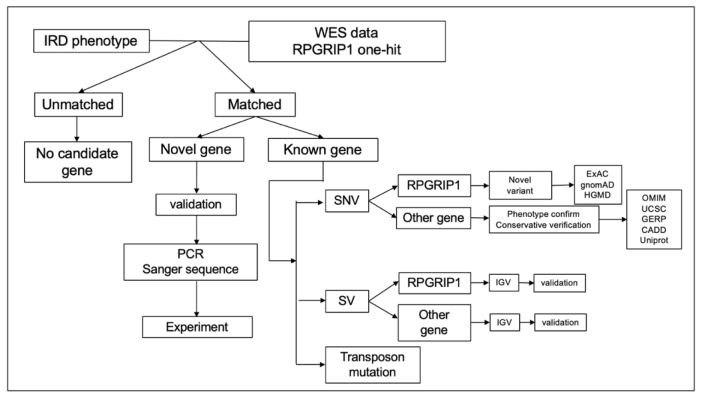
Despite the extensive use of next-generation sequencing (NGS) technology to identify disease-causing genomic variations, a major gap in our understanding of Mendelian diseases is the unidentified molecular lesion in a significant portion of patients. For inherited retinal degenerations (IRDs), although currently close to 300 disease-associated genes have been identified, the mutations in approximately one-third of patients remain unknown. With mounting evidence that noncoding mutations might contribute significantly to disease burden, we aimed to systematically investigate the contributions of noncoding regions in the genome to IRDs.
In this study, we focused on , which has been linked to various IRD phenotypes, including Leber congenital amaurosis (LCA), retinitis pigmentosa (RP), and macular dystrophy (MD). As several noncoding mutant alleles have been reported in and we observed that the mutation carrier frequency of is higher in patient cohorts with unsolved IRDs, we hypothesized that mutations in the noncoding regions of might be a significant contributor to pathogenicity. To test this hypothesis, we performed whole-genome sequencing (WGS) for 25 patients with unassigned IRD who carry a single mutation in .
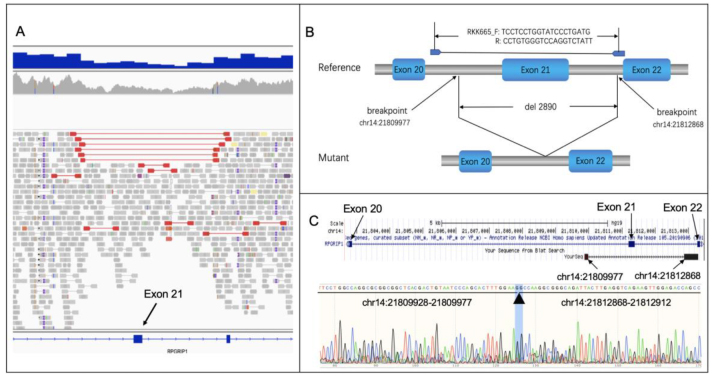
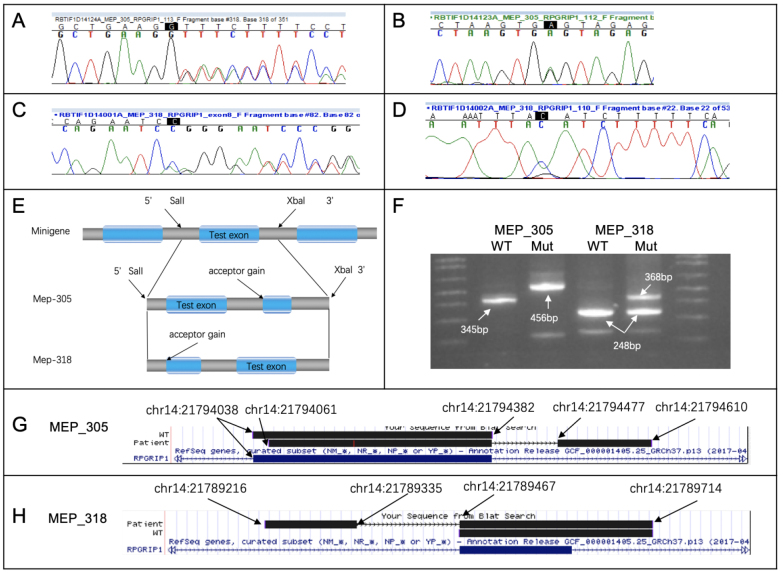
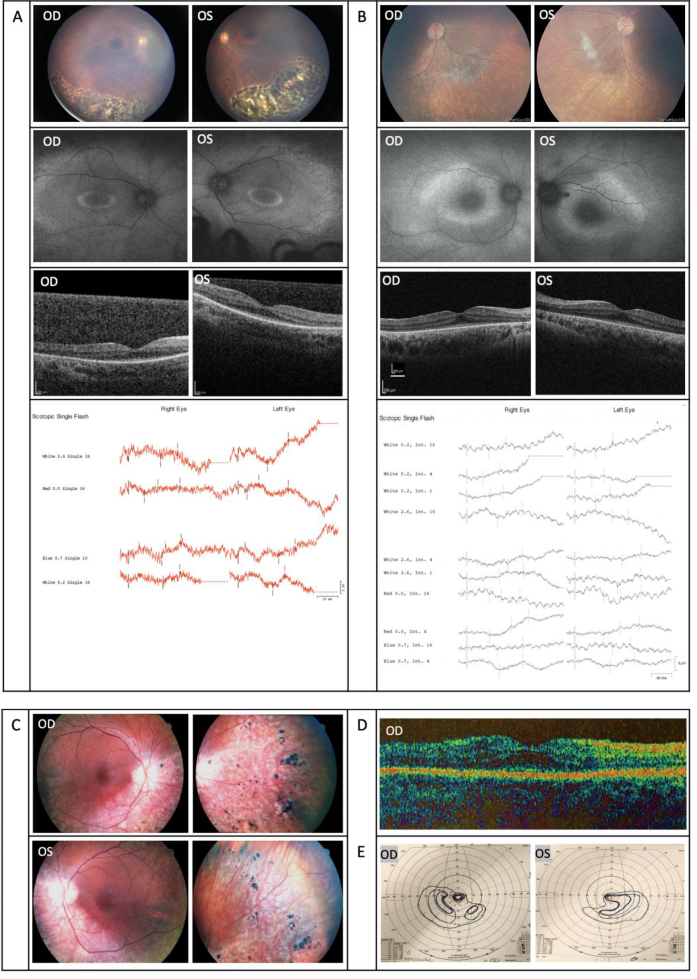
Three noncoding variants in , including a 2,890 bp deletion and two deep-intronic variants (c.2710+233G>A and c.1468-263G>C), were identified as putative second hits of in three patients with LCA. The mutant alleles were validated with direct sequencing or in vitro assays.
The results highlight the significance of the contribution of noncoding pathogenic variants to unsolved IRD cases.
尽管下一代测序(NGS)技术已被广泛用于鉴定致病的基因组变异,但我们对孟德尔疾病的理解仍存在一个主要的空白,即很大一部分患者的分子病变仍然未知。对于遗传性视网膜变性(IRDs),尽管目前已经确定了近 300 个与疾病相关的基因,但大约三分之一患者的突变仍然未知。越来越多的证据表明,非编码突变可能对疾病负担有重大影响,因此我们旨在系统地研究基因组中非编码区域对 IRDs 的贡献。
在这项研究中,我们专注于 ,它与各种 IRD 表型有关,包括莱伯先天性黑矇(LCA)、色素性视网膜炎(RP)和黄斑营养不良(MD)。由于已经报道了 中的几个非编码突变等位基因,并且我们观察到在未解决的 IRD 患者群体中, 的突变携带者频率较高,我们假设 非编码区域的突变可能是致病性的重要因素。为了验证这一假设,我们对携带 中的单个突变但具有未分配 IRD 的 25 名患者进行了全基因组测序(WGS)。
在三名患有 LCA 的患者中,鉴定出 中的三个非编码变异,包括 2890bp 的缺失和两个深内含子变异(c.2710+233G>A 和 c.1468-263G>C),它们被认为是 中的第二个潜在致病突变。通过直接测序或体外实验验证了突变等位基因。
结果强调了非编码致病性变异对未解决的 IRD 病例的重要贡献。