Value Evidence and Outcomes, GlaxoSmithKline plc., Greater China and Intercontinental, 139234, Singapore.
Real World Evidence & Epidemiology, Adelphi Real World, Macclesfield, Cheshire, UK.
Int J Chron Obstruct Pulmon Dis. 2021 Apr 20;16:1075-1091. doi: 10.2147/COPD.S290887. eCollection 2021.
Long-acting bronchodilator (LABD) use is the mainstay of pharmacologic treatment for chronic obstructive pulmonary disease (COPD). Few studies describe evolving patterns of LABD use in the setting of changing inhaler availability and updated clinical guidelines.
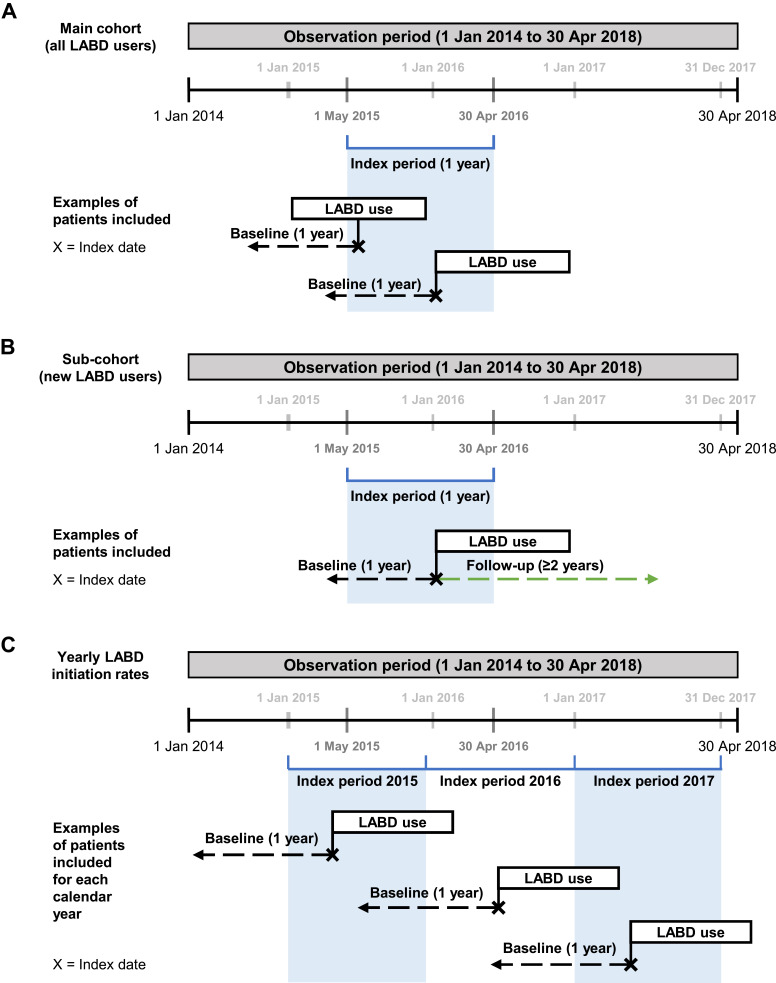
A retrospective cohort study in New Zealand using the HealthStat general practice database (01/2014 to 04/2018). Eligible patients (aged ≥40 years) had COPD and ≥1 LABD prescription (long-acting muscarinic antagonist [LAMA] and/or long-acting β-agonist [LABA]) during the index period (05/2015 to 04/2016). Demographics and clinical characteristics of all LABD users (overall/by treatment) were described at baseline. Patients starting LABD treatment during the index period, termed "new" users, were also described, as was their treatment evolution over 24 months of follow-up. Yearly LABD initiation rates were assessed from 2015 to 2017, covering changes to Pharmaceutical Management Agency criteria and clinical guidelines.
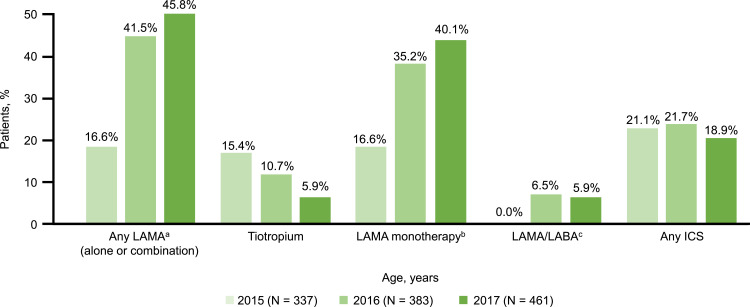
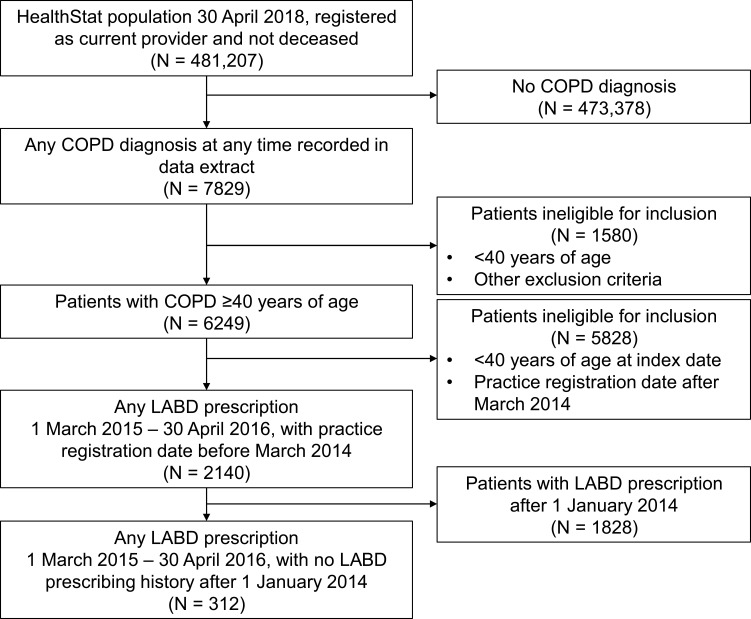
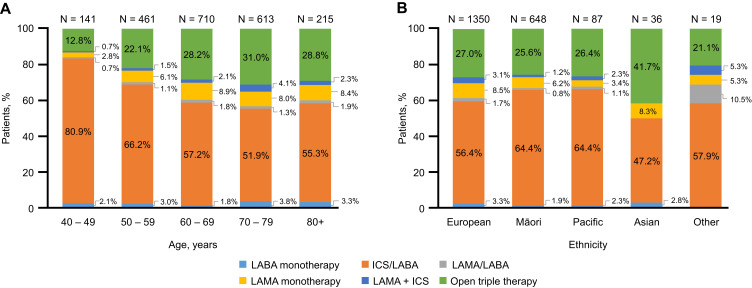
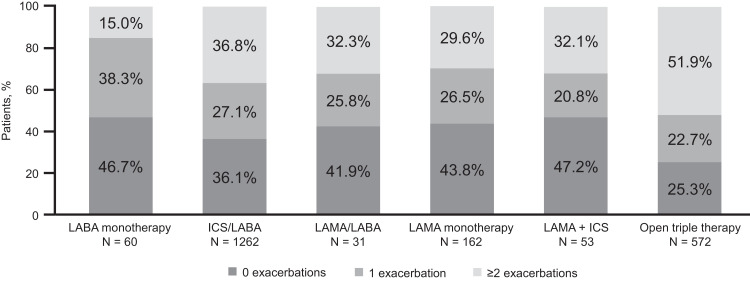
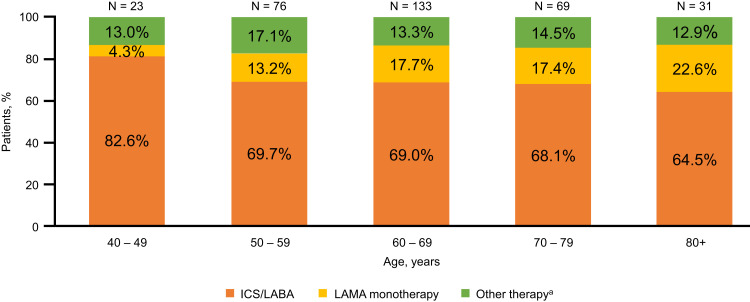
Across 2140 eligible patients, the most common index treatments were inhaled corticosteroid (ICS)/LABA (59.0%) and open triple therapy (LAMA+LABA+ICS; 26.7%). ICS/LABA therapy was highest in younger patients, with open triple therapy highest in older patients. Prior yearly exacerbation rates were lowest in those receiving monotherapy (LABA: 0.9/year; LAMA: 1.1/year) versus dual therapy (all 1.4/year) and open triple therapy (2.2/year). Of 312 new LABD users, ICS/LABA was the most common index treatment (69.6%), followed by LAMA monotherapy (16.0%). Continuous use with index treatment was 31.1% at 12 months and 13.5% at 24 months; mean time to treatment change was 175.5 and 244.1 days, respectively. Among patients modifying treatment at 24 months, 23.0% augmented, 7.0% switched, 45.6% re-started, and 24.4% discontinued/stepped down. Among patients initiating LABD each year from 2015 to 2017, LAMA prescription increased (17% to 46%) while ICS prescription remained stable (approximately 20%).
Predominant use of ICS/LABA (05/2015 to 04/2016) reflects available LABDs and previous restrictions on LAMA use in New Zealand.
长效支气管扩张剂(LABD)的使用是慢性阻塞性肺疾病(COPD)药物治疗的主要手段。很少有研究描述在吸入器可用性和更新的临床指南发生变化的情况下 LABD 使用的演变模式。
这是一项在新西兰进行的回顾性队列研究,使用了 HealthStat 全科医生数据库(2014 年 1 月至 2018 年 4 月)。合格患者(年龄≥40 岁)在索引期(2015 年 5 月至 2016 年 4 月)内有 COPD 和≥1 种 LABD 处方(长效毒蕈碱拮抗剂 [LAMA] 和/或长效β-激动剂 [LABA])。描述了所有 LABD 使用者(总体/按治疗)的基线人口统计学和临床特征。在索引期开始 LABD 治疗的患者(称为“新”使用者)也进行了描述,并描述了他们在 24 个月的随访期间的治疗演变。从 2015 年到 2017 年评估了每年 LABD 的起始率,涵盖了药物管理局标准和临床指南的变化。
在 2140 名合格患者中,最常见的索引治疗是吸入皮质类固醇(ICS)/LABA(59.0%)和开放三联疗法(LAMA+LABA+ICS;26.7%)。ICS/LABA 疗法在年轻患者中最高,而开放三联疗法在老年患者中最高。接受单药治疗(LABA:0.9/年;LAMA:1.1/年)的患者与接受双联治疗(均为 1.4/年)和开放三联疗法(2.2/年)的患者相比,每年恶化的比率最低。在 312 名新 LABD 使用者中,ICS/LABA 是最常见的索引治疗(69.6%),其次是 LAMA 单药治疗(16.0%)。在 12 个月时,使用索引治疗的连续率为 31.1%,在 24 个月时为 13.5%;分别为 175.5 和 244.1 天。在 24 个月时改变治疗的患者中,23.0%进行了增加治疗,7.0%进行了药物转换,45.6%重新开始治疗,24.4%停止/减少了治疗。在 2015 年至 2017 年期间每年开始 LABD 治疗的患者中,LAMA 处方增加(17%至 46%),而 ICS 处方保持稳定(约 20%)。
ICS/LABA 的主要使用(2015 年 5 月至 2016 年 4 月)反映了新西兰现有的 LABD 和以前对 LAMA 使用的限制。