Xue Mingshan, Zhang Teng, Chen Hao, Zeng Yifeng, Lin Runpei, Zhen Yingjie, Li Ning, Huang Zhifeng, Hu Haisheng, Zhou Luqian, Wang Hui, Zhang Xiaohua Douglas, Sun Baoqing
State Key Laboratory of Respiratory Disease, National Clinical Research Center for Respiratory Disease, Guangzhou Institute of Respiratory Health, First Affiliated Hospital of Guangzhou Medical University, Guangzhou 510120, China.
Faculty of Health Sciences, University of Macau. Taipa, Macau, China.
Int J Biol Sci. 2021 Apr 10;17(6):1565-1573. doi: 10.7150/ijbs.58825. eCollection 2021.
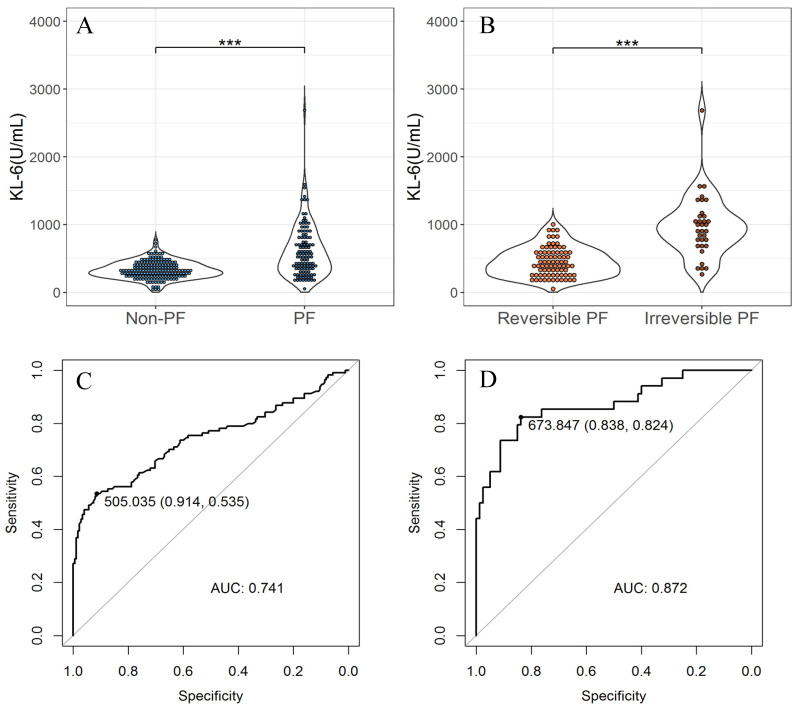
Dysregulated immune response and abnormal repairment could cause secondary pulmonary fibrosis of varying severity in COVID-19, especially for the elders. The Krebs Von den Lungen-6 (KL-6) as a sensitive marker reflects the degree of fibrosis and this study will focus on analyzing the evaluative efficacy and predictive role of KL-6 in COVID-19 secondary pulmonary fibrosis. The study lasted more than three months and included total 289 COVID-19 patients who were divided into moderate (n=226) and severe groups (n=63) according to the severity of illness. Clinical information such as inflammation indicators, radiological results and lung function tests were collected. The time points of nucleic acid test were also recorded. Furthermore, based on Chest radiology detection, it was identified that 80 (27.7%) patients developed reversible pulmonary fibrosis and 34 (11.8%) patients developed irreversible pulmonary fibrosis. Receiver operating characteristic (ROC) curve analysis shows that KL-6 could diagnose the severity of COVID-19 (AUC=0.862) and predict the occurrence of pulmonary fibrosis (AUC = 0.741) and irreversible pulmonary fibrosis (AUC=0.872). Importantly, the cross-correlation analysis demonstrates that KL-6 rises earlier than the development of lung radiology fibrosis, thus also illuminating the predictive function of KL-6. We set specific values (505U/mL and 674U/mL) for KL-6 in order to assess the risk of pulmonary fibrosis after SARS-CoV-2 infection. The survival curves for days in hospital show that the higher the KL-6 levels, the longer the hospital stay (P<0.0001). In conclusion, KL-6 could be used as an important predictor to evaluate the secondary pulmonary fibrosis degree for COVID-19.
免疫反应失调和异常修复可导致新冠病毒病(COVID-19)患者出现不同程度的继发性肺纤维化,尤其是老年人。克雷布斯-冯-登-卢肯-6(KL-6)作为一种敏感标志物,可反映纤维化程度,本研究将重点分析KL-6在COVID-19继发性肺纤维化中的评估效能和预测作用。该研究持续了三个多月,共纳入289例COVID-19患者,根据病情严重程度分为中度组(n=226)和重度组(n=63)。收集了炎症指标、影像学结果和肺功能测试等临床信息,还记录了核酸检测的时间点。此外,根据胸部影像学检测,确定80例(27.7%)患者发生可逆性肺纤维化,34例(11.8%)患者发生不可逆性肺纤维化。受试者工作特征(ROC)曲线分析表明,KL-6可诊断COVID-19的严重程度(AUC=0.862),并预测肺纤维化(AUC = 0.741)和不可逆性肺纤维化(AUC=0.872)的发生。重要的是,交叉相关性分析表明,KL-6升高早于肺部影像学纤维化的出现,从而也说明了KL-6的预测功能。我们设定了KL-6的特定值(505U/mL和674U/mL),以评估严重急性呼吸综合征冠状病毒2(SARS-CoV-2)感染后肺纤维化的风险。住院天数的生存曲线显示,KL-6水平越高,住院时间越长(P<0.0001)。总之,KL-6可作为评估COVID-19继发性肺纤维化程度的重要预测指标。