Cai Can, Liu Fang-Chao, Li Jian-Xin, Huang Ke-Yong, Yang Xue-Li, Chen Ji-Chun, Liu Xiao-Qing, Cao Jie, Chen Shu-Feng, Shen Chong, Yu Ling, Lu Fang-Hong, Wu Xian-Ping, Zhao Lian-Cheng, Li Ying, Hu Dong-Sheng, Huang Jian-Feng, Zhou Xiao-Yang, Lu Xiang-Feng, Gu Dong-Feng
Department of Cardiology, Renmin Hospital of Wuhan University, Wuhan 430060, China.
Key Laboratory of Cardiovascular Epidemiology & Department of Epidemiology, Fuwai Hospital, National Center for Cardiovascular Diseases, Chinese Academy of Medical Sciences and Peking Union Medical College, Beijing 100037, China.
J Geriatr Cardiol. 2021 Mar 28;18(3):175-184. doi: 10.11909/j.issn.1671-5411.2021.03.002.
Moderate to vigorous physical activity is recommended to prevent hypertension according to the current guidelines. However, the degree to which the total physical activity (TPA) and its changes benefit normotensives and hypertensives is uncertain. We aimed to examine the effects of TPA and its changes on the incidence, progression, and remission of hypertension in the large-scale prospective cohorts.
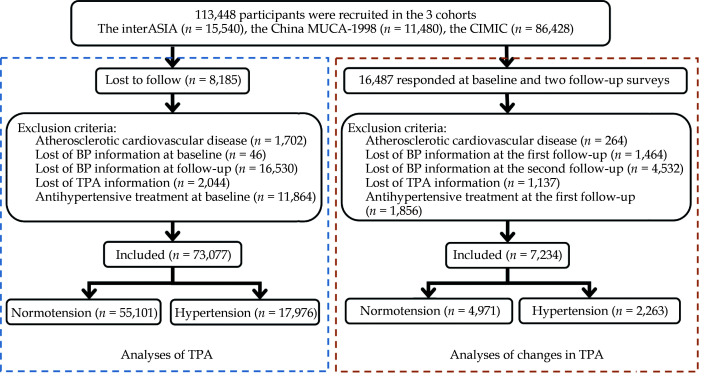
A total of 73,077 participants (55,101 normotensives and 17,976 hypertensives) were eligible for TPA analyses. During a mean follow-up of 7.16 years (394,038 person-years), 12,211 hypertension cases were identified. TPA was estimated as metabolic equivalents and categorized into quartiles. Cox proportional hazards regression and multivariable logistic regression were used to estimate associations of TPA and changes in TPA with incident hypertension and progression/remission of hypertension.
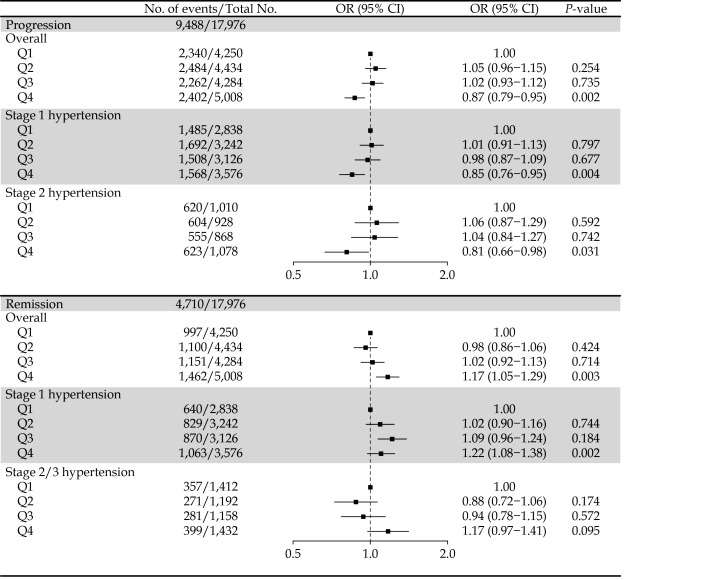
Compared with the lowest quartile of TPA, normotensives at the third and the highest quartile had a decreased risk of incident hypertension, with hazard ratios (HRs) of 0.86 [95% confidence interval (CI): 0.81-0.91] and 0.81 (95% CI: 0.77-0.86), respectively. Hypertensives at the highest quartile of TPA demonstrated a decreased risk of progression of hypertension [odds ratio (OR) = 0.87, 95% CI: 0.79-0.95], and an increased probability of hypertension remission (OR = 1.17, 95% CI: 1.05-1.29). Moreover, getting active from a sedentary lifestyle during the follow-up period could reduce 25% (HR = 0.75, 95% CI: 0.58-0.96) risk of incident hypertension, whereas those becoming sedentary did not achieve benefit from initially being active.
Our findings indicated that increasing and maintaining TPA levels could benefit normotensives, whereas higher TPA levels were needed to effectively control progression and improve remission of hypertension. Physical activity played undoubtedly an essential role in both primary and secondary prevention of hypertension.
根据当前指南,建议进行中等至剧烈强度的体育活动以预防高血压。然而,总体体育活动(TPA)及其变化对血压正常者和高血压患者有益的程度尚不确定。我们旨在研究大规模前瞻性队列中TPA及其变化对高血压发病率、进展和缓解的影响。
共有73077名参与者(55101名血压正常者和17976名高血压患者)符合TPA分析条件。在平均7.16年(394038人年)的随访期间,共识别出12211例高血压病例。TPA以代谢当量估计,并分为四分位数。采用Cox比例风险回归和多变量逻辑回归来估计TPA及其变化与高血压发病以及高血压进展/缓解之间的关联。
与TPA最低四分位数相比,处于第三和最高四分位数的血压正常者发生高血压的风险降低,风险比(HR)分别为0.86[95%置信区间(CI):0.81 - 0.91]和0.81(95%CI:0.77 - 0.86)。TPA最高四分位数的高血压患者高血压进展风险降低[优势比(OR)= 0.87,95%CI:0.79 - 0.95],高血压缓解概率增加(OR = 1.17,95%CI:1.05 - 1.29)。此外,在随访期间从久坐不动的生活方式转变为积极活动可降低25%(HR = 0.75,95%CI:0.58 - 0.96)的高血压发病风险,而那些变得久坐不动的人并未从最初的积极活动中获益。
我们的研究结果表明,增加并维持TPA水平对血压正常者有益,而需要更高的TPA水平才能有效控制高血压进展并改善缓解情况。体育活动在高血压的一级和二级预防中无疑都起着至关重要的作用。