Cleven Laura, Dziuba Anna, Krell-Roesch Janina, Schmidt Steffen C E, Bös Klaus, Jekauc Darko, Woll Alexander
Institute of Sports and Sports Science, Karlsruhe Institute of Technology, Engler-Bunte-Ring 15, 76131, Karlsruhe, Germany.
Institute of Sport Sciences, Department of Sport Psychology, Goethe University Frankfurt, Ginnheimer Landstraße 39, 60487, Frankfurt, Germany.
Diabetol Metab Syndr. 2023 Apr 26;15(1):82. doi: 10.1186/s13098-023-01062-5.
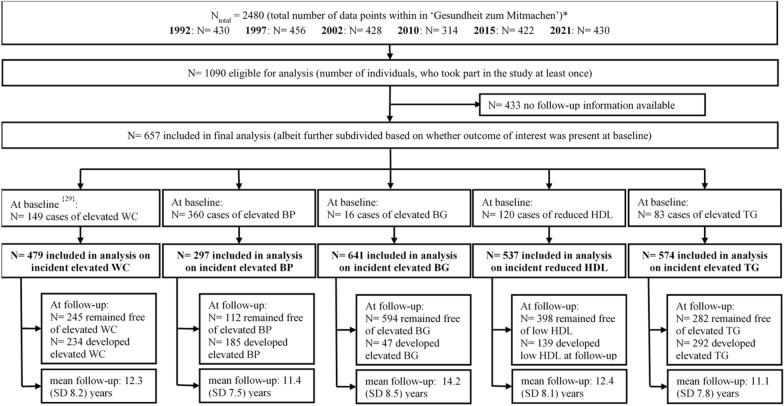
We examined the longitudinal association between (change in) physical activity (PA) with new onset of five risk factors of metabolic syndrome among 657 middle-aged adults (mean age 44.1 (standard deviation (SD) 8.6) years) who were free of the respective outcome at baseline, in a longitudinal cohort study spanning over 29 years.
Levels of habitual PA and sports-related PA were assessed by a self-reported questionnaire. Incident elevated waist circumference (WC), elevated triglycerides (TG), reduced high-density lipoprotein cholesterols (HDL), elevated blood pressure (BP), and elevated blood-glucose (BG) were assessed by physicians and by self-reported questionnaires. We calculated Cox proportional hazard ratio regressions and 95% confidence intervals.
Over time, participants developed (cases of incident risk factor; mean (SD) follow-up time) elevated WC (234 cases; 12.3 (8.2) years), elevated TG (292 cases; 11.1 (7.8) years), reduced HDL (139 cases; 12.4 (8.1) years), elevated BP (185 cases; 11.4 (7.5) years), or elevated BG (47 cases; 14.2 (8.5) years). For PA variables at baseline, risk reductions ranging between 37 and 42% for reduced HDL levels were detected. Furthermore, higher levels of PA (≥ 16.6 METh per week) were associated with a 49% elevated risk for incident elevated BP. Participants who increased PA levels over time, had risk reductions ranging between 38 and 57% for elevated WC, elevated TG and reduced HDL. Participants with stable high amounts of PA from baseline to follow-up had risk reductions ranging between 45 and 87% for incident reduced HDL and elevated BG.
PA at baseline, starting PA engagement, maintaining and increasing PA level over time are associated with favorable metabolic health outcomes.
在一项长达29年的纵向队列研究中,我们对657名中年成年人(平均年龄44.1岁(标准差8.6岁))进行了研究,这些人在基线时没有相应的代谢综合征风险因素,我们探讨了身体活动(PA)(的变化)与代谢综合征五个新出现的风险因素之间的纵向关联。
通过自我报告问卷评估习惯性PA和与运动相关的PA水平。由医生和自我报告问卷评估腰围(WC)升高、甘油三酯(TG)升高、高密度脂蛋白胆固醇(HDL)降低、血压(BP)升高和血糖(BG)升高的发生率。我们计算了Cox比例风险回归和95%置信区间。
随着时间的推移,参与者出现了(风险因素发生的病例数;平均(标准差)随访时间)WC升高(234例;12.3(8.2)年)、TG升高(292例;11.1(7.8)年)、HDL降低(139例;12.4(8.1)年)、BP升高(185例;11.4(7.5)年)或BG升高(47例;14.2(8.5)年)。对于基线时的PA变量,发现HDL水平降低的风险降低了37%至42%。此外,较高水平的PA(每周≥16.6代谢当量)与BP升高的风险增加49%相关。随着时间推移PA水平增加的参与者,WC升高、TG升高和HDL降低的风险降低了38%至57%。从基线到随访期间PA量稳定较高的参与者,HDL降低和BG升高的风险降低了45%至87%。
基线时的PA、开始进行PA、随着时间维持和增加PA水平与良好的代谢健康结果相关。