Longcroft-Wheaton Gaius, Tolfree Natalie, Gangi Anmol, Beable Richard, Bhandari Pradeep
Portsmouth Hospitals NHS trust, Portsmouth Hospitals NHS Trust, Portsmouth, UK.
Pharmacy and Biomedical Sciences, University of Portsmouth, Portsmouth, UK.
Frontline Gastroenterol. 2020 Jul 30;12(3):193-199. doi: 10.1136/flgastro-2020-101543. eCollection 2021.
The global COVID-19 pandemic has changed healthcare across the world. Efforts have concentrated on managing this crisis, with impact on cancer care unclear. We investigated the impact on endoscopy services and gastrointestinal (GI) cancer diagnosis in the UK.
Analysis of endoscopy procedures and cancer diagnosis at a UK Major General Hospital. Procedure rates and diagnosis of GI malignancy were examined over 8-week periods in spring, summer and autumn 2019 before the start of the crisis and were compared with rates since onset of national lockdown and restrictions on elective endoscopy. The number of CT scans performed and malignancies diagnosed in the two corresponding periods in 2019 and 2020 were also evaluated.
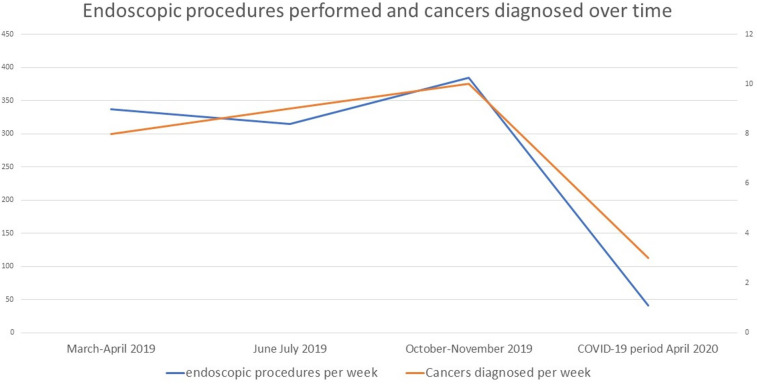
2 698 2516 and 3074 endoscopic procedures were performed in 2019, diagnosing 64, 73 and 78 cancers, respectively, the majority being in patients with alarm symptoms and fecal immunochemical test+ve bowel cancer screening population. Following initiation of new guidelines for management of endoscopy services 245 procedures were performed in a 6 week duration, diagnosing 18 cancers. This equates to potentially delayed diagnosis of 37 cancers per million population per month. Clinician triage improved, resulting in 13.6 procedures performed to diagnose one cancer.
Our data demonstrate an 88% reduction in procedures during the first 6 weeks of COVID-19 crisis, resulting in 66% fewer GI cancer diagnoses. Triage changes reduced the number of procedures required to diagnose cancer. Our data can help healthcare planning to manage the extra workload on endoscopy departments during the recovery period from COVID-19.
全球新冠疫情改变了世界各地的医疗保健状况。各方努力都集中在应对这场危机上,对癌症护理的影响尚不清楚。我们调查了其对英国内镜检查服务和胃肠道(GI)癌症诊断的影响。
对英国一家大型综合医院的内镜检查程序和癌症诊断进行分析。在危机开始前的2019年春季、夏季和秋季的8周期间,检查了胃肠道恶性肿瘤的程序率和诊断情况,并与全国封锁和选择性内镜检查受限以来的比率进行了比较。还评估了2019年和2020年两个相应时期进行的CT扫描数量和诊断出的恶性肿瘤数量。
2019年分别进行了2698、2516和3074例内镜检查程序,分别诊断出64、73和78例癌症,大多数患者有警报症状且粪便免疫化学检测呈阳性,属于肠癌筛查人群。在内镜检查服务新管理指南出台后,在6周内进行了245例检查,诊断出18例癌症。这相当于每百万人口每月可能有37例癌症诊断延迟。临床医生的分诊得到改善,诊断一例癌症需要进行13.6次检查。
我们的数据显示,在新冠疫情危机的前6周,检查程序减少了88%,导致胃肠道癌症诊断减少了66%。分诊的改变减少了诊断癌症所需的检查程序数量。我们的数据有助于医疗保健规划,以应对新冠疫情恢复期内镜科室的额外工作量。