Barclay Nicola L, Pineda Moncusí Marta, Jödicke Annika M, Prieto-Alhambra Daniel, Raventós Berta, Newby Danielle, Delmestri Antonella, Man Wai Yi, Chen Xihang, Català Marti
Pharmaco- and Device Epidemiology, Centre for Statistics in Medicine, Nuffield Department of Orthopaedics, Rheumatology and Musculoskeletal Sciences (NDORMS), University of Oxford, Oxford, United Kingdom.
Department of Medical Informatics, Erasmus Medical Center University, Rotterdam, Netherlands.
Front Oncol. 2024 Mar 27;14:1370862. doi: 10.3389/fonc.2024.1370862. eCollection 2024.
The COVID-19 pandemic had collateral effects on many health systems. Cancer screening and diagnostic tests were postponed, resulting in delays in diagnosis and treatment. This study assessed the impact of the pandemic on screening, diagnostics and incidence of breast, colorectal, lung, and prostate cancer; and whether rates returned to pre-pandemic levels by December, 2021.
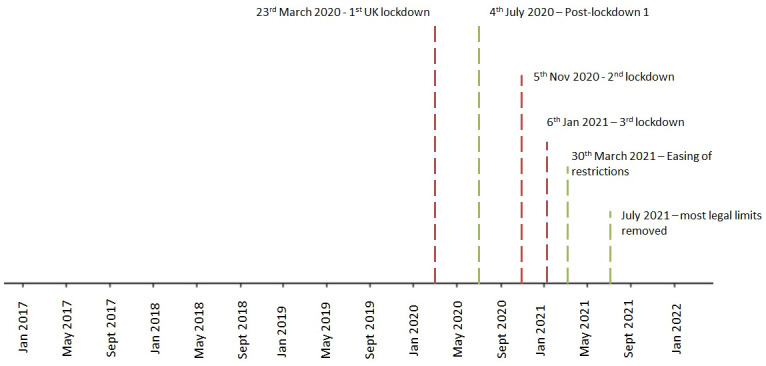
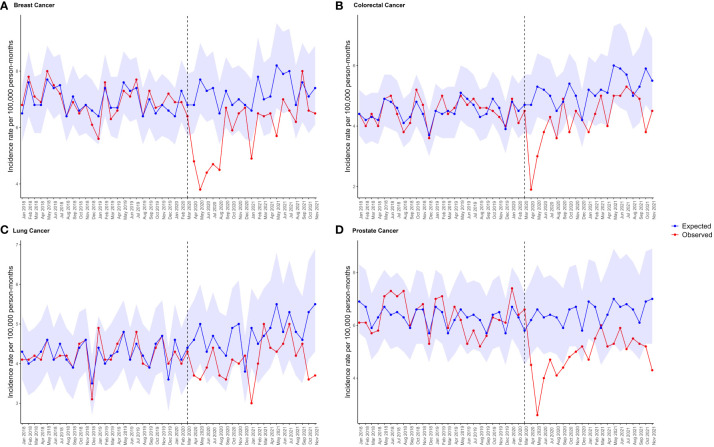
This is a cohort study of electronic health records from the United Kingdom (UK) primary care Clinical Practice Research Datalink (CPRD) GOLD database. The study included individuals registered with CPRD GOLD between January, 2017 and December, 2021, with at least 365 days of clinical history. The study focused on screening, diagnostic tests, referrals and diagnoses of first-ever breast, colorectal, lung, and prostate cancer. Incidence rates (IR) were stratified by age, sex, and region, and incidence rate ratios (IRR) were calculated to compare rates during and after lockdown with rates before lockdown. Forecasted rates were estimated using negative binomial regression models.
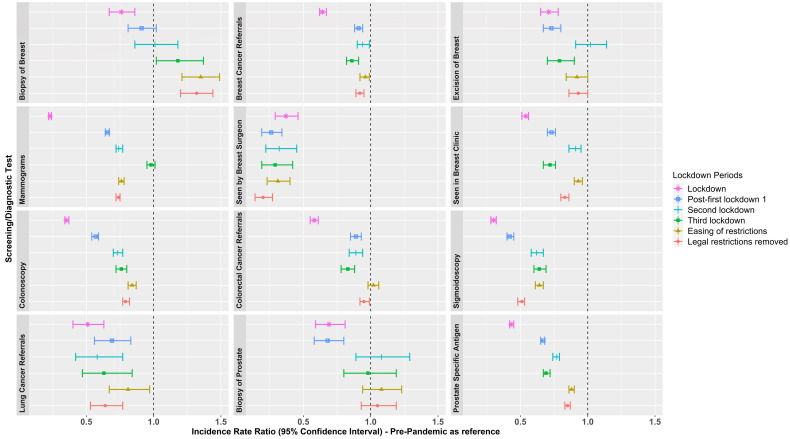
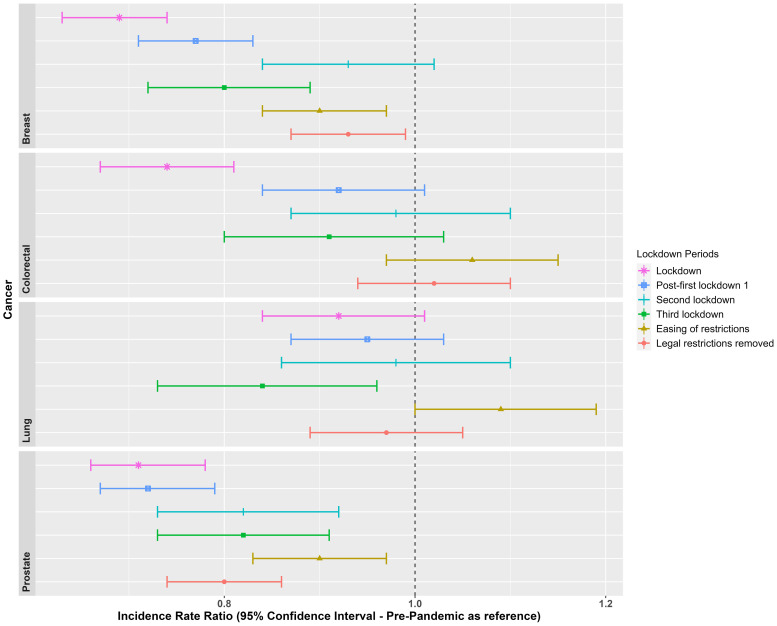
Among 5,191,650 eligible participants, the first lockdown resulted in reduced screening and diagnostic tests for all cancers, which remained dramatically reduced across the whole observation period for almost all tests investigated. There were significant IRR reductions in breast (0.69 [95% CI: 0.63-0.74]), colorectal (0.74 [95% CI: 0.67-0.81]), and prostate (0.71 [95% CI: 0.66-0.78]) cancer diagnoses. IRR reductions for lung cancer were non-significant (0.92 [95% CI: 0.84-1.01]). Extrapolating to the entire UK population, an estimated 18,000 breast, 13,000 colorectal, 10,000 lung, and 21,000 prostate cancer diagnoses were missed from March, 2020 to December, 2021.
The UK COVID-19 lockdown had a substantial impact on cancer screening, diagnostic tests, referrals, and diagnoses. Incidence rates remained significantly lower than pre-pandemic levels for breast and prostate cancers and associated tests by December, 2021. Delays in diagnosis are likely to have adverse consequences on cancer stage, treatment initiation, mortality rates, and years of life lost. Urgent strategies are needed to identify undiagnosed cases and address the long-term implications of delayed diagnoses.
新冠疫情对许多卫生系统产生了附带影响。癌症筛查和诊断测试被推迟,导致诊断和治疗延误。本研究评估了疫情对乳腺癌、结直肠癌、肺癌和前列腺癌的筛查、诊断及发病率的影响;以及到2021年12月时这些发病率是否恢复到疫情前水平。
这是一项基于英国初级医疗临床实践研究数据链(CPRD)GOLD数据库电子健康记录的队列研究。该研究纳入了2017年1月至2021年12月期间在CPRD GOLD注册且有至少365天临床病史的个体。研究重点关注首次发生的乳腺癌、结直肠癌、肺癌和前列腺癌的筛查、诊断测试、转诊和诊断。发病率按年龄、性别和地区分层,并计算发病率比(IRR)以比较封锁期间及之后与封锁前的发病率。使用负二项回归模型估计预测发病率。
在5191650名符合条件的参与者中,首次封锁导致所有癌症的筛查和诊断测试减少,在整个观察期内,几乎所有所调查的测试仍大幅减少。乳腺癌(0.69 [95%可信区间:0.63 - 0.74])、结直肠癌(0.74 [95%可信区间:0.67 - 0.81])和前列腺癌(0.71 [95%可信区间:0.66 - 0.78])诊断的IRR显著降低。肺癌诊断的IRR降低不显著(0.92 [95%可信区间:0.84 - 1.01])。推断至整个英国人口,2020年3月至2021年12月期间估计有18000例乳腺癌、13000例结直肠癌、10000例肺癌和21000例前列腺癌诊断被遗漏。
英国的新冠疫情封锁对癌症筛查、诊断测试、转诊和诊断产生了重大影响。到2021年12月,乳腺癌和前列腺癌及其相关测试的发病率仍显著低于疫情前水平。诊断延迟可能对癌症分期、治疗开始、死亡率和寿命损失产生不利影响。需要紧急策略来识别未确诊病例并应对诊断延迟的长期影响。