Department of Life Science, College of Science, Rikkyo University, 3-34-1 Nishi-Ikebukuro, Toshima-ku, Tokyo 171-8501, Japan.
Nucleic Acids Res. 2021 Sep 7;49(15):8407-8418. doi: 10.1093/nar/gkab298.
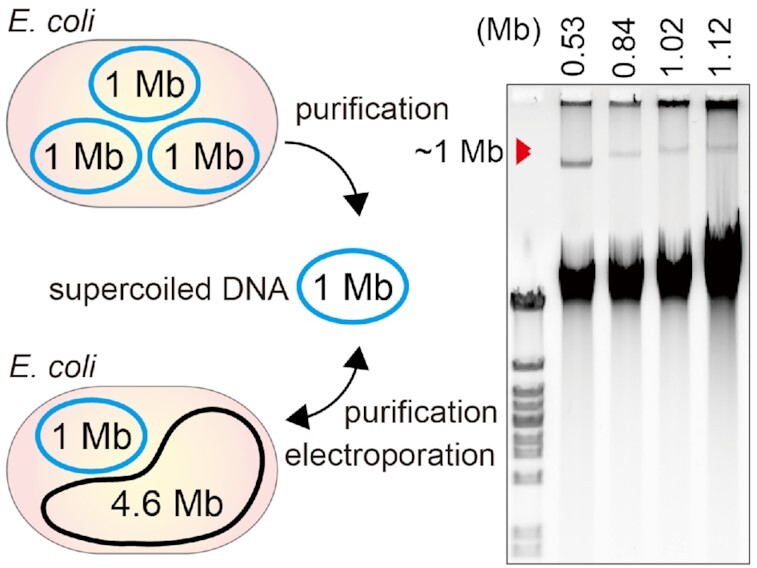
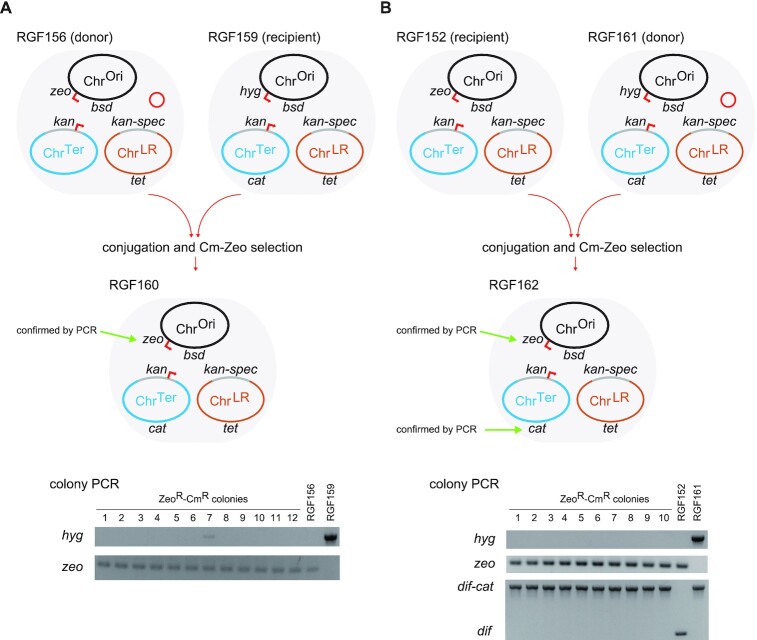
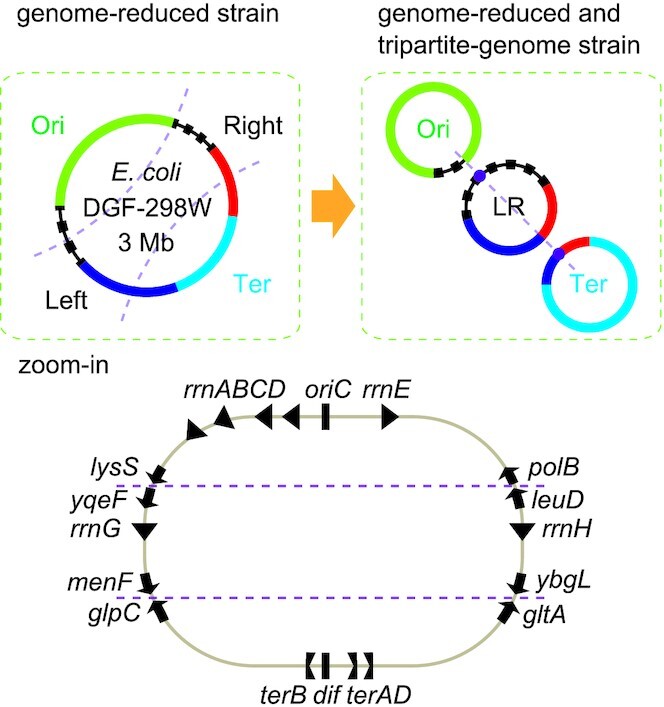
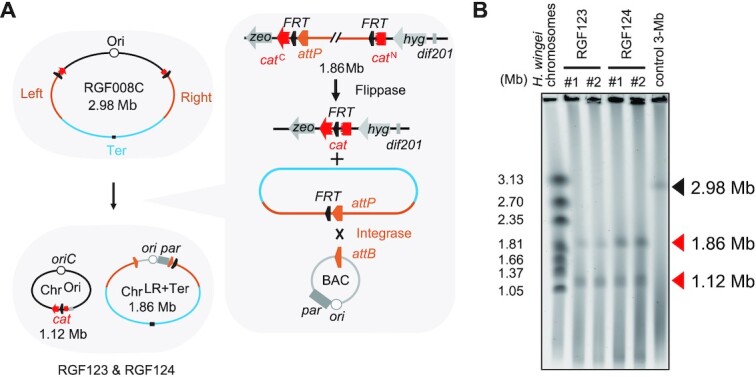
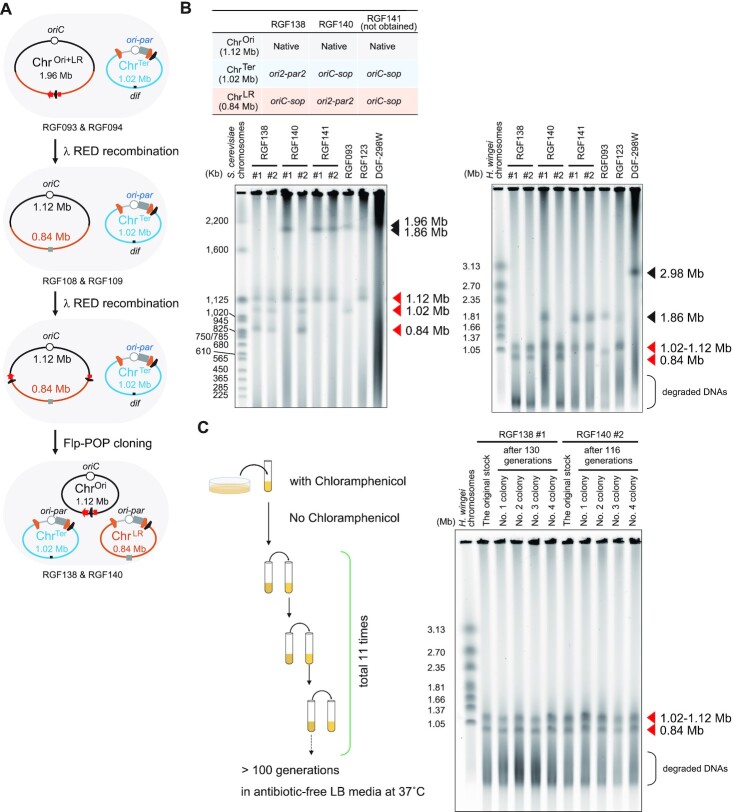
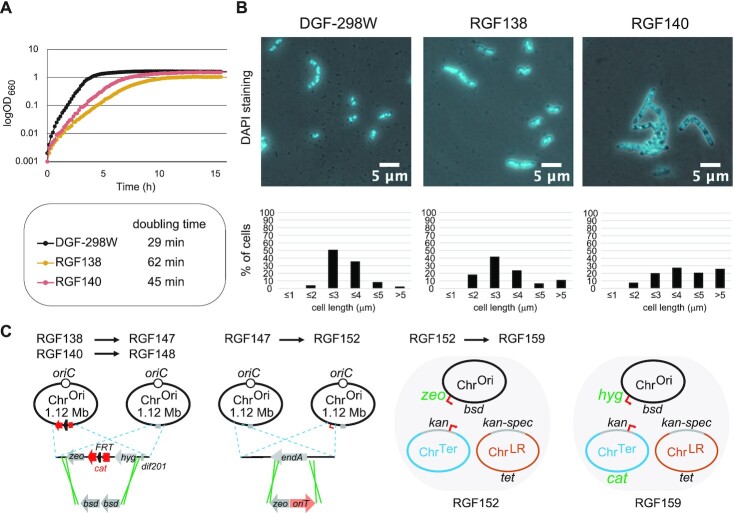
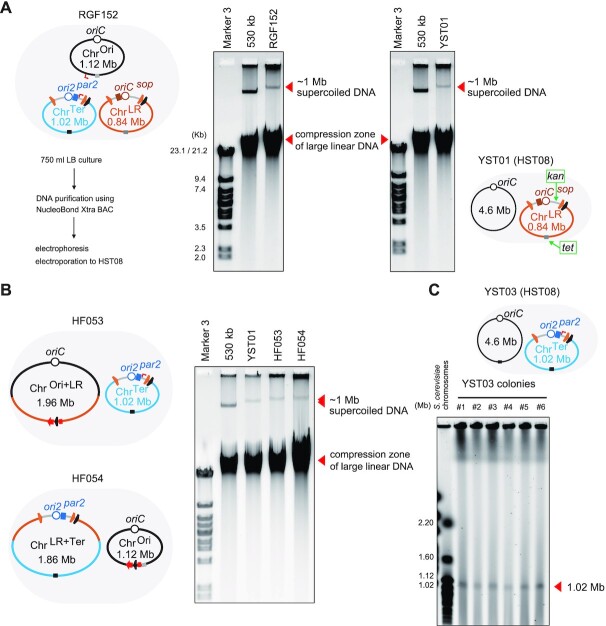
In bacterial synthetic biology, whole genome transplantation has been achieved only in mycoplasmas that contain a small genome and are competent for foreign genome uptake. In this study, we developed Escherichia coli strains programmed by three 1-megabase (Mb) chromosomes by splitting the 3-Mb chromosome of a genome-reduced strain. The first split-chromosome retains the original replication origin (oriC) and partitioning (par) system. The second one has an oriC and the par locus from the F plasmid, while the third one has the ori and par locus of the Vibrio tubiashii secondary chromosome. The tripartite-genome cells maintained the rod-shaped form and grew only twice as slowly as their parent, allowing their further genetic engineering. A proportion of these 1-Mb chromosomes were purified as covalently closed supercoiled molecules with a conventional alkaline lysis method and anion exchange columns. Furthermore, the second and third chromosomes could be individually electroporated into competent cells. In contrast, the first split-chromosome was not able to coexist with another chromosome carrying the same origin region. However, it was exchangeable via conjugation between tripartite-genome strains by using different selection markers. We believe that this E. coli-based technology has the potential to greatly accelerate synthetic biology and synthetic genomics.
在细菌合成生物学中,全基因组移植仅在含有小基因组且能够摄取外来基因组的支原体中实现。在这项研究中,我们通过拆分基因组减少菌株的 3-Mb 染色体,开发了由三个 1-Mb 染色体编程的大肠杆菌菌株。第一个分裂染色体保留了原始复制起点(oriC)和分区(par)系统。第二个染色体具有来自 F 质粒的 oriC 和 par 基因座,而第三个染色体具有 Vibrio tubiashii 次级染色体的 ori 和 par 基因座。三分体基因组细胞保持杆状形态,生长速度仅为其亲本的两倍,从而允许进一步进行遗传工程。这些 1-Mb 染色体的一部分可以通过常规碱性裂解方法和阴离子交换柱以共价闭合超螺旋分子的形式纯化。此外,第二和第三个染色体可以分别电穿孔到感受态细胞中。相比之下,第一个分裂染色体不能够与携带相同起始区域的另一个染色体共存。然而,它可以通过使用不同的选择标记在三分体菌株之间通过接合进行交换。我们相信,这种基于大肠杆菌的技术有可能极大地加速合成生物学和合成基因组学的发展。