Department of Physics, School of Science, Tianjin University, Tianjin 300072, China.
Department of Physics, School of Science, Tianjin University, Tianjin 300072, China; Frontiers Science Center for Synthetic Biology and Key Laboratory of Systems Bioengineering (Ministry of Education), Tianjin University, Tianjin 300072, China; SynBio Research Platform, Collaborative Innovation Center of Chemical Science and Engineering (Tianjin), Tianjin 300072, China.
Genomics Proteomics Bioinformatics. 2022 Dec;20(6):1207-1213. doi: 10.1016/j.gpb.2022.10.002. Epub 2022 Oct 17.
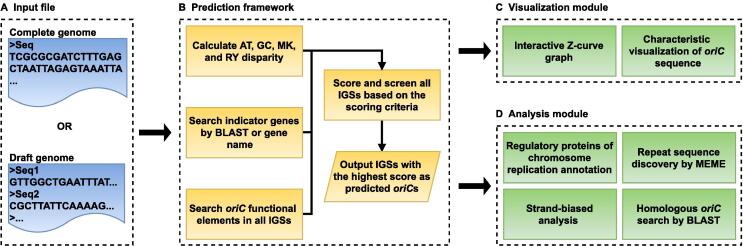
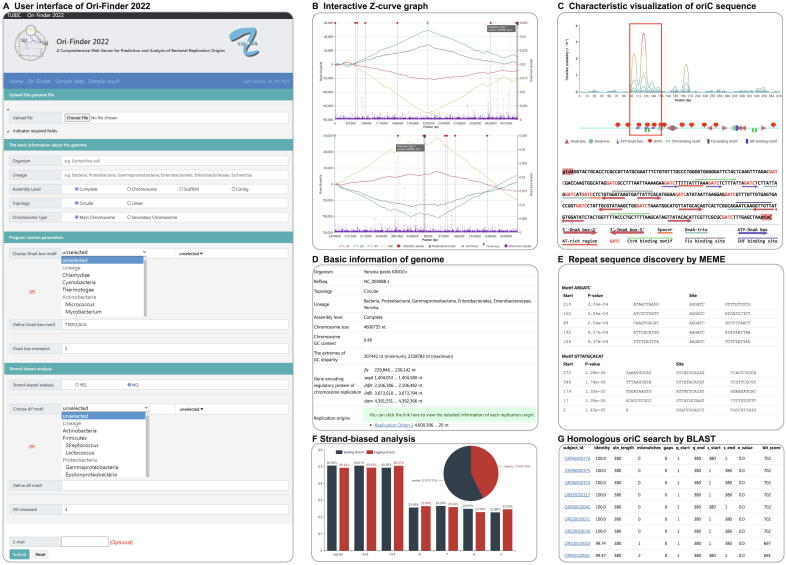
The replication of DNA is a complex biological process that is essential for life. Bacterial DNA replication is initiated at genomic loci referred to as replication origins (oriCs). Integrating the Z-curve method, DnaA box distribution, and comparative genomic analysis, we developed a web server to predict bacterial oriCs in 2008 called Ori-Finder, which is helpful to clarify the characteristics of bacterial oriCs. The oriCs of hundreds of sequenced bacterial genomes have been annotated in the genome reports using Ori-Finder and the predicted results have been deposited in DoriC, a manually curated database of oriCs. This has facilitated large-scale data mining of functional elements in oriCs and strand-biased analysis. Here, we describe Ori-Finder 2022 with updated prediction framework, interactive visualization module, new analysis module, and user-friendly interface. More species-specific indicator genes and functional elements of oriCs are integrated into the updated framework, which has also been redesigned to predict oriCs in draft genomes. The interactive visualization module displays more genomic information related to oriCs and their functional elements. The analysis module includes regulatory protein annotation, repeat sequence discovery, homologous oriC search, and strand-biased analyses. The redesigned interface provides additional customization options for oriC prediction. Ori-Finder 2022 is freely available at http://tubic.tju.edu.cn/Ori-Finder/ and https://tubic.org/Ori-Finder/.
DNA 的复制是一个复杂的生物学过程,对生命至关重要。细菌的 DNA 复制是从称为复制起点(oriC)的基因组位置开始的。我们整合 Z 曲线方法、DnaA 盒分布和比较基因组分析,于 2008 年开发了一个预测细菌 oriC 的网络服务器 Ori-Finder,有助于阐明细菌 oriC 的特征。数百个已测序细菌基因组的 oriC 已使用 Ori-Finder 在基因组报告中进行注释,预测结果已存入 OriC,这是一个 oriC 的人工 curated 数据库。这促进了 oriC 中功能元件的大规模数据挖掘和链偏向分析。在这里,我们描述了 2022 年的 Ori-Finder,它具有更新的预测框架、交互式可视化模块、新的分析模块和用户友好的界面。更多物种特异性的指示基因和 oriC 的功能元件被整合到更新的框架中,该框架也被重新设计以预测草图基因组中的 oriC。交互式可视化模块显示了更多与 oriC 及其功能元件相关的基因组信息。分析模块包括调控蛋白注释、重复序列发现、同源 oriC 搜索和链偏向分析。重新设计的界面为 oriC 预测提供了额外的自定义选项。Ori-Finder 2022 可在 http://tubic.tju.edu.cn/Ori-Finder/ 和 https://tubic.org/Ori-Finder/ 免费获得。