School of Medicine, Cheeloo College of Medicine, Shandong University, Jinan, Shandong 250012, P.R. China.
Department of Thoracic Surgery, The First People's Hospital of Taian Affiliated to Shandong First Medical University, Taian, Shandong 271000, P.R. China.
Int J Mol Med. 2021 Jun;47(6). doi: 10.3892/ijmm.2021.4938. Epub 2021 Apr 28.
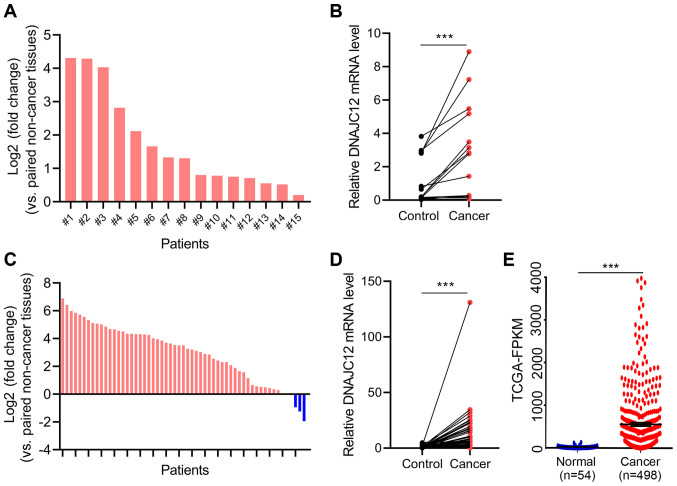
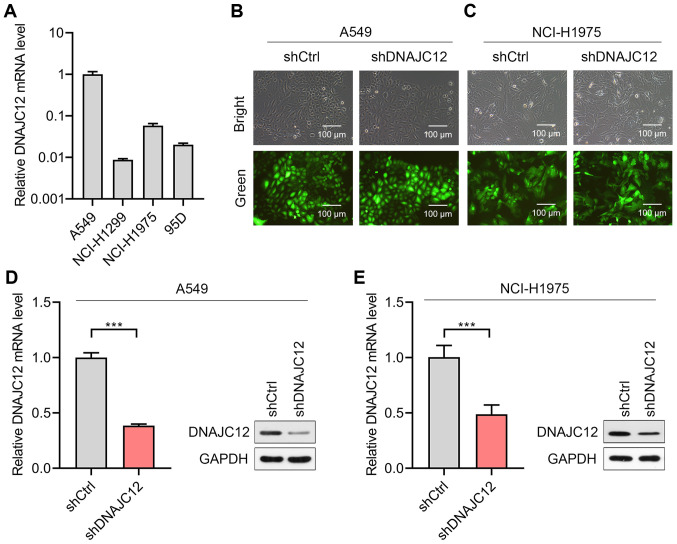
Lung cancer has become the leading cause of cancer‑associated mortality worldwide. However, the underlying mechanisms of lung cancer remain poorly understood. DnaJ heat shock protein family (HSP40) member C12 (DNAJC12) is a type III member belonging to the HSP40/DNAJ family. The role of DNAJC12 in numerous types of cancer has been previously reported; however, the effect of DNAJC12 in lung cancer remains unknown. The results of the present study indicated that DNAJC12 may be involved in lung cancer proliferation and migration by regulating the β‑catenin signaling pathway. Data generated in the present study and from The Cancer Genome Atlas revealed that the DNAJC12 expression levels were significantly upregulated in lung cancer tissues compared with non‑cancer lung tissues. The expression of DNAJC12 was subsequently knocked down in A549 and NCI‑H1975 lung cancer cells using lentiviral transfections and further experiments demonstrated that the knockdown of DNAJC12 inhibited the proliferation, colony formation, migration and invasion of lung cancer cells. The results of flow cytometric assays also revealed that the knockdown of DNAJC12 induced the apoptosis of lung cancer cells. In addition, the effects of DNAJC12 knockdown on the growth of lung cancer cells were observed. Signaling pathway analysis revealed that the knockdown of DNAJC12 expression suppressed the phosphorylation of p65 NF‑κB, downregulated the expression levels and inhibited the subsequent activation of β‑catenin, and downregulated the expression levels of vimentin. Rescue experiments demonstrated that the overexpression of β‑catenin, but not that of NF‑κB or vimentin, reversed the effects of DNAJC12 knockdown on the proliferation and invasion of lung cancer cells. On the whole, the findings of the present study suggest that DNAJC12 may play a crucial role in lung cancer tumorigenesis by regulating the expression and activation of β‑catenin. Therefore, DNAJC12 may represent a novel target for the treatment of lung cancer.
肺癌已成为全球癌症相关死亡的主要原因。然而,肺癌的潜在机制仍知之甚少。DNAJ 热休克蛋白家族(HSP40)成员 C12(DNAJC12)是属于 HSP40/DNAJ 家族的 III 型成员。先前已有报道称 DNAJC12 在多种类型的癌症中发挥作用;然而,DNAJC12 在肺癌中的作用尚不清楚。本研究结果表明,DNAJC12 可能通过调节 β-连环蛋白信号通路参与肺癌的增殖和迁移。本研究和癌症基因组图谱(The Cancer Genome Atlas)产生的数据显示,与非癌性肺组织相比,肺癌组织中 DNAJC12 的表达水平显著上调。随后使用慢病毒转染在 A549 和 NCI-H1975 肺癌细胞中敲低 DNAJC12 的表达,并进一步实验表明,敲低 DNAJC12 抑制了肺癌细胞的增殖、集落形成、迁移和侵袭。流式细胞术分析的结果还显示,敲低 DNAJC12 诱导了肺癌细胞的凋亡。此外,观察了 DNAJC12 敲低对肺癌细胞生长的影响。信号通路分析显示,敲低 DNAJC12 表达抑制了 p65 NF-κB 的磷酸化,下调了 β-连环蛋白的表达水平并抑制了其随后的激活,并下调了波形蛋白的表达水平。挽救实验表明,β-连环蛋白的过表达(而非 NF-κB 或波形蛋白)逆转了 DNAJC12 敲低对肺癌细胞增殖和侵袭的影响。总的来说,本研究的结果表明,DNAJC12 可能通过调节 β-连环蛋白的表达和激活在肺癌发生中发挥关键作用。因此,DNAJC12 可能成为治疗肺癌的新靶点。