Department of Otorhinolaryngology and Head and Neck Surgery, Radboudumc, Nijmegen, the Netherlands.
Department of Pathology, Radboudumc, Nijmegen, the Netherlands.
Cancer Cytopathol. 2021 Sep;129(9):719-728. doi: 10.1002/cncy.22435. Epub 2021 Apr 28.
Differentiating between malignant and benign salivary gland tumors with fine-needle aspiration cytology (FNAC) can be challenging. This study was aimed at testing the validity of the Milan System for Reporting Salivary Gland Cytopathology (MSRSGC) and at assessing possible differences in the sensitivity and specificity of parotid gland FNAC between dedicated head and neck (H&N) centers, subdivided into head and neck oncology centers (HNOCs) and head and neck oncology affiliated centers (HNOACs), and general hospitals (GHs).
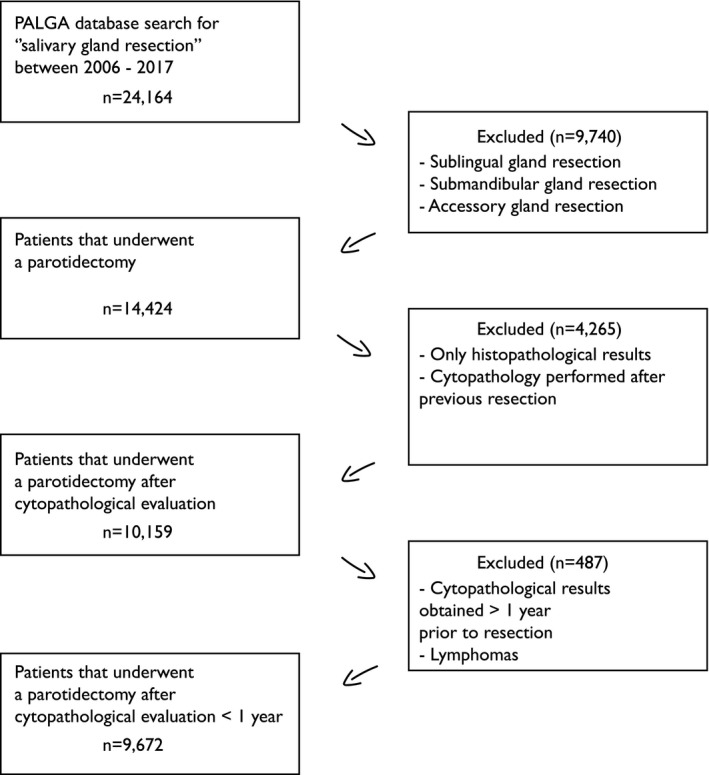
The Dutch Pathology Registry (PALGA) database was searched for patients who had undergone a salivary gland resection between January 1, 2006, and January 1, 2017, and had a preoperative FNAC result. The FNAC reports were retrospectively assigned to MSRSGC categories. The risk of malignancy (ROM) was calculated for each category. The sensitivity and specificity for diagnosing malignancy were calculated and compared among HNOCs, HNOACs, and GHs.
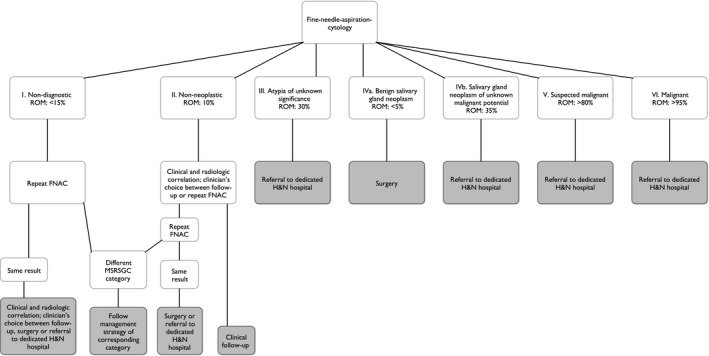
In all, 12,898 FNAC aspirates were evaluated. The ROMs for each category were as follows: 12.5% in MSRSGC I, 10.3% in MSRSGC II, 29% in MSRSGC III, 2.3% in MSRSGC IVa, 28.6% in MSRSGC IVb, 83% in MSRSGC V, and 99.3% in MSRSGC VI. The sensitivity of FNAC was highest in HNOCs (88.1%), HNOACs scored lower (79.7%), and GHs had a sensitivity of 75.0%.
The MSRSGC is a valid tool for reporting parotid gland FNAC; therefore, these results strongly advocate its use. On the basis of the higher sensitivity of FNAC in dedicated H&N centers, the authors recommend that GHs use the presented management strategies to help to minimize the chances of a preoperative misdiagnosis.
通过细针穿刺细胞学检查(FNAC)来区分恶性和良性涎腺肿瘤具有一定挑战性。本研究旨在检验米兰涎腺细胞病理学报告系统(MSRSGC)的有效性,并评估专门的头颈部(H&N)中心(细分为头颈肿瘤中心(HNOC)和头颈肿瘤附属中心(HNOAC)以及综合医院(GH))之间,FNAC 对腮腺的敏感性和特异性是否存在差异。
检索荷兰病理登记处(PALGA)数据库,纳入 2006 年 1 月 1 日至 2017 年 1 月 1 日期间行涎腺切除术且术前有 FNAC 结果的患者。回顾性地将 FNAC 报告分配到 MSRSGC 类别中。计算每个类别下的恶性肿瘤风险(ROM)。计算并比较 HNOC、HNOAC 和 GH 之间用于诊断恶性肿瘤的 FNAC 敏感性和特异性。
共评估了 12898 例 FNAC 抽吸物。每个类别下的 ROM 如下:MSRSGC I 为 12.5%,MSRSGC II 为 10.3%,MSRSGC III 为 29%,MSRSGC IVa 为 2.3%,MSRSGC IVb 为 28.6%,MSRSGC V 为 83%,MSRSGC VI 为 99.3%。FNAC 的敏感性在 HNOC 中最高(88.1%),HNOAC 次之(79.7%),GH 最低(75.0%)。
MSRSGC 是报告腮腺 FNAC 的有效工具;因此,强烈推荐使用该系统。基于专门的 H&N 中心中 FNAC 的更高敏感性,作者建议 GH 使用所提出的管理策略,以帮助最大程度地减少术前误诊的机会。