Center for Tobacco Research and Intervention, University of Wisconsin School of Medicine and Public Health, Madison, WI, USA.
Department of Medicine, University of Wisconsin School of Medicine and Public Health, Madison, WI, USA.
Addiction. 2021 Nov;116(11):3167-3179. doi: 10.1111/add.15528. Epub 2021 May 19.
To assess the effectiveness of intervention components designed to increase quit attempts and promote abstinence in patients initially unwilling to quit smoking.
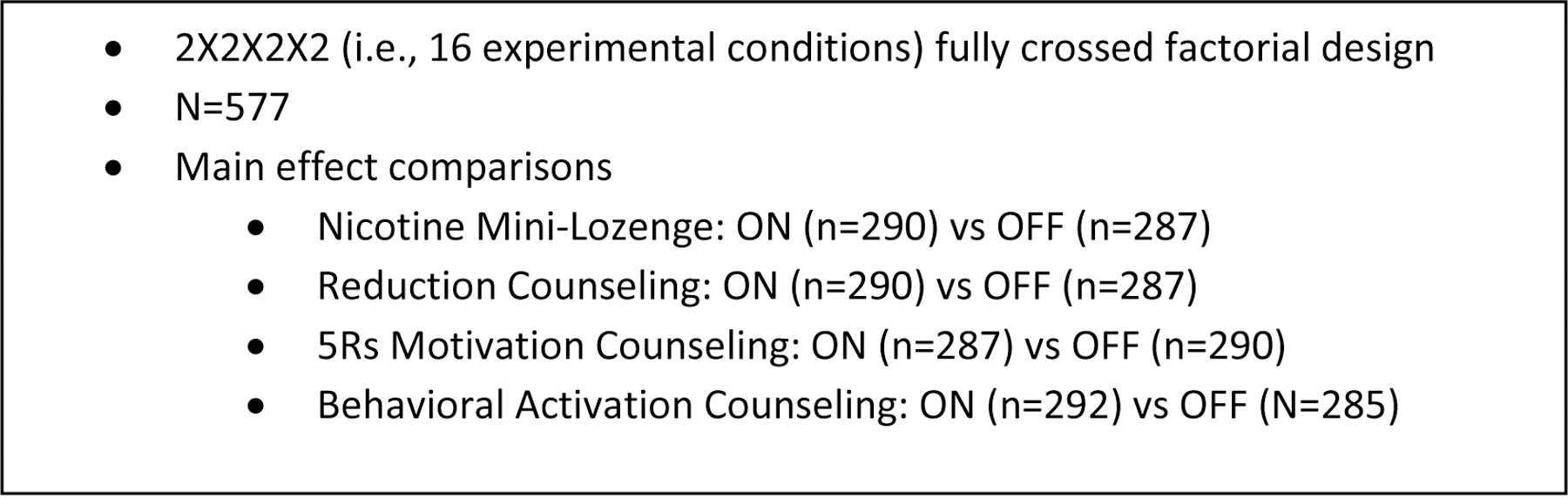
A four-factor, randomized factorial experiment.
Sixteen primary care clinics in southern Wisconsin.
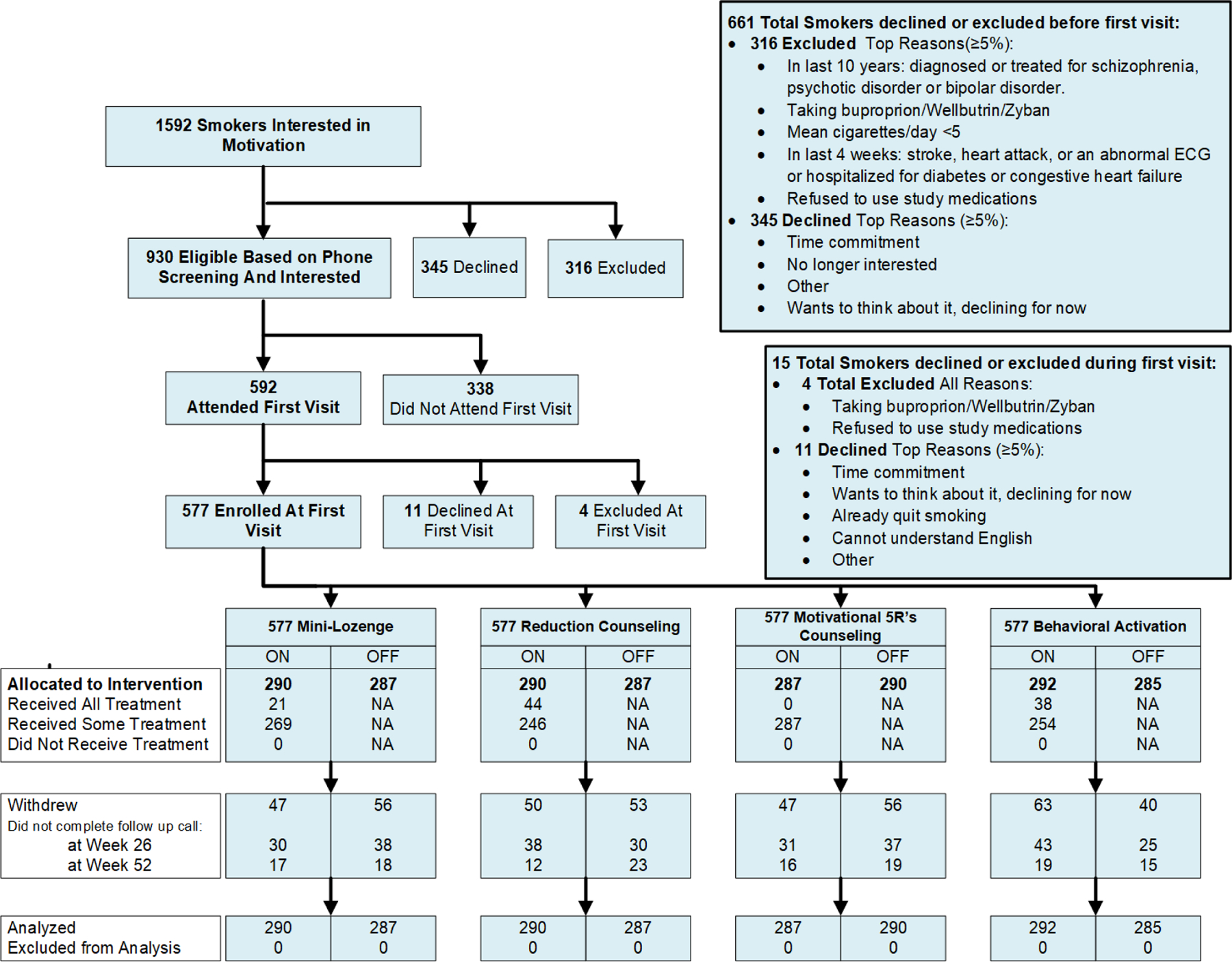
A total of 577 adults who smoke (60% women, 80% White) recruited during primary care visits who were currently willing to reduce their smoking but unwilling to try to quit. Interventions Four factors contrasted intervention components administered over a 1-year period: (i) nicotine mini-lozenge versus none; (ii) reduction counseling versus none; (iii) behavioral activation (BA) counseling versus none; and (iv) motivational 5Rs counseling versus none. Participants could request cessation treatment at any time.
The primary outcome was 7-day point-prevalence abstinence at 52 weeks post enrollment; secondary outcomes were point-prevalence abstinence at 26 weeks and making a quit attempt by weeks 26 and 52.
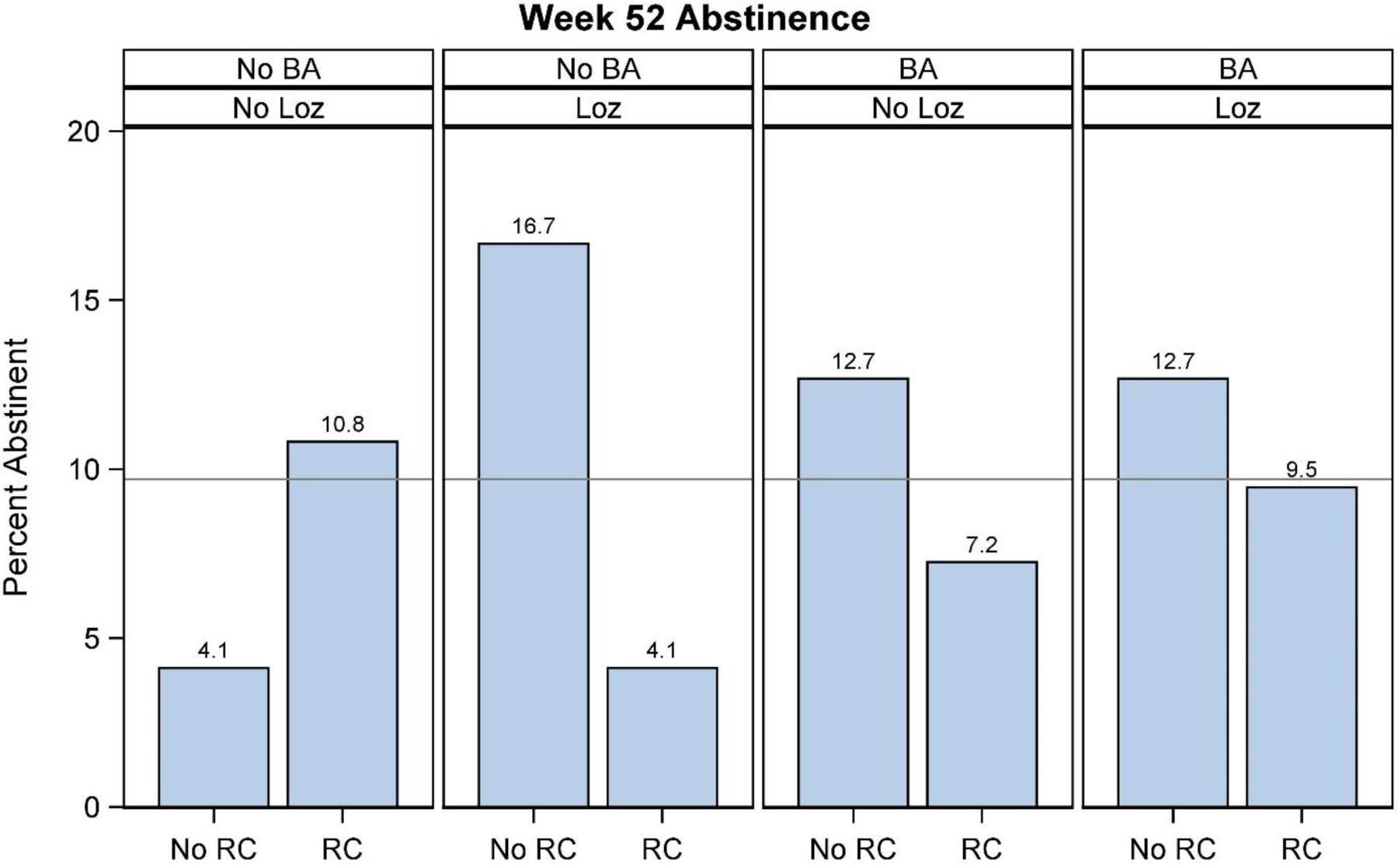
No abstinence main effects were found but a mini-lozenge × reduction counseling × BA interaction was found at 52 weeks; P = 0.03. Unpacking this interaction showed that the mini-lozenge alone produced the highest abstinence rate (16.7%); combining it with reduction counseling produced an especially low abstinence rate (4.1%). Reduction counseling decreased the likelihood of making a quit attempt by 52 weeks relative to no reduction counseling (P = 0.01).
Nicotine mini-lozenges may increase smoking abstinence in people initially unwilling to quit smoking, but their effectiveness declines when used with smoking reduction counseling or other behavioral interventions. Reduction counseling decreases the likelihood of making a quit attempt in people initially unwilling to quit smoking.
评估旨在增加初始不愿意戒烟的患者戒烟尝试并促进戒烟的干预措施的有效性。
四因素随机析因实验。
威斯康星州南部的 16 个初级保健诊所。
共招募了 577 名在初级保健就诊期间目前愿意减少吸烟量但不愿意尝试戒烟的成年吸烟者(60%为女性,80%为白人)。
在 1 年内对比了四种干预措施的组件:(i)尼古丁迷你锭与无干预;(ii)减少咨询与无咨询;(iii)行为激活(BA)咨询与无咨询;(iv)动机 5Rs 咨询与无咨询。参与者可以在任何时候要求戒烟治疗。
主要结果是 52 周后 7 天点流行率戒烟;次要结果是 26 周和 26 周和 52 周的点流行率戒烟和戒烟尝试。
未发现戒烟的主要效果,但在 52 周时发现了迷你锭与减少咨询与 BA 之间的交互作用;P=0.03。对这种交互作用进行剖析显示,单独使用迷你锭产生的戒烟率最高(16.7%);与减少咨询结合使用会产生特别低的戒烟率(4.1%)。与无减少咨询相比,减少咨询降低了 52 周时戒烟尝试的可能性(P=0.01)。
尼古丁迷你锭可能会增加初始不愿意戒烟的患者的吸烟戒烟率,但当与吸烟减少咨询或其他行为干预措施结合使用时,其效果会降低。减少咨询降低了初始不愿意戒烟的患者戒烟尝试的可能性。