Rao Manaeha, Bar Lilly, Yu Yunnan, Srinivasan Malathi, Mukherjea Arnab, Li Jiang, Chung Sukyung, Venkatraman Siddharth, Dan Shozen, Palaniappan Latha
Stanford Center for Asian Health Research and Education, Stanford University School of Medicine, Stanford, CA, USA.
Department of Neuroscience, University of Chicago, Hyde Park, IL, USA.
J Racial Ethn Health Disparities. 2022 Jun;9(3):856-864. doi: 10.1007/s40615-021-01024-5. Epub 2021 Apr 28.
Asian Americans suffer high rates of smoking and tobacco-related deaths, varying by ethnic group. Trends of cigarette and alternative tobacco product use among Asian Americans, specifically considering ethnic group, sex, and nativity, are infrequently reported.
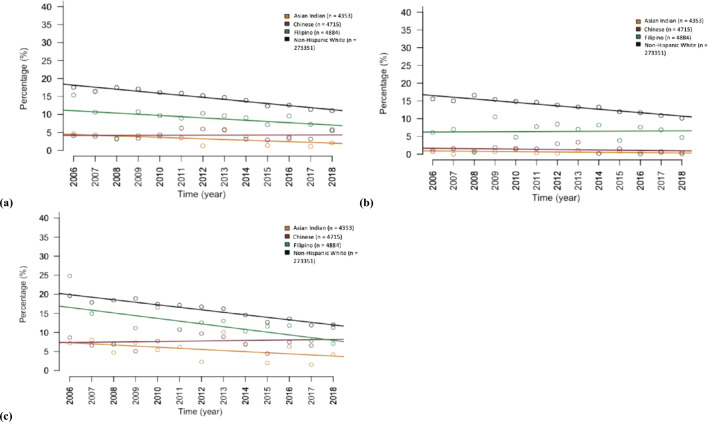
Using National Health Interview Survey (NHIS) data from 2006-2018 and the 2016-2018 alternative tobacco supplement (e-cigarettes, cigars, smokeless tobacco, pipes), we explored cigarette and alternative tobacco product use by Asian ethnic group (Asian Indian (n = 4373), Chinese (n = 4736), Filipino (n = 4912)) in comparison to non-Hispanic Whites (NHWs (n = 275,025)), adjusting for socioeconomic and demographic factors.
Among 289,046 adults, 12% of Filipinos were current smokers, twice the prevalence in Asian Indians and Chinese (p < 0.001). The male-female gender difference was fivefold for Chinese (10.3% vs. 2.2%; p < 0.001), eightfold for Asian Indians (8.7% vs. 1.1%; p < 0.001), and twofold for Filipinos (16.8% vs. 9.0%). Moreover, 16.3% of US-born and 10.3% of foreign-born Filipinos were current smokers. Odds of ever using e-cigarettes, cigars, smokeless tobacco, and pipes in comparison to NHWs were lowest for Chinese (ORs 0.6, 0.5, 0.2, and 0.5).
Filipinos had the highest current smoking rates of Asian ethnic groups. Though more Asian men were current smokers, the high rate of current smoking among Filipinas is concerning. More US-born Filipinos were current smokers than foreign-born, despite rates typically decreasing for US-born Asians. Investigating cultural factors contributing to less frequent use of tobacco products, such as alternative tobacco products among Chinese, may aid campaigns in curbing tobacco usage.
亚裔美国人吸烟率和与烟草相关的死亡率很高,且因种族群体而异。亚裔美国人中香烟和替代烟草产品的使用趋势,特别是考虑到种族群体、性别和出生地,很少有报道。
利用2006 - 2018年的国家健康访谈调查(NHIS)数据以及2016 - 2018年的替代烟草补充调查(电子烟、雪茄、无烟烟草、烟斗),我们探究了亚洲种族群体(印度裔亚洲人(n = 4373)、华裔(n = 4736)、菲律宾裔(n = 4912))与非西班牙裔白人(NHWs(n = 275,025))相比的香烟和替代烟草产品使用情况,并对社会经济和人口因素进行了调整。
在289,046名成年人中,12%的菲律宾裔是当前吸烟者,是印度裔亚洲人和华裔患病率的两倍(p < 0.001)。华裔的男女差异为五倍(10.3%对2.2%;p < 0.001),印度裔亚洲人为八倍(8.7%对1.1%;p < 0.001),菲律宾裔为两倍(16.8%对9.0%)。此外,16.3%的美国出生的菲律宾裔和10.3%的外国出生的菲律宾裔是当前吸烟者。与NHWs相比,华裔曾经使用电子烟、雪茄、无烟烟草和烟斗的几率最低(比值比分别为0.6、0.5、0.2和0.5)。
菲律宾裔在亚洲种族群体中的当前吸烟率最高。尽管当前吸烟者中亚洲男性更多,但菲律宾裔女性的高吸烟率令人担忧。尽管美国出生的亚洲人的吸烟率通常会下降,但美国出生的菲律宾裔当前吸烟者比外国出生的更多。调查导致烟草产品使用频率较低的文化因素,比如华裔对替代烟草产品的使用情况,可能有助于控烟运动。