Department of Molecular Biology & Biochemistry, University of California Irvine, Irvine, California, USA.
Department of Chemistry, University of California Irvine, Irvine, California, USA.
mSphere. 2021 Apr 28;6(2):e00203-21. doi: 10.1128/mSphere.00203-21.
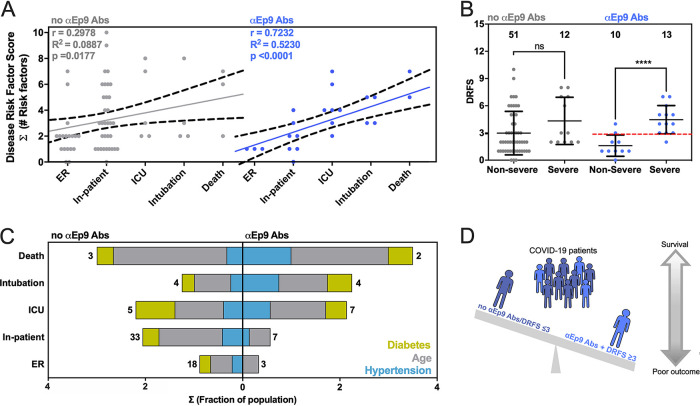
Effective methods for predicting COVID-19 disease trajectories are urgently needed. Here, enzyme-linked immunosorbent assay (ELISA) and coronavirus antigen microarray (COVAM) analysis mapped antibody epitopes in the plasma of COVID-19 patients ( = 86) experiencing a wide range of disease states. The experiments identified antibodies to a 21-residue epitope from nucleocapsid (termed Ep9) associated with severe disease, including admission to the intensive care unit (ICU), requirement for ventilators, or death. Importantly, anti-Ep9 antibodies can be detected within 6 days post-symptom onset and sometimes within 1 day. Furthermore, anti-Ep9 antibodies correlate with various comorbidities and hallmarks of immune hyperactivity. We introduce a simple-to-calculate, disease risk factor score to quantitate each patient's comorbidities and age. For patients with anti-Ep9 antibodies, scores above 3.0 predict more severe disease outcomes with a 13.42 likelihood ratio (96.7% specificity). The results lay the groundwork for a new type of COVID-19 prognostic to allow early identification and triage of high-risk patients. Such information could guide more effective therapeutic intervention. The COVID-19 pandemic has resulted in over two million deaths worldwide. Despite efforts to fight the virus, the disease continues to overwhelm hospitals with severely ill patients. Diagnosis of COVID-19 is readily accomplished through a multitude of reliable testing platforms; however, prognostic prediction remains elusive. To this end, we identified a short epitope from the SARS-CoV-2 nucleocapsid protein and also a disease risk factor score based upon comorbidities and age. The presence of antibodies specifically binding to this epitope plus a score cutoff can predict severe COVID-19 outcomes with 96.7% specificity.
有效的 COVID-19 疾病轨迹预测方法亟待开发。在此,酶联免疫吸附测定(ELISA)和冠状病毒抗原微阵列(COVAM)分析绘制了 COVID-19 患者( = 86)血浆中的抗体表位图谱,这些患者经历了广泛的疾病状态。实验鉴定了核衣壳中 21 个残基表位(命名为 Ep9)的抗体,这些抗体与严重疾病相关,包括入住重症监护病房(ICU)、需要呼吸机或死亡。重要的是,抗 Ep9 抗体可在症状出现后 6 天内检测到,有时甚至在 1 天内。此外,抗 Ep9 抗体与各种合并症和免疫过度活跃的特征相关。我们引入了一种简单计算的疾病危险因素评分,以量化每位患者的合并症和年龄。对于具有抗 Ep9 抗体的患者,评分高于 3.0 可预测更严重的疾病结局,其似然比为 13.42(96.7%特异性)。结果为新型 COVID-19 预后奠定了基础,允许早期识别和对高危患者进行分类。此类信息可指导更有效的治疗干预。COVID-19 大流行已导致全球超过 200 万人死亡。尽管努力抗击病毒,但该疾病仍使医院不堪重负,挤满了重病患者。COVID-19 的诊断可通过多种可靠的检测平台轻松完成;然而,预后预测仍难以捉摸。为此,我们从 SARS-CoV-2 核衣壳蛋白中鉴定了一个短表位,以及一个基于合并症和年龄的疾病危险因素评分。特异性结合该表位的抗体存在加上评分截止值可以预测严重 COVID-19 结局,特异性为 96.7%。