Hossain Mehrab E, Lister David, Bartolo Caroline, Kinsella Paul M, Knox James, Aldrich Rosemary, Cowan Raquel, Commons Robert J
Internal Medical Services, Ballarat Health Services, Ballarat, VIC, Australia.
Department of Infectious Diseases, University Hospital Geelong, Geelong, VIC, Australia.
Infect Dis (Auckl). 2021 Apr 13;14:11786337211010428. doi: 10.1177/11786337211010428. eCollection 2021.
The risk of transmission of Coronavirus Disease 2019 (COVID-19) is increasingly understood to be greatest early after symptom onset, however, factors associated with prolonged and increased risk of transmission remain unclear. In settings where COVID-19 prevalence is low, there may be a benefit of extending the period that patients are isolated to decrease the risk of transmission. This study explored the duration of viral shedding in such a location, in patients with mild-moderate COVID-19 disease in Ballarat, Australia.
Patients diagnosed with COVID-19 disease using a real-time reverse-transcriptase-polymerase-chain-reaction (RT-PCR) assay from oropharyngeal and bilateral deep nasopharyngeal sampling and managed through Ballarat Health Services between March 1 and May 1, 2020 were included. Patients were retested if they were afebrile for >72 hours, asymptomatic and >14 days since symptom onset. If positive on retesting, patients were tested every 3 to 7 days thereafter.
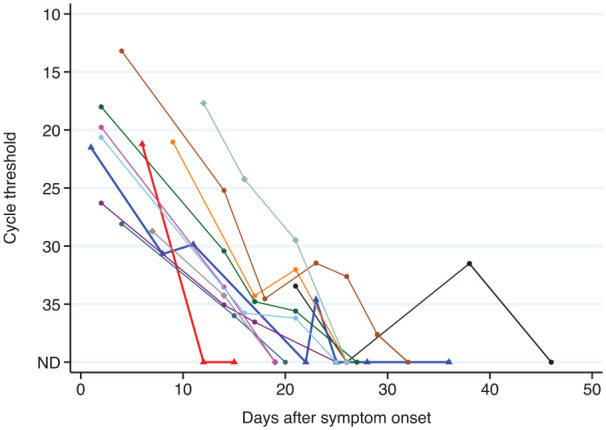
Patients underwent testing a median of 4 days (range 1-12) after initial symptom onset. Duration of symptoms ranged from 1 to 36 days. Positive tests were recorded up to a median of day 21 (range 6-38). Cycle thresholds were inversely correlated with time since symptom onset ( < .0001). Median time to the first negative test was 25 days (range 12-32). Two patients who had remained asymptomatic for >7 days after initial symptom onset had recrudescence of mild symptoms on day 13 and 14; both tested positive on follow-up tests at this time.
This study demonstrates prolonged shedding of COVID-19 in patients with mild-moderate disease. It suggests that some patients with mild disease may have recrudescence of symptoms a week or more after their initial symptoms resolved.
人们越来越认识到,2019冠状病毒病(COVID-19)在症状出现后的早期传播风险最大,然而,与传播风险延长和增加相关的因素仍不清楚。在COVID-19患病率较低的地区,延长患者隔离期可能有助于降低传播风险。本研究在澳大利亚巴拉瑞特,对轻度至中度COVID-19疾病患者的病毒脱落持续时间进行了探索。
纳入2020年3月1日至5月1日期间,通过口咽和双侧深部鼻咽采样,采用实时逆转录聚合酶链反应(RT-PCR)检测确诊为COVID-19疾病,并在巴拉瑞特健康服务中心接受治疗的患者。如果患者发热消退超过72小时、无症状且自症状出现后超过14天,则进行重新检测。如果重新检测呈阳性,则此后每3至7天对患者进行一次检测。
患者在初次症状出现后中位4天(范围1至12天)接受检测。症状持续时间为1至36天。阳性检测记录的中位数为第21天(范围6至38天)。循环阈值与症状出现后的时间呈负相关(<0.0001)。首次检测呈阴性的中位时间为25天(范围12至32天)。两名在初次症状出现后无症状超过7天的患者,在第13天和第14天出现轻度症状复发;此时的随访检测均呈阳性。
本研究表明,轻度至中度疾病患者的COVID-19病毒脱落时间延长。这表明,一些轻症患者在初始症状缓解一周或更长时间后,可能会出现症状复发。