Chen Xi, Tu Ping, Sun Xing-Lan, Hu Ting-Ying, Wan Jia, Hu Yi-Wei, Zhou Hui-Ling, Su Hai
Department of Cardiovascular Medicine, The Second Affiliated Hospital of Nanchang University, Nanchang, 330006, People's Republic of China.
Department of Post Anesthesia Care Unit, The Second Affiliated Hospital of Nanchang University, Nanchang, 330006, People's Republic of China.
Int J Gen Med. 2021 Apr 22;14:1507-1511. doi: 10.2147/IJGM.S291431. eCollection 2021.
The aim of this study is to evaluate the impact on blood pressure (BP) of a 10°C change in room temperature (between 18°C and 28°C).
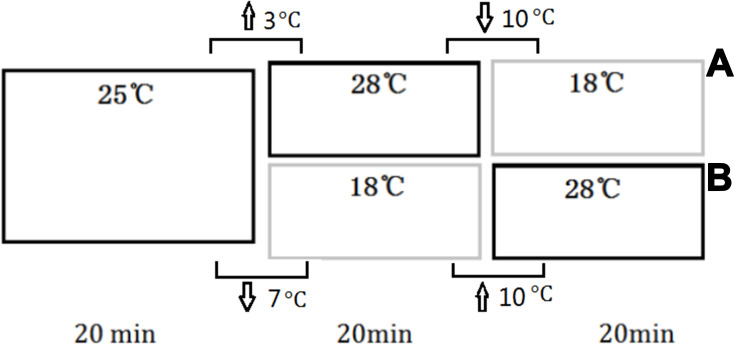
A total of 112 volunteers, 56 males and 56 females, 55 with and 57 without hypertension, were enrolled in the study. First, the participants were placed in a 25°C room. Second, they were randomly assigned to either a 28°C (group A) or an 18°C room (group B). Finally, they were moved from the 28°C to the 18°C room, or vice versa. They stayed in each room for 20 minutes. Seated BP was measured at the 17th and 19th minute in each room, and the average was used. The difference in the subject's BP between the second two rooms was recorded as delta BP.
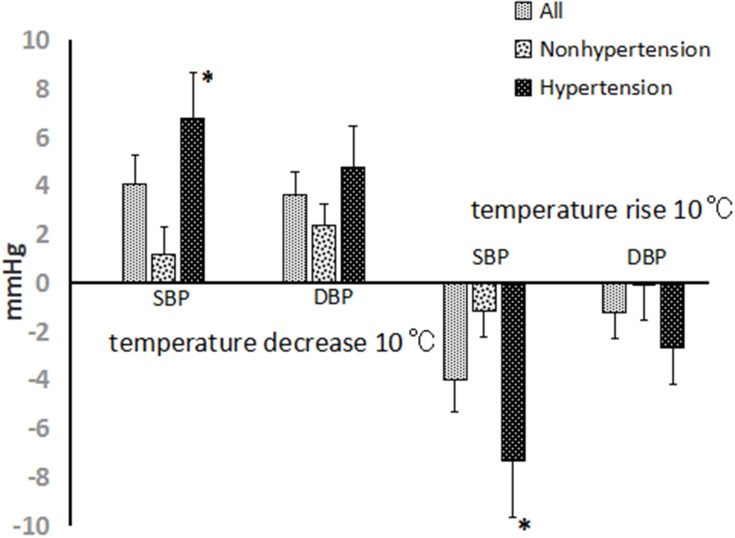
The baseline systolic BP (SBP), age, gender distribution, and incidence of hypertension were similar between the two groups. In group A, the decrease in room temperature of 10°C induced a mean rise in SBP of 4.1 mmHg. In group B, the increase of 10°C caused SBP to decrease by 4.0 mmHg. When compared with the group without hypertension, the group with hypertension had a significantly higher rise in mean SBP (6.8 vs 1.2 mmHg) as a result of the decrease in temperature and a significantly higher drop in SBP (7.3 vs 1.2 mmHg) as a result of the increase in temperature. The participants in the group with hypertension were older.
A 10°C change in room temperature, from 18°C to 28°C, for 20 min can cause a significant change in SBP. The extent of this change is more obvious in the older group.
本研究旨在评估室温在18°C至28°C之间变化10°C对血压(BP)的影响。
共有112名志愿者参与研究,其中男性56名,女性56名,55名有高血压,57名无高血压。首先,将参与者置于25°C的房间。其次,他们被随机分配到28°C的房间(A组)或18°C的房间(B组)。最后,将他们从28°C的房间转移到18°C的房间,或反之。他们在每个房间停留20分钟。在每个房间的第17分钟和第19分钟测量坐位血压,并取平均值。记录受试者在后两个房间的血压差值作为血压变化量(delta BP)。
两组之间的基线收缩压(SBP)、年龄、性别分布和高血压发病率相似。在A组中,室温降低10°C导致SBP平均升高4.1 mmHg。在B组中,室温升高10°C导致SBP降低4.0 mmHg。与无高血压组相比,高血压组因温度降低导致的平均SBP升高幅度显著更高(6.8 vs 1.2 mmHg),因温度升高导致的SBP下降幅度也显著更高(7.3 vs 1.2 mmHg)。高血压组的参与者年龄更大。
室温在18°C至28°C之间变化10°C持续20分钟可导致SBP发生显著变化。这种变化在老年组中更为明显。