Zhou Xue-Ming, Liu Chen-Yue, Liu Yue-Yun, Ma Qing-Yu, Zhao Xin, Jiang You-Ming, Li Xiao-Juan, Chen Jia-Xu
School of Traditional Chinese Medicine, Beijing University of Chinese Medicine, Beijing, China.
School of Basic Medical Sciences, Heilongjiang University of Chinese Medicine, Haerbin, China.
Front Pharmacol. 2021 Apr 12;12:586788. doi: 10.3389/fphar.2021.586788. eCollection 2021.
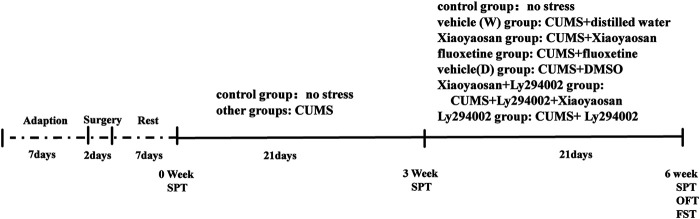
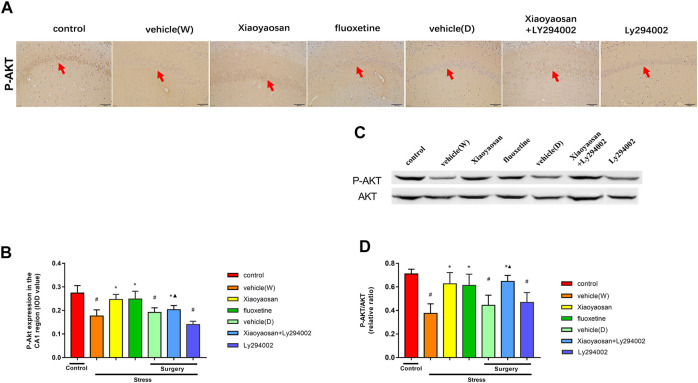
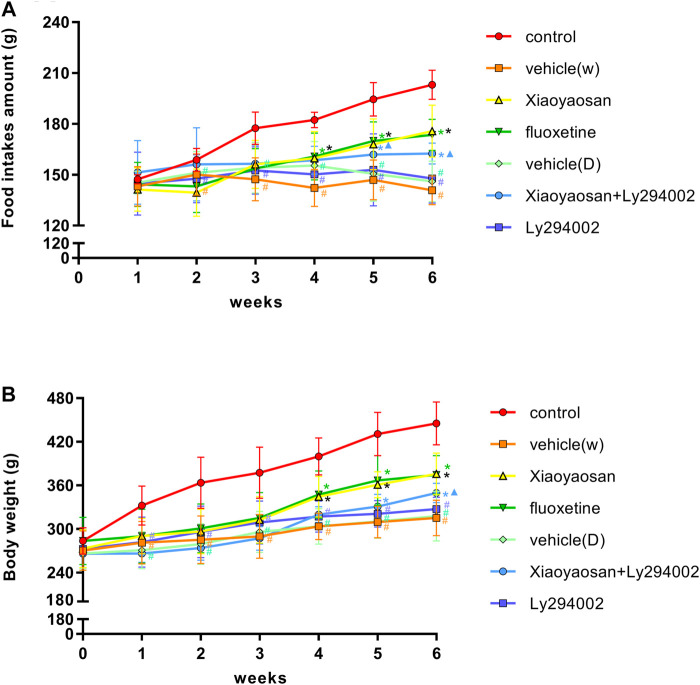
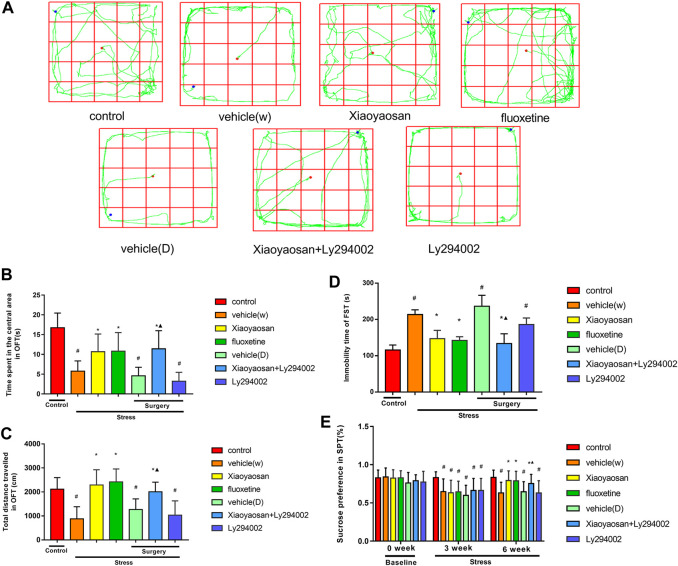
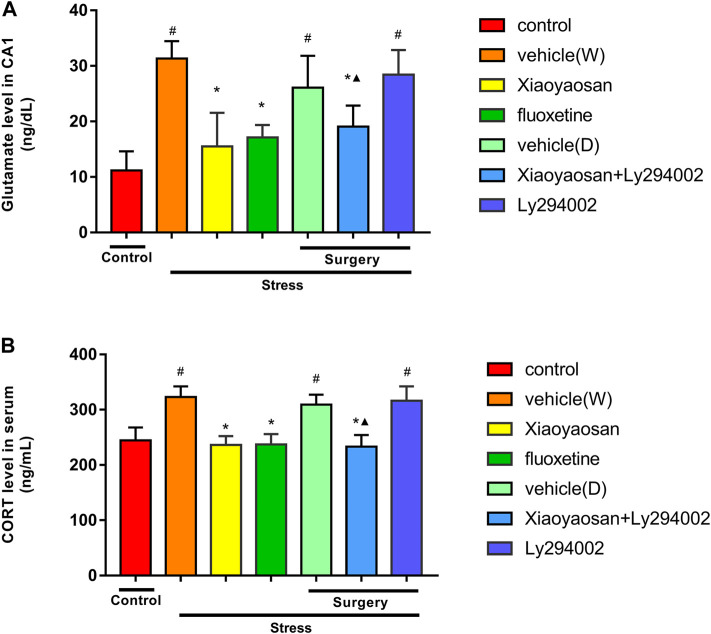
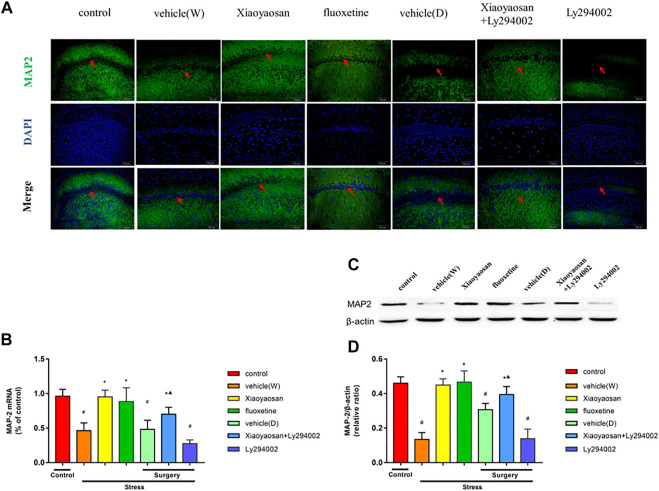
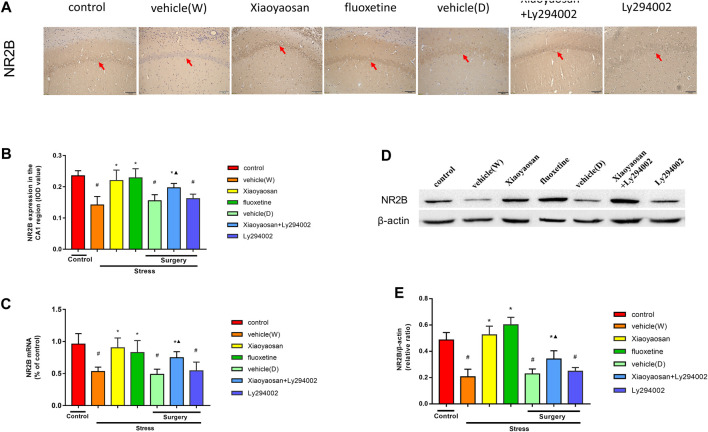
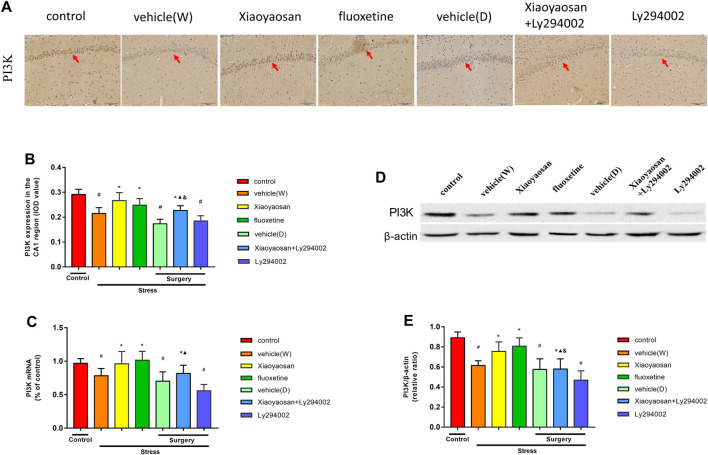
It is revealed that Xiaoyaosan could reduce glutamate level in the hippocampus of depressed rats, whose metabolism leads to the pathophysiology of depression. However, the underlying mechanism remains unclear. This study aims to explore the effect of Xiaoyaosan on glutamate metabolism, and how to regulate the excitatory injury caused by glutamate. Rats were induced by chronic unpredictable mild stress, then divided into control, vehicle (distilled water), Xiaoyaosan, fluoxetine, vehicle (DMSO), Xiaoyaosan + Ly294002 and Ly294002 groups. Ly294002 was microinjected into the lateral ventricular catheterization at 5 mM. Xiaoyaosan (2.224 g/kg) and fluoxetine (2.0 mg/kg) were orally administered for three weeks. The open field test (OFT), forced swimming test (FST), and sucrose preference test (SPT) were used to assess depressive behavior. The glutamate and corticosterone (CORT) levels were detected by ELISA. Western blot, immunochemistry or immunofluorescence were used to detect the expressions of NR2B, MAP2, PI3K and P-AKT/Akt in the hippocampal CA1 region. The mRNA level of MAP2, NR2B and PI3K were detected by RT-qPCR. Compared to the rats in control group, body weight and food intake of CUMS rats was decreased. CUMS rats also showed depression-like behavior as well as down regulate the NR2B and PI3K/Akt signaling pathway. Xiaoyaosan treatments could increase food intake and body weight as well as improved time spent in the central area, total distance traveled in the OFT. Xiaoyaosan could also decrease the immobility time as well as increase the sucrose preference in SPT. Moreover, xiaoyaosan decreased the level of glutamate in the hippocampal CA1 region and serum CORT in CUMS rats. Furthermore, xiaoyaosan improved the expression of MAP2 as well as increased the expression of NR2B, PI3K and the P-AKT/AKT ratio in the hippocampal CA1 region in the CUMS rats. Xiaoyaosan treatment can exert the antidepressant effect by rescuing hippocampal neurons loss induced by the glutamate-mediated excitotoxicity in CUMS rats. The underlying pathway maybe through NR2B and PI3K/Akt signaling pathways. These results may suggest the potential of Xiaoyaosan in preventing the development of depression.
研究发现,逍遥散可降低抑郁大鼠海马中的谷氨酸水平,其代谢导致抑郁症的病理生理学。然而,其潜在机制仍不清楚。本研究旨在探讨逍遥散对谷氨酸代谢的影响,以及如何调节谷氨酸引起的兴奋性损伤。将大鼠通过慢性不可预测轻度应激诱导,然后分为对照组、溶剂(蒸馏水)组、逍遥散组、氟西汀组、溶剂(二甲基亚砜)组、逍遥散+LY294002组和LY294002组。将LY294002以5 mM的浓度微量注射到侧脑室插管中。逍遥散(2.224 g/kg)和氟西汀(2.0 mg/kg)口服给药三周。采用旷场试验(OFT)、强迫游泳试验(FST)和蔗糖偏好试验(SPT)评估抑郁行为。通过酶联免疫吸附测定法检测谷氨酸和皮质酮(CORT)水平。采用蛋白质免疫印迹法、免疫化学或免疫荧光法检测海马CA1区NR2B、微管相关蛋白2(MAP2)、磷脂酰肌醇-3激酶(PI3K)和磷酸化蛋白激酶B/蛋白激酶B(P-AKT/Akt)的表达。通过逆转录定量聚合酶链反应(RT-qPCR)检测MAP2、NR2B和PI3K的mRNA水平。与对照组大鼠相比,慢性不可预测轻度应激(CUMS)大鼠的体重和食物摄入量降低。CUMS大鼠还表现出抑郁样行为,并下调NR2B和PI3K/Akt信号通路。逍遥散治疗可增加食物摄入量和体重,并改善旷场试验中在中央区域停留的时间、总行进距离。逍遥散还可减少强迫游泳试验中的不动时间,并增加蔗糖偏好试验中的蔗糖偏好。此外,逍遥散降低了CUMS大鼠海马CA1区的谷氨酸水平和血清CORT水平。此外,逍遥散改善了CUMS大鼠海马CA1区MAP2的表达,并增加了NR2B、PI3K的表达以及P-AKT/AKT比值。逍遥散治疗可通过挽救CUMS大鼠中谷氨酸介导的兴奋性毒性诱导的海马神经元丢失来发挥抗抑郁作用。潜在途径可能是通过NR2B和PI3K/Akt信号通路。这些结果可能提示逍遥散在预防抑郁症发展方面的潜力。