Joseph Robert M, Skwerer Daniela Plesa, Eggleston Brady, Meyer Steven R, Tager-Flusberg Helen
Boston University School of Medicine, USA; Boston University, USA.
Boston University, USA.
Autism Dev Lang Impair. 2019 Jan 1;4:1-13. doi: 10.1177/2396941519834717. Epub 2019 Mar 6.
When children hear a novel word, they tend to associate it with a novel rather than a familiar object. The ability to map a novel word to its corresponding referent is thought to depend, at least in part, on language-learning strategies, such as mutual exclusivity and lexical contrast. Although the importance of word learning strategies has been broadly investigated in typically developing children as well as younger children with autism spectrum disorder, who are usually language delayed, there is a paucity of research on such strategies and their role in language learning in school-age children and adolescents with autism spectrum disorder who have failed to develop fluent speech. In this study, we examined the ability of minimally verbal children and adolescents with autism spectrum disorder to learn and retain novel words in an experimental task, as well as the cognitive, language, and social correlates of these abilities. We were primarily interested in the characteristics that differentiated between three subgroups of participants: those unable to use word learning strategies, particularly mutual exclusivity, to learn novel words; those able to learn novel words over several exposure trials but not able retain them; and those able to retain the words they learned.
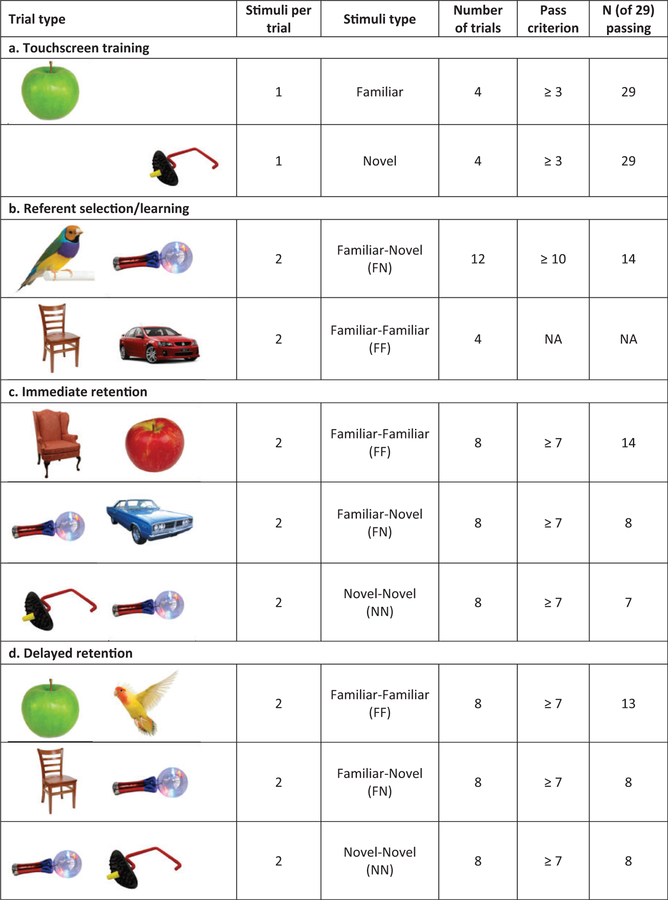
Participants were 29 minimally verbal individuals with autism spectrum disorder from 5 to 17 years of age. Participants completed a computerized touchscreen novel-word-learning procedure followed by assessments of immediate retention and of delayed retention, two hours later. Participants were grouped according to whether they passed/failed at least 7 of 8 (binomial <.035) novel word learning trials and 7 of 8 immediate or delayed retention trials, and were compared on measures of nonverbal IQ, receptive and expressive vocabulary, phonological processing, joint attention and symptom severity.
Of 29 participants, 14 failed both learning and immediate retention, 8 passed learning but failed immediate retention, and 7 passed both learning and immediate retention. Group performance was highly similar for delayed retention. Language level, particularly expressive vocabulary, differentiated between participants who did and did not succeed in retention, even while controlling for differences in nonverbal IQ.
The ability of minimally verbal school-age children and adolescents with autism spectrum disorder to identify the referents of novel words was associated with nonverbal cognitive abilities. Retention of words was associated with concurrent expressive language abilities.
Our findings of associations between the retention of novel words acquired in a lab-based experimental task and concurrent language ability warrants further investigation with larger samples and longitudinal research designs, which may support the incorporation of contrastive word learning strategies into language learning interventions for severely language-impaired individuals with autism spectrum disorder.
当儿童听到一个新单词时,他们倾向于将其与新事物而非熟悉的事物联系起来。将新单词映射到其相应指代对象的能力被认为至少部分取决于语言学习策略,如互斥性和词汇对比。尽管单词学习策略的重要性已在发育正常的儿童以及通常存在语言发育迟缓的自闭症谱系障碍幼儿中得到广泛研究,但对于那些未能发展出流利言语的自闭症谱系障碍学龄儿童和青少年的此类策略及其在语言学习中的作用,研究却很少。在本研究中,我们考察了自闭症谱系障碍的极少量言语儿童和青少年在一项实验任务中学习和记忆新单词的能力,以及这些能力的认知、语言和社会相关性。我们主要关注区分三个参与者亚组的特征:那些无法使用单词学习策略(特别是互斥性)来学习新单词的人;那些能够在多次接触试验中学习新单词但无法记住它们的人;以及那些能够记住所学单词的人。
参与者为29名年龄在5至17岁之间的自闭症谱系障碍极少量言语个体。参与者完成了一个计算机化触摸屏新单词学习程序,随后进行即时记忆和两小时后的延迟记忆评估。参与者根据他们在8次新单词学习试验中是否至少通过/未通过7次(二项式<.035)以及在8次即时或延迟记忆试验中是否至少通过/未通过7次进行分组,并在非言语智商、接受性和表达性词汇、语音处理、共同注意和症状严重程度的测量指标上进行比较。
29名参与者中,14人在学习和即时记忆方面均未通过,8人通过学习但即时记忆未通过,7人学习和即时记忆均通过。延迟记忆方面,各组表现高度相似。即使在控制了非言语智商差异之后,语言水平,特别是表达性词汇,在成功和未成功记忆的参与者之间仍存在差异。
自闭症谱系障碍的极少量言语学龄儿童和青少年识别新单词指代对象的能力与非言语认知能力相关。单词记忆与同时期的表达性语言能力相关。
我们关于在基于实验室的实验任务中习得的新单词记忆与同时期语言能力之间关联的研究结果,值得通过更大样本和纵向研究设计进行进一步调查,这可能支持将对比性单词学习策略纳入针对严重语言障碍的自闭症谱系障碍个体的语言学习干预中。
