Ugwu Nelson, Atzmony Lihi, Ellis Katharine T, Panse Gauri, Jain Dhanpat, Ko Christine J, Nassiri Naiem, Choate Keith A
Department of Dermatology, School of Medicine, Yale University, New Haven, CT 06510, USA.
Vascular Malformations Program (VaMP), Yale New Haven Hospital, New Haven, CT, USA.
HGG Adv. 2021 Apr 8;2(2). doi: 10.1016/j.xhgg.2021.100028. Epub 2021 Mar 1.
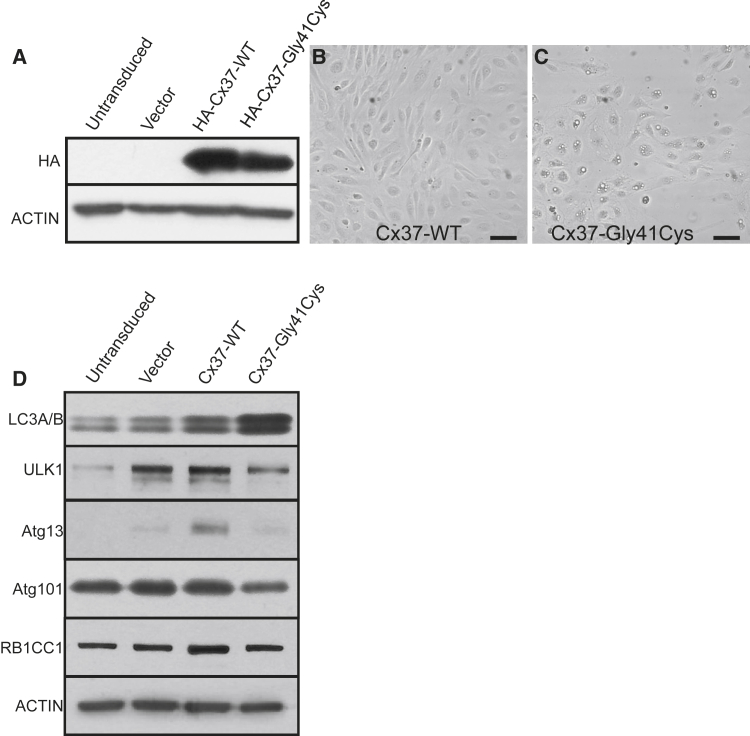
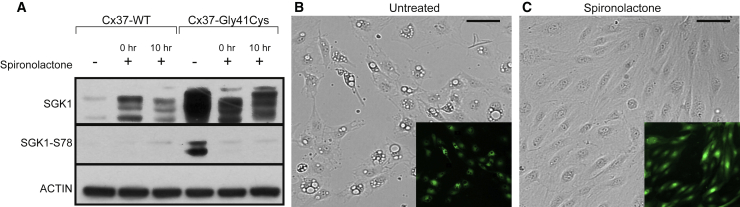
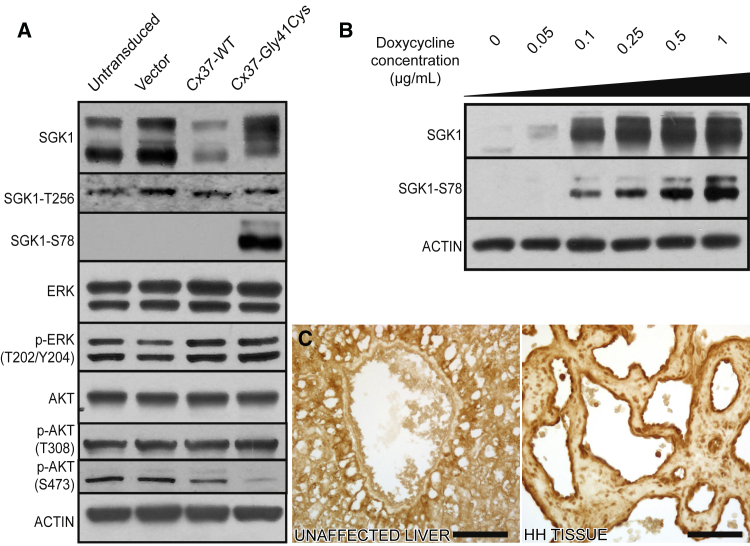
The term "cavernous hemangioma" has been used to describe vascular anomalies with histology featuring dilated vascular spaces, vessel walls consisting mainly of fibrous stromal bands lined by a layer of flattened endothelial cells, and an irregular outer rim of interrupted smooth muscle cells. Hepatic hemangiomas (HHs) and cutaneous venous malformations (VMs) share this histologic pattern, and we examined lesions in both tissues to identify genetic drivers. Paired whole-exome sequencing (WES) of lesional tissue and normal liver in HH subjects revealed a recurrent c.121G>T (p.Gly41Cys) somatic mutation in four of five unrelated individuals, and targeted sequencing in paired tissue from 9 additional HH individuals identified the same mutation in 8. In cutaneous lesions, paired targeted sequencing in 5 VMs and normal epidermis found the same c.121G>T (p.Gly41Cys) somatic mutation in three. encodes gap junction protein alpha 4, also called connexin 37 (Cx37), and the p.Gly41Cys mutation falls within the first transmembrane domain at a residue highly conserved among vertebrates. We interrogated the impact of the Cx37 mutant via lentiviral transduction of primary human endothelial cells. We found that the mutant induced changes in cell morphology and activated serum/glucocorticoid-regulated kinase 1 (SGK1), a serine/threonine kinase known to regulate cell proliferation and apoptosis, via non-canonical activation. Treatment with spironolactone, an inhibitor of angiogenesis, suppressed mutant SGK1 activation and reversed changes in cell morphology. These findings identify a recurrent somatic c.121G>T mutation as a driver of hepatic and cutaneous VMs, revealing a new pathway for vascular anomalies, with spironolactone a potential pathogenesis-based therapy.
术语“海绵状血管瘤”用于描述组织学特征为血管腔扩张的血管异常,血管壁主要由纤维基质带组成,内衬一层扁平内皮细胞,并有一层中断的平滑肌细胞构成的不规则外缘。肝血管瘤(HHs)和皮肤静脉畸形(VMs)具有这种组织学模式,我们检查了这两种组织中的病变以确定基因驱动因素。对HH患者的病变组织和正常肝脏进行配对全外显子测序(WES),在5名无亲缘关系的个体中有4名发现了一个反复出现的c.121G>T(p.Gly41Cys)体细胞突变,对另外9名HH个体的配对组织进行靶向测序,在8名个体中发现了相同的突变。在皮肤病变中,对5例VMs和正常表皮进行配对靶向测序,在3例中发现了相同的c.121G>T(p.Gly41Cys)体细胞突变。该基因编码间隙连接蛋白α4,也称为连接蛋白37(Cx37),p.Gly41Cys突变位于第一个跨膜结构域内一个在脊椎动物中高度保守的残基处。我们通过慢病毒转导原代人内皮细胞来研究Cx37突变体的影响。我们发现该突变体诱导细胞形态发生变化,并通过非经典激活激活血清/糖皮质激素调节激酶1(SGK1),这是一种已知可调节细胞增殖和凋亡的丝氨酸/苏氨酸激酶。用血管生成抑制剂螺内酯治疗可抑制突变体SGK1的激活并逆转细胞形态的变化。这些发现确定了一个反复出现的体细胞c.121G>T突变是肝和皮肤VMs的驱动因素,揭示了血管异常的一条新途径,螺内酯是一种基于发病机制的潜在治疗方法。