Liu Natalie, Venkatesh Manasa, Hanlon Bret M, Muraveva Anna, Johnson Morgan K, Hanrahan Lawrence P, Funk Luke M
Department of Surgery, University of Wisconsin School of Medicine and Public Health, Madison, WI.
Department of Biostatistics and Medical Informatics, University of Wisconsin School of Medicine and Public Health, Madison, WI.
Ann Surg Open. 2021 Jan 7;2(1):e028. doi: 10.1097/AS9.0000000000000028. eCollection 2021 Mar.
To compare outcomes after bariatric surgery between Medicaid and non-Medicaid patients and assess whether differences in social determinants of health were associated with postoperative weight loss.
The literature remains mixed on weight loss outcomes and healthcare utilization for Medicaid patients after bariatric surgery. It is unclear if social determinants of health geocoded at the neighborhood level are associated with outcomes.
Patients who underwent laparoscopic sleeve gastrectomy (SG) or Roux-en-Y gastric bypass (RYGB) from 2008 to 2017 and had ≥1 year of follow-up within a large health system were included. Baseline characteristics, 90-day and 1-year outcomes, and weight loss were compared between Medicaid and non-Medicaid patients. Area deprivation index (ADI), urbanicity, and walkability were analyzed at the neighborhood level. Median regression with percent total body weight (TBW) loss as the outcome was used to assess predictors of weight loss after surgery.
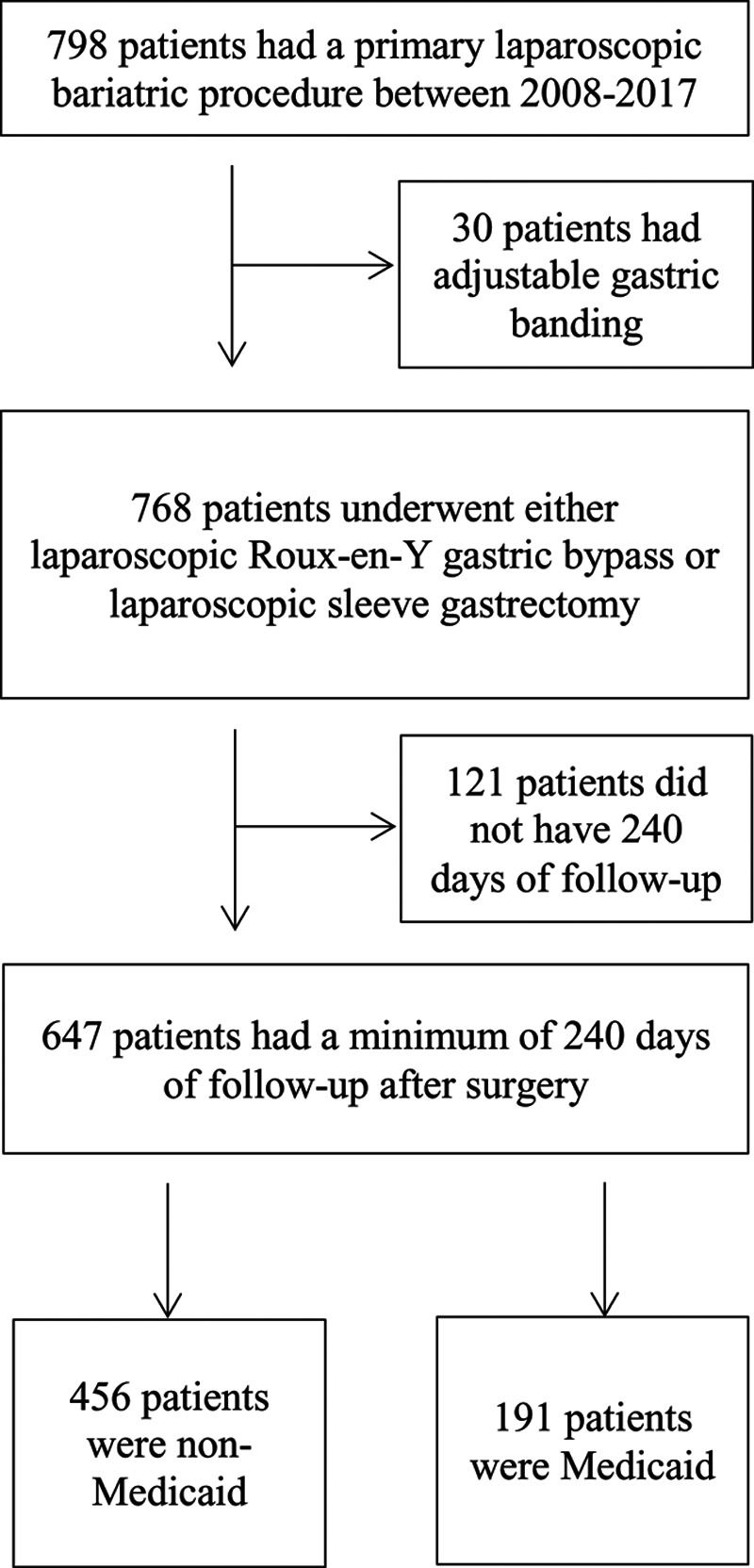
Six hundred forty-seven patients met study criteria (191 Medicaid and 456 non-Medicaid). Medicaid patients had a higher 90-day readmission rate compared to non-Medicaid patients (19.9% vs 12.3%, < 0.016). Weight loss was similar between Medicaid and non-Medicaid patients (23.1% vs 21.9% TBW loss, respectively; = 0.266) at a median follow-up of 3.1 years. In adjusted analyses, Medicaid status, ADI, urbanicity, and walkability were not associated with weight loss outcomes.
Medicaid status and social determinants of health at the neighborhood level were not associated with weight loss outcomes after bariatric surgery. These findings suggest that if Medicaid patients are appropriately selected for bariatric surgery, they can achieve equivalent outcomes as non-Medicaid patients.
比较医疗补助计划参保患者与非医疗补助计划参保患者接受减肥手术后的结局,并评估健康的社会决定因素差异是否与术后体重减轻相关。
关于减肥手术后医疗补助计划参保患者的体重减轻结局和医疗保健利用情况,文献报道不一。尚不清楚邻里层面经地理编码的健康社会决定因素是否与结局相关。
纳入2008年至2017年接受腹腔镜袖状胃切除术(SG)或Roux-en-Y胃旁路术(RYGB)且在一个大型医疗系统内有≥1年随访的患者。比较医疗补助计划参保患者与非医疗补助计划参保患者的基线特征、90天和1年结局以及体重减轻情况。在邻里层面分析地区贫困指数(ADI)、城市化程度和步行便利性。以总体重(TBW)减轻百分比为结局的中位数回归用于评估术后体重减轻的预测因素。
647例患者符合研究标准(191例医疗补助计划参保患者和456例非医疗补助计划参保患者)。与非医疗补助计划参保患者相比,医疗补助计划参保患者90天再入院率更高(分别为19.9%和12.3%,<0.016)。在中位随访3.1年时,医疗补助计划参保患者与非医疗补助计划参保患者的体重减轻情况相似(分别为TBW减轻23.1%和21.9%;P = 0.266)。在多因素分析中,医疗补助计划参保状态、ADI、城市化程度和步行便利性与体重减轻结局无关。
医疗补助计划参保状态和邻里层面的健康社会决定因素与减肥手术后的体重减轻结局无关。这些发现表明,如果为医疗补助计划参保患者适当选择减肥手术,他们可以取得与非医疗补助计划参保患者相当的结局。