Department of Radiology, Juntendo University Hospital, Tokyo 113-8431, Japan.
Department of Radiation Oncology, Graduate School of Medicine, Juntendo University, Tokyo 113-8421, Japan.
J Radiat Res. 2021 Jul 10;62(4):718-725. doi: 10.1093/jrr/rrab033.
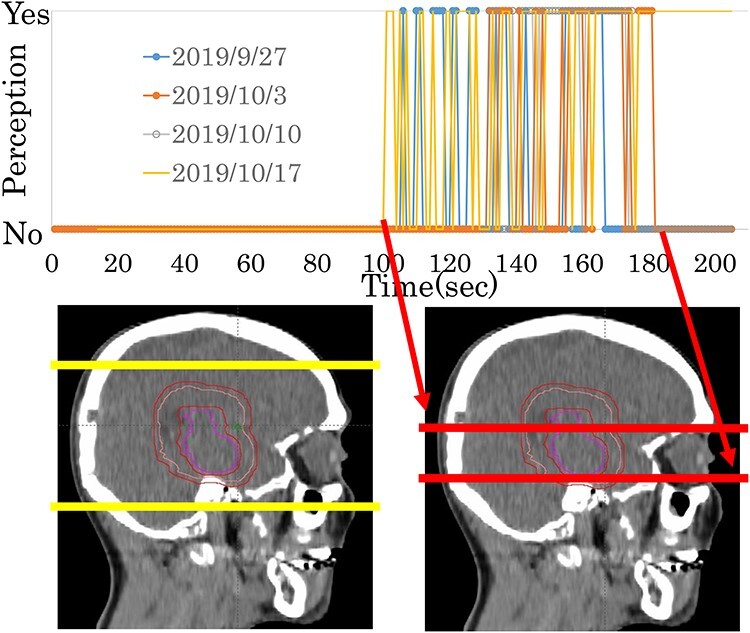
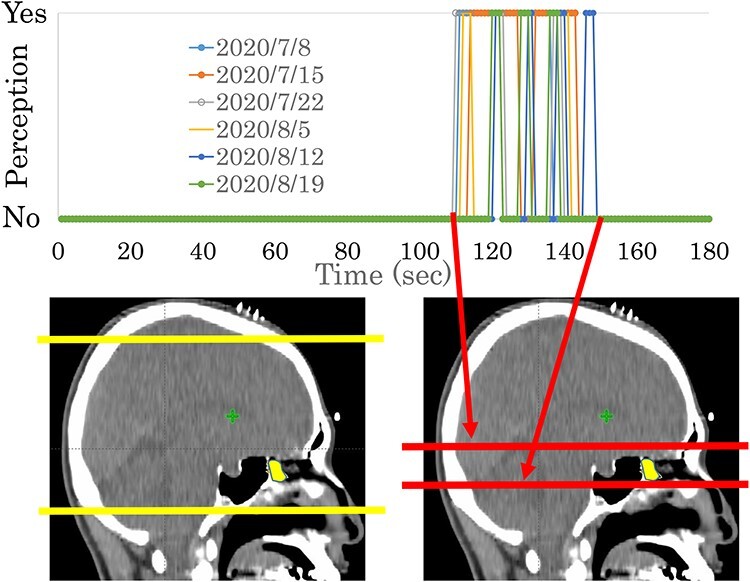
During radiotherapy sessions to treat brain tumors or head-and-neck cancers, some patients experience unusual visual and/or olfactory perceptions. This prospective study sought to answer two questions: (i) what proportion of patients experience these unpleasant sensations?, and (ii) which organs are responsible? Eligible patients had brain or near-orbital tumors treated by helical tomotherapy. All were aged 10 years or older, able to communicate, and interviewed by a radiation oncologist at least once weekly during radiation therapy. If they had experienced such sensations, they were encouraged to join the second phase of the study. The patients were asked to indicate, using a button, when a sensation commenced and ended. The recorded data were collated with the treatment log. Thirty-eight consecutive patients were eligible. Twenty-six experienced visual and 13 olfactory sensations. The radiation doses to the organs related to the visual or olfactory sensations did not differ between patients who reported sensations and those who did not. Seventeen patients were enrolled in the second phase of the study. All 14 with visual sensations reported that the sensations occurred when the X-rays passed at eye level. Olfactory sensations were reported by eight out of nine patients when the X-rays passed through the olfactory epithelium and/or ethmoid sinus level. In conclusion, 68% of patients experienced visual sensations caused by X-rays passing through the level of the eyes, and 34% complained of olfactory sensations. With the exception of one patient, olfactory sensations occurred when the X-rays passed through the levels of the olfactory epithelium and/or ethmoid sinus.
在治疗脑肿瘤或头颈部癌症的放射治疗过程中,一些患者会出现异常的视觉和/或嗅觉感知。这项前瞻性研究旨在回答两个问题:(i)有多少比例的患者会经历这些不愉快的感觉?以及(ii)哪些器官是罪魁祸首?符合条件的患者接受螺旋断层放疗治疗脑或眶周肿瘤。所有患者年龄均在 10 岁或以上,能够交流,并在放射治疗期间每周至少由一名放射肿瘤学家进行一次访谈。如果他们有过这种感觉,他们被鼓励参加研究的第二阶段。患者被要求使用按钮指示感觉开始和结束的时间。记录的数据与治疗记录进行了整理。有 38 名连续患者符合条件。26 名患者出现视觉感觉,13 名患者出现嗅觉感觉。报告有感觉的患者与没有感觉的患者之间,与视觉或嗅觉感觉相关的器官的辐射剂量没有差异。有 17 名患者参加了研究的第二阶段。所有 14 名有视觉感觉的患者报告说,当 X 射线经过眼睛水平时,会出现感觉。9 名有嗅觉感觉的患者中有 8 名报告说,当 X 射线穿过嗅上皮和/或筛窦水平时,会出现嗅觉感觉。总之,68%的患者经历了由 X 射线穿过眼睛水平引起的视觉感觉,34%的患者抱怨嗅觉感觉。除了一名患者外,当 X 射线穿过嗅上皮和/或筛窦水平时,都会出现嗅觉感觉。