Tianjin University of Traditional Chinese Medicine, Tianjin 300193, China.
Tianjin Union Medical Center of Nankai University, Department of Oncology, Tianjin 300121, China.
J Radiat Res. 2021 Jul 10;62(4):574-581. doi: 10.1093/jrr/rrab035.
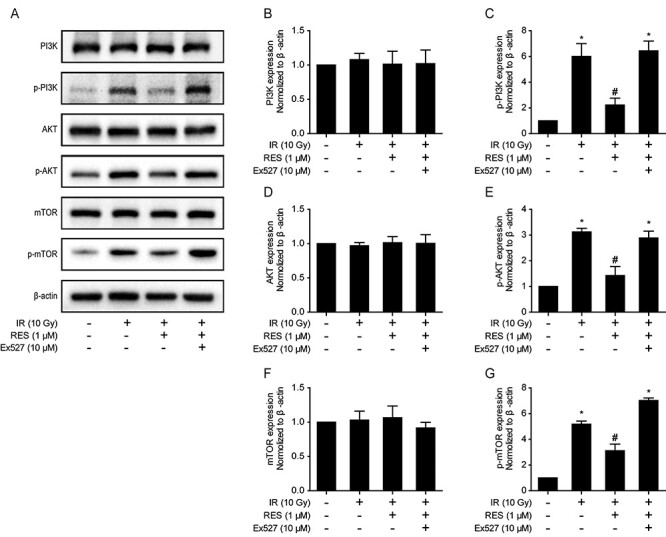
Intrinsic autophagy is important for the maintenance of intestinal homeostasis and intestinal regeneration. Ionizing radiation suppresses intrinsic autophagy and reduces damage-induced regeneration in the intestine, resulting in intestinal injury. Resveratrol, a sirtuin 1 (SIRT1) agonist, promotes autophagy and exerts radioprotective effect. In this study, the protective effect of resveratrol against radiation-induced intestinal injury and its potential mechanism were investigated. Intestinal epithelial cells (IEC-6) were exposed to 10 Gy ionizing radiation and resveratrol (0.1-40.0 μM). Cell viability was investigated using Cell Counting Kit 8 (CCK8), apoptosis was observed by Annexin V-fluorescein isothiocyanate/propidium iodide (PI) staining and flow cytometry, and the expression of apoptotic and autophagic proteins was determined by western blotting. Resveratrol exerted a high toxicity against IEC-6 cells, but at low concentrations, it inhibited ionizing radiation-induced apoptosis. Resveratrol increased SIRT1 expression after irradiation and inhibited ionizing radiation-induced p53 acetylation and pro-apoptotic protein, Bax, expression. Furthermore, resveratrol promoted autophagy via the phosphoinositide 3-kinase (PI3K)/AKT/mammalian target of rapamycin (mTOR) pathway, thereby protecting IEC-6 cells against radiation-induced damage. These results suggest that resveratrol reduces radiation-induced IEC-6 cell damage by inhibiting apoptosis and promoting autophagy via the activation of SIRT1, and that the PI3K/AKT/mTOR signaling pathway is involved in the induction of autophagy.
内在自噬对于维持肠道内稳态和肠道再生是很重要的。电离辐射会抑制内在自噬,并减少损伤诱导的肠道再生,从而导致肠道损伤。白藜芦醇是一种 SIRT1 激动剂,可促进自噬并发挥放射保护作用。本研究旨在探讨白藜芦醇对电离辐射诱导的肠道损伤的保护作用及其潜在机制。将肠上皮细胞(IEC-6)暴露于 10Gy 电离辐射和白藜芦醇(0.1-40.0μM)中。使用细胞计数试剂盒 8(CCK8)检测细胞活力,通过 Annexin V-荧光素异硫氰酸酯/碘化丙啶(PI)染色和流式细胞术观察细胞凋亡,通过 Western blot 检测凋亡和自噬蛋白的表达。白藜芦醇对 IEC-6 细胞具有高毒性,但在低浓度时可抑制电离辐射诱导的细胞凋亡。白藜芦醇在照射后增加 SIRT1 表达,并抑制电离辐射诱导的 p53 乙酰化和促凋亡蛋白 Bax 的表达。此外,白藜芦醇通过磷酸肌醇 3-激酶(PI3K)/蛋白激酶 B(AKT)/雷帕霉素靶蛋白(mTOR)通路促进自噬,从而保护 IEC-6 细胞免受辐射损伤。这些结果表明,白藜芦醇通过抑制凋亡和激活 SIRT1 促进自噬来减少电离辐射对 IEC-6 细胞的损伤,而 PI3K/AKT/mTOR 信号通路参与了自噬的诱导。