Endocrinology and Diabetology Unit, ASL 1, Imperia, Italy.
Department of Internal Medicine and Medical Specialties (DiMI), Genoa University, Viale Benedetto XV, 6 I-16132, Genova, Italy.
Immunol Res. 2021 Apr;69(2):129-138. doi: 10.1007/s12026-021-09192-6. Epub 2021 Apr 29.
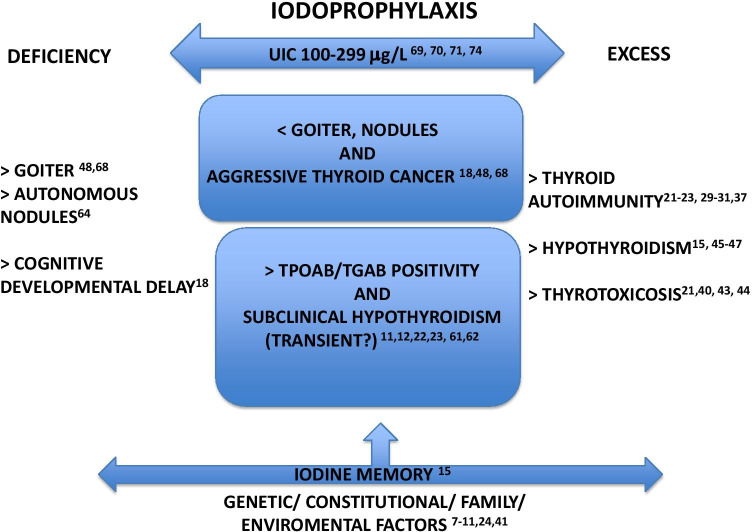
Adequate iodine intake is necessary for normal thyroid function. Iodine deficiency is associated with serious complications, but also iodine excess can lead to thyroid dysfunction, and iodine supplementation aimed to prevent iodine deficiency disorders has been associated with development of thyroid autoimmunity. The epidemiology of thyroid diseases has undergone profound changes since the implementation of iodoprophylaxis, notably by means of iodine-enriched salt, specifically resulting in decreased prevalence of goiter and neonatal hypothyroidism, improved cognitive function development in infancy, and reduced incidence of more aggressive forms of thyroid cancer. The main question we address with this review is the clinical relevance of the possible effect on autoimmunity exerted by the use of iodine-enriched salt to correct iodine deficiency. In animal models, exogenous iodine is able to trigger or exacerbate thyroid autoimmunity, but it is still not clear whether the observed immunological changes are due to a direct effect of iodine on immune response, or whether they represent a secondary response to a toxic effect of iodine on thyroid tissue. Previous iodine status of a population seems to influence the functional thyroid response to increased iodine intake and possibly the development of thyroid autoimmunity. Moreover, the prevalence of thyroid antibodies, regarded as hallmark of autoimmune thyroid disease, varies between populations under the influence of genetic and environmental factors, and the presence of thyroid antibodies does not always coincide with the presence of thyroid disease or its future development. In addition, the incidence of autoimmune diseases shows a general increasing trend in the last decades. For all these reasons, available data are quite heterogeneous and difficult to analyze and compare. In conclusion, available data from long-term population surveys show that a higher than adequate population iodine intake due to a poorly controlled program of iodine prophylaxis could induce thyroid dysfunction, including thyroid autoimmunity mostly represented by euthyroid or subclinical hypothyroid autoimmune thyroiditis. Close monitoring iodine prophylaxis is therefore advised to ensure that effects of both iodine deficiency and iodine excess are avoided.
碘的摄入量充足对于甲状腺功能的正常运作是必要的。碘缺乏与严重的并发症有关,但碘过量也会导致甲状腺功能障碍,而旨在预防碘缺乏症的碘补充剂已与甲状腺自身免疫的发展有关。自碘预防措施实施以来,甲状腺疾病的流行病学发生了深刻变化,特别是通过富碘盐,这显著降低了甲状腺肿和新生儿甲状腺功能减退症的患病率,改善了婴儿期认知功能的发展,并降低了侵袭性更强的甲状腺癌的发病率。我们通过本次综述主要探讨的问题是,使用富碘盐纠正碘缺乏对自身免疫可能产生的影响的临床相关性。在动物模型中,外源性碘能够引发或加重甲状腺自身免疫,但目前仍不清楚观察到的免疫变化是由于碘对免疫反应的直接作用,还是由于碘对甲状腺组织的毒性作用的继发反应。人群的先前碘状态似乎会影响对增加碘摄入的功能性甲状腺反应,并且可能影响甲状腺自身免疫的发展。此外,被认为是自身免疫性甲状腺疾病标志的甲状腺抗体的患病率在遗传和环境因素的影响下在不同人群之间有所不同,并且甲状腺抗体的存在并不总是与甲状腺疾病的存在或其未来发展相一致。此外,自身免疫性疾病的发病率在过去几十年中呈普遍上升趋势。由于所有这些原因,可用数据相当多样化,难以分析和比较。总之,来自长期人群调查的现有数据表明,由于碘预防计划控制不佳而导致的高于适量的人群碘摄入可能会导致甲状腺功能障碍,包括甲状腺自身免疫,主要表现为甲状腺功能正常或亚临床甲状腺自身免疫性甲状腺炎。因此,建议密切监测碘预防,以确保避免碘缺乏和碘过量的影响。