Departments of Psychiatry/Paediatrics and Centre for Education Research and Innovation, Schulich School of Medicine and Dentistry, Western University, London, Ontario, Canada.
Hospital for Sick Children (SickKids), Department of Psychiatry, University of Toronto, Toronto, Canada.
Perspect Med Educ. 2021 Aug;10(4):222-229. doi: 10.1007/s40037-021-00663-y. Epub 2021 Apr 29.
The COVID-19 pandemic has taken a significant toll on the health of structurally vulnerable patient populations as well as healthcare workers. The concepts of structural stigma and moral distress are important and interrelated, yet rarely explored or researched in medical education. Structural stigma refers to how discrimination towards certain groups is enacted through policy and practice. Moral distress describes the tension and conflict that health workers experience when they are unable to fulfil their duties due to circumstances outside of their control. In this study, the authors explored how resident physicians perceive moral distress in relation to structural stigma. An improved understanding of such experiences may provide insights into how to prepare future physicians to improve health equity.
Utilizing constructivist grounded theory methodology, 22 participants from across Canada including 17 resident physicians from diverse specialties and 5 faculty members were recruited for semi-structured interviews from April-June 2020. Data were analyzed using constant comparative analysis.
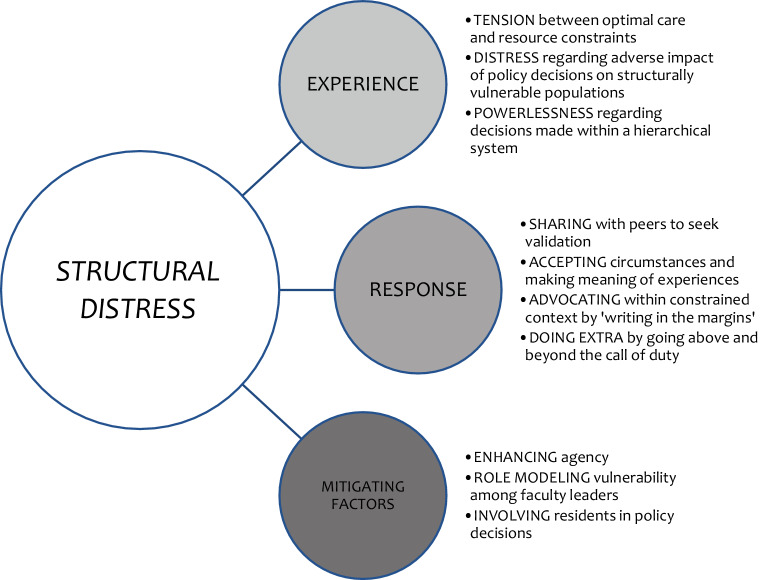
Results describe a distinctive form of moral distress called structural distress, which centers upon the experience of powerlessness leading resident physicians to go above and beyond the call of duty, potentially worsening their psychological well-being. Faculty play a buffering role in mitigating the impact of structural distress by role modeling vulnerability and involving residents in policy decisions.
These findings provide unique insights into teaching and learning about the care of structurally vulnerable populations and faculty's role related to resident advocacy and decision-making. The concept of structural distress may provide the foundation for future research into the intersection between resident well-being and training related to health equity.
COVID-19 大流行对结构上脆弱的患者群体以及医疗保健工作者的健康造成了重大影响。结构性耻辱和道德困境这两个概念非常重要且相互关联,但在医学教育中很少被探讨或研究。结构性耻辱是指通过政策和实践对某些群体的歧视行为。道德困境是指卫生工作者由于无法控制的情况而无法履行职责时所经历的紧张和冲突。在这项研究中,作者探讨了住院医师如何感知与结构性耻辱相关的道德困境。对这些经历的深入了解可能有助于了解如何培养未来的医生来改善健康公平。
利用建构主义扎根理论方法,从 2020 年 4 月至 6 月,从加拿大各地招募了 22 名参与者,包括来自不同专业的 17 名住院医师和 5 名教师。使用恒定性比较分析对数据进行分析。
研究结果描述了一种独特的道德困境形式,称为结构性困境,其核心是无力感导致住院医师超越职责范围,可能会恶化他们的心理健康。教师通过模拟脆弱性和让住院医师参与政策决策,在减轻结构性困境的影响方面发挥缓冲作用。
这些发现为教学和学习有关护理结构脆弱人群的知识提供了独特的见解,以及教师在住院医师倡导和决策方面的作用。结构性困境的概念可能为未来关于居民福祉和与健康公平相关培训的研究提供基础。