Ge Zhouhong, Helmijr Jean C A, Jansen Maurice P H M, Boor Patrick P C, Noordam Lisanne, Peppelenbosch Maikel, Kwekkeboom Jaap, Kraan Jaco, Sprengers Dave
Departments of Gastroenterology and Hepatology, Erasmus MC-University Medical Center, Wytemaweg 80, Rotterdam 3015 CN, The Netherlands.
Departments of Medical Oncology, Erasmus MC-University Medical Center, Rotterdam, The Netherlands.
Transl Oncol. 2021 Jul;14(7):101073. doi: 10.1016/j.tranon.2021.101073. Epub 2021 Apr 26.
Circulating tumor cells (CTCs) or circulating tumor DNA (ctDNA) may be used for diagnostic or prognostic purposes in patients with hepatocellular carcinoma (HCC). We aim to determine whether CTCs or ctDNA are suitable to determine oncogenic mutations in HCC patients.
Twenty-six mostly advanced HCC patients were enrolled. 30 mL peripheral blood from each patient was obtained. CellSearch system was used for CTC detection. A sequencing panel covering 14 cancer-relevant genes was used to identify oncogenic mutations. TERT promoter C228T and C250T mutations were determined by droplet digital PCR.
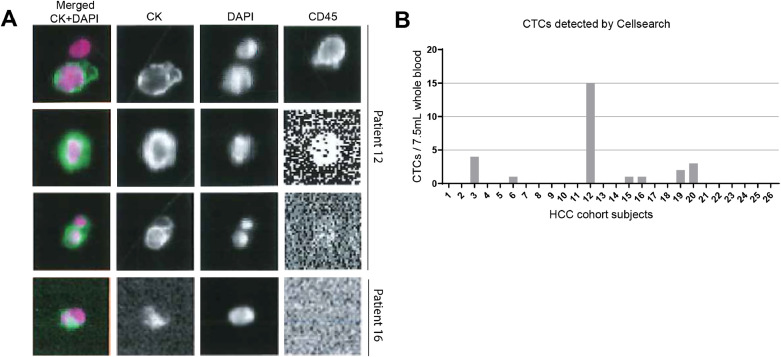
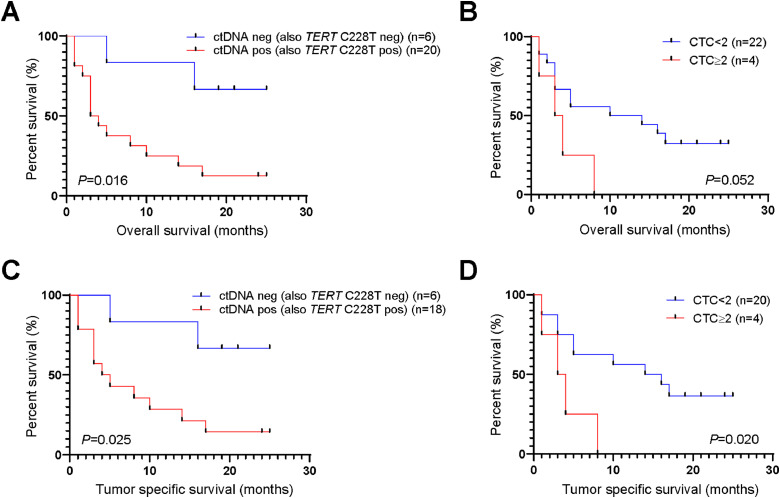
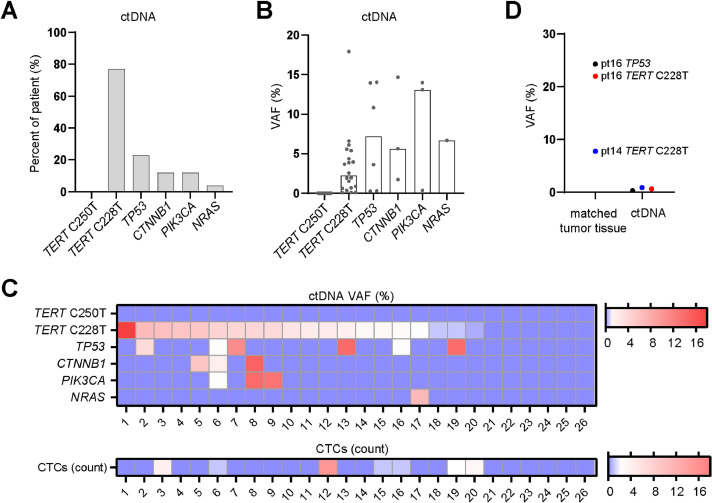
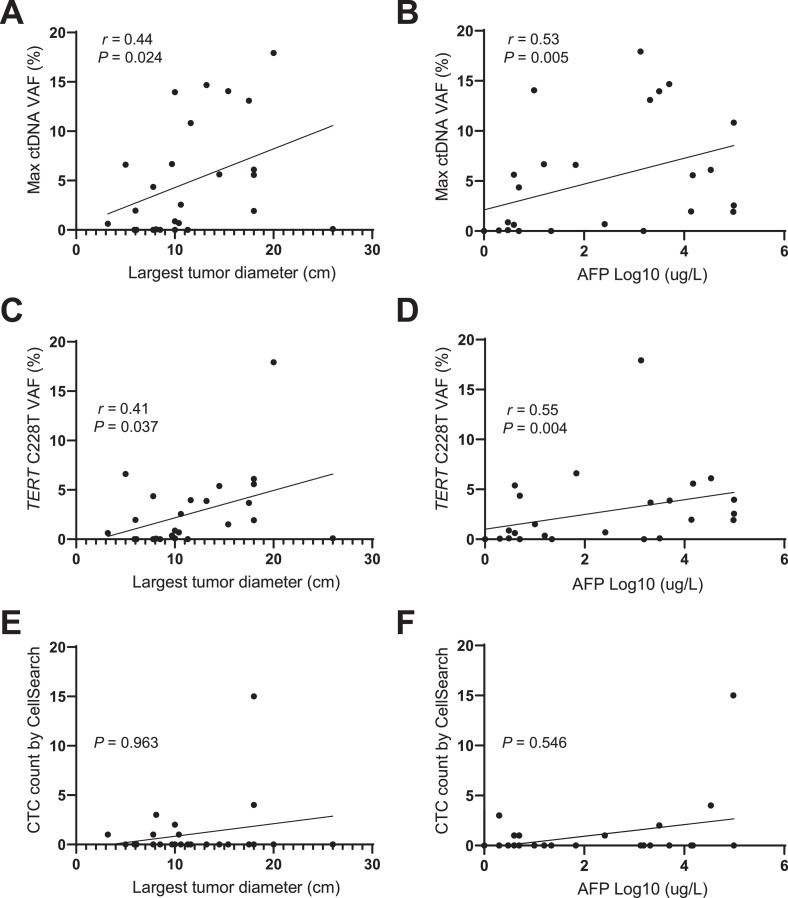
CTCs were detected in 27% (7/26) of subjects but at low numbers (median: 2 cells, range: 1-15 cells) and ctDNA in 77% (20/26) of patients. Mutations in ctDNA were identified in several genes: TERT promoter C228T (77%, 20/26), TP53 (23%, 6/26), CTNNB1 (12%, 3/26), PIK3CA (12%, 3/26) and NRAS (4%, 1/26). The TERT C228T mutation was present in all patients with one or more ctDNA mutations, or detectable CTCs. The TERT C228T and TP53 mutations detected in ctDNA were present at higher levels in matched primary HCC tumor tissue. The maximal variant allele frequency (VAF) of ctDNA was linearly correlated with largest tumor size and AFP level (Log10). CtDNA (or TERT C228T) positivity was associated with macrovascular invasion, and positivity of ctDNA (or TERT C228T) or CTCs (≥ 2) correlated with poor patient survival.
Oncogenic mutations could be detected in ctDNA from advanced HCC patients. CtDNA analysis may serve as a promising liquid biopsy to identify druggable mutations.
循环肿瘤细胞(CTC)或循环肿瘤DNA(ctDNA)可用于肝细胞癌(HCC)患者的诊断或预后评估。我们旨在确定CTC或ctDNA是否适合用于检测HCC患者的致癌突变。
纳入26例大多为晚期的HCC患者。采集每位患者30 mL外周血。采用CellSearch系统检测CTC。使用覆盖14个癌症相关基因的测序板来鉴定致癌突变。通过液滴数字PCR测定TERT启动子C228T和C250T突变。
27%(7/26)的受试者检测到CTC,但数量较少(中位数:2个细胞,范围:1 - 15个细胞),77%(20/26)的患者检测到ctDNA。在ctDNA中鉴定出多个基因的突变:TERT启动子C228T(77%,20/26)、TP53(23%,6/26)、CTNNB1(12%,3/26)、PIK3CA(12%,3/26)和NRAS(4%,1/26)。所有有一个或多个ctDNA突变或可检测到CTC的患者均存在TERT C228T突变。在匹配的原发性HCC肿瘤组织中,ctDNA中检测到的TERT C228T和TP53突变水平更高。ctDNA的最大变异等位基因频率(VAF)与最大肿瘤大小和甲胎蛋白水平(Log10)呈线性相关。ctDNA(或TERT C228T)阳性与大血管侵犯相关,ctDNA(或TERT C228T)或CTC(≥2)阳性与患者预后不良相关。
晚期HCC患者的ctDNA中可检测到致癌突变。ctDNA分析可能是一种有前景的液体活检方法,用于鉴定可靶向治疗的突变。