Mustonen Anne-Mari, Nieminen Petteri
Institute of Biomedicine, School of Medicine, Faculty of Health Sciences, University of Eastern Finland, P.O. Box 1627, FI-70211 Kuopio, Finland.
Department of Environmental and Biological Sciences, Faculty of Science and Forestry, University of Eastern Finland, P.O. Box 111, FI-80101 Joensuu, Finland.
Pharmaceuticals (Basel). 2021 Apr 1;14(4):315. doi: 10.3390/ph14040315.
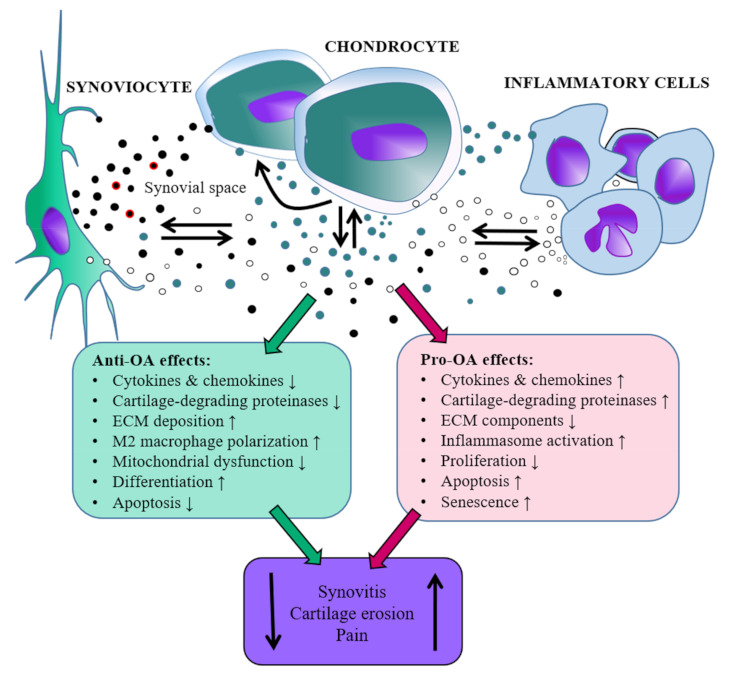
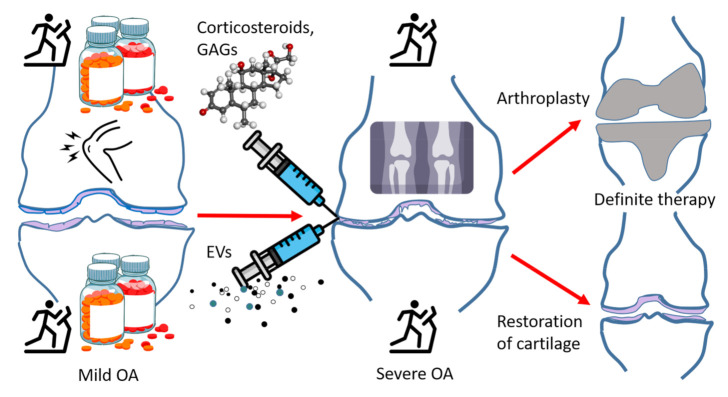
Osteoarthritis (OA) is a chronic joint disease characterized by inflammation, gradual destruction of articular cartilage, joint pain, and functional limitations that eventually lead to disability. Join tissues, including synovium and articular cartilage, release extracellular vesicles (EVs) that have been proposed to sustain joint homeostasis as well as to contribute to OA pathogenesis. EVs transport biologically active molecules, and OA can be characterized by altered EV counts and composition in synovial fluid. Of EV cargo, specific non-coding RNAs could have future potential as diagnostic biomarkers for early OA. EVs may contribute to the propagation of inflammation and cartilage destruction by transporting and enhancing the production of inflammatory mediators and cartilage-degrading proteinases. In addition to inducing OA-related gene expression patterns in synoviocytes and articular chondrocytes, EVs can induce anti-OA effects, including increased extracellular matrix deposition and cartilage protection. Especially mesenchymal stem cell-derived EVs can alleviate intra-articular inflammation and relieve OA pain. In addition, surgically- or chemically-induced cartilage defects have been repaired with EV therapies in animal models. While human clinical trials are still in the future, the potential of actual cures to OA by EV products is very promising.
骨关节炎(OA)是一种慢性关节疾病,其特征为炎症、关节软骨逐渐破坏、关节疼痛以及最终导致残疾的功能受限。包括滑膜和关节软骨在内的关节组织会释放细胞外囊泡(EVs),这些囊泡被认为有助于维持关节稳态以及参与骨关节炎的发病机制。细胞外囊泡运输生物活性分子,骨关节炎的特征可能是滑液中细胞外囊泡数量和组成的改变。在细胞外囊泡的货物中,特定的非编码RNA未来可能具有作为早期骨关节炎诊断生物标志物的潜力。细胞外囊泡可能通过运输和增强炎症介质及软骨降解蛋白酶的产生,促进炎症传播和软骨破坏。除了在滑膜细胞和关节软骨细胞中诱导骨关节炎相关的基因表达模式外,细胞外囊泡还可诱导抗骨关节炎作用,包括增加细胞外基质沉积和保护软骨。特别是间充质干细胞衍生的细胞外囊泡可以减轻关节内炎症并缓解骨关节炎疼痛。此外,在动物模型中,已通过细胞外囊泡疗法修复了手术或化学诱导的软骨缺损。虽然人类临床试验尚在未来,但细胞外囊泡产品实际治愈骨关节炎的潜力非常可观。