Safadi Rifaat, Khoury Tawfik, Saed Nizar, Hakim Marwan, Jamalia Jeryes, Nijim Yousef, Farah Nicola, Nuser Tawfik, Natur Nidaa, Mahamid Mahmud, Amer Johnny, Roppert Pia L, Gerlich Wolfram H, Glebe Dieter
Liver Unit, Institute of Gastroenterology, Hadassah-Hebrew University Hospital, Jerusalem 91120, Israel.
Liver Unit, Holy Family Hospital, Nazareth 1613101, Israel.
Vaccines (Basel). 2021 Apr 1;9(4):331. doi: 10.3390/vaccines9040331.
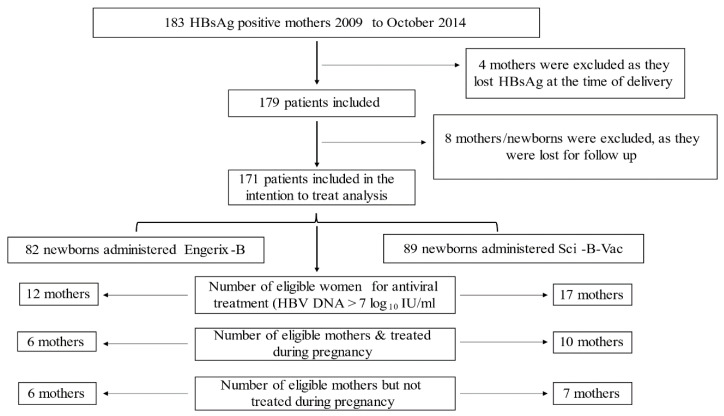
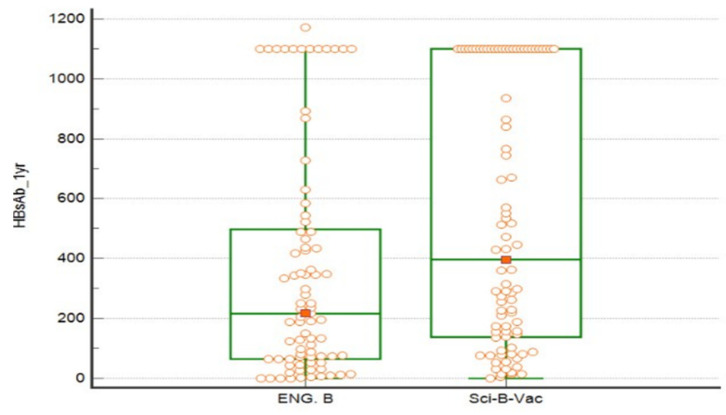
Peripartum transmission of hepatitis B virus (HBV) from an infected mother to the child can be prevented in most but not all cases by immediate vaccination of the newborn. The aim of this study was to compare the efficacy of two licensed hepatitis B vaccines, Engerix-B versus Sci-B-Vac, in preventing peripartum HBV transmission. A prospective multicenter randomized controlled study in 4 delivery centers was performed from 2009 to 2014. HBsAg positive pregnant women and their newborns were recruited at the delivery rooms. All newborns received Hepatitis B Immune Globulin within 10 h after birth, as well as active HBV vaccination at 0, 1 and 6 months of age. Maternal assessment at delivery included transaminases, blood count, international normalized ratio and viral status. Infants were tested for HBsAg, anti-HBc and anti-HBs at 12 months of age. In the intention to treat (ITT), 171 infant and mother pairs fulfilled the study enrollment criteria and completed follow up, 82 received Engerix-B and 89 Sci-B-Vac. Maternal parameters and viral status were similar in both groups. At 12 months of age, the Sci-B-Vac group had lower HBsAg carriage rates (1/89, 1.1%) than the Engerix-B group (5/82, 6.1%) with borderline significance (risk difference of -0.05, 95% CI -0.11-0.007, -test = 0.05), and borderline significance lower vaccine failure rates with anti-HBs < 10 mIU/mL in the Sci-B-Vac (2/89, 2.2%) than in the Engerix-B (8/82, 9.8%, = 0.05). Higher seroprotection rates were found in the Sci-B-Vac group with all anti-HBs titer stratifications of >10 mIU/mL ( = 0.05), >100 mIU/mL ( = 0.05) and >1000 mIU/mL ( = 0.01). Active/passive vaccination was effective in 10/13 cases with maternal HBV DNA levels > 7 log10 IU/mL up to 9.5 log10 IU/mL, but failed in 3 cases for unknown reasons. Sci-B-Vac was superior to Engerix-B in preventing peripartum HBV transmission in neonates from HBsAg+ mothers and induces significantly higher anti-HBs levels. NIH registration number: NCT01133184.
在大多数(但并非所有)情况下,通过对新生儿立即接种疫苗可预防乙型肝炎病毒(HBV)在围产期从感染母亲传播给孩子。本研究的目的是比较两种已获许可的乙肝疫苗(安在时乙肝疫苗与 Sci - B - Vac 疫苗)在预防围产期 HBV 传播方面的疗效。2009 年至 2014 年在 4 个分娩中心进行了一项前瞻性多中心随机对照研究。在产房招募 HBsAg 阳性孕妇及其新生儿。所有新生儿在出生后 10 小时内接受乙肝免疫球蛋白,以及在 0、1 和 6 月龄时进行 HBV 主动疫苗接种。分娩时对母亲的评估包括转氨酶、血细胞计数、国际标准化比值和病毒状态。在婴儿 12 月龄时检测其 HBsAg、抗 - HBc 和抗 - HBs。在意向性分析(ITT)中,171 对母婴符合研究纳入标准并完成随访,82 对接受安在时乙肝疫苗,89 对接受 Sci - B - Vac 疫苗。两组母亲的参数和病毒状态相似。在 12 月龄时,Sci - B - Vac 组的 HBsAg 携带率(1/89,1.1%)低于安在时乙肝疫苗组(5/82,6.1%),具有临界显著性(风险差异为 -0.05,95%可信区间 -0.11 - 0.007,P 值 = 0.05),并且 Sci - B - Vac 组抗 - HBs < 10 mIU/mL 的疫苗失败率临界显著性低于安在时乙肝疫苗组(2/89,2.2% 对比 8/82,9.8%,P 值 = 0.05)。在 Sci - B - Vac 组中,所有抗 - HBs 滴度分层 >10 mIU/mL(P 值 = 0.05)、>100 mIU/mL(P 值 = 0.05)和 >1000 mIU/mL(P 值 = 0.01)时,血清保护率更高。主动/被动疫苗接种在 13 例母亲 HBV DNA 水平 > 7 log10 IU/mL 至 9.5 log10 IU/mL 的病例中有 10 例有效,但有 3 例原因不明失败。在预防 HBsAg 阳性母亲的新生儿围产期 HBV 传播方面,Sci - B - Vac 优于安在时乙肝疫苗,并诱导产生显著更高的抗 - HBs 水平。美国国立医学图书馆(NIH)注册号:NCT01133184。