Microbiology, Universidad de Buenos Aires. Facultad de Farmacia y Bioquímica. Instituto de Investigaciones en Bacteriología y Virología Molecular, Buenos Aires C1113AAD, Argentina.
Consejo Nacional de Investigaciones Científicas y Técnicas, Buenos Aires C1425FQB, Argentina.
World J Gastroenterol. 2022 Aug 21;28(31):4249-4262. doi: 10.3748/wjg.v28.i31.4249.
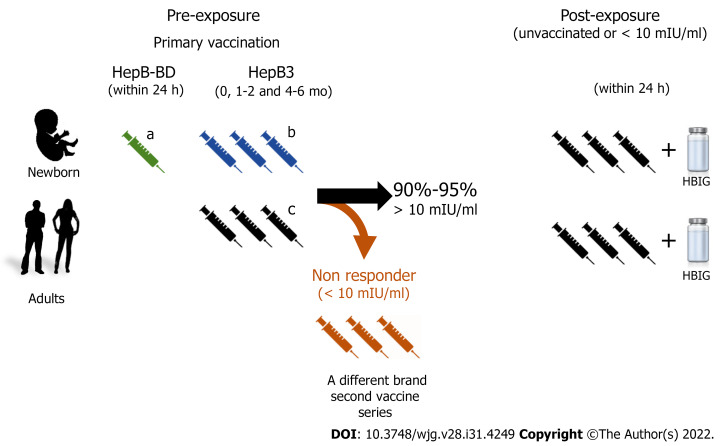
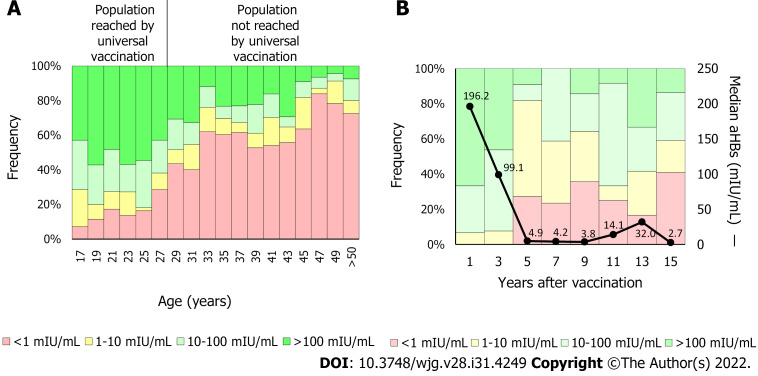
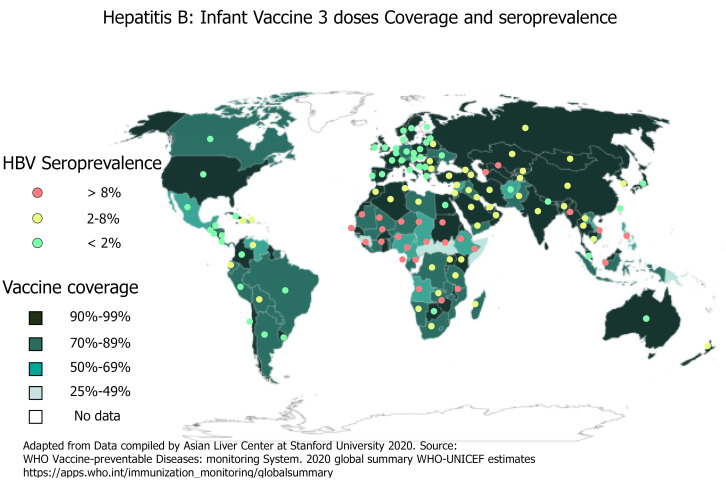
After more than four decades of hepatitis B virus (HBV) vaccine implementation, its safety and efficacy in preventing HBV infection have been proven and several milestones have been achieved. Most countries have included HBV immunization schedules in their health policies and progress has been made regarding universalization of the first HBV vaccine dose at birth. All of these actions have significantly contributed to reducing both the incidence of HBV infection and its related complications. However, there are still many drawbacks to overcome. The main concerns are the deficient coverage rate of the dose at birth and the large adult population that has not been reached timely by universal immunization. Additionally, the current most widely used second-generation vaccines do not induce protective immunity in 5% to 10% of the population, particularly in people over 40-years-old, obese (body mass index > 25 kg/m), heavy smokers, and patients undergoing dialysis or infection with human immunodeficiency virus. Recently developed and approved novel vaccine formulations using more potent adjuvants or multiple antigens have shown better performance, particularly in difficult settings. These advances re-launch the expectations of achieving the World Health Organization's objective of completing hepatitis control by 2030.
经过四十多年的乙型肝炎病毒 (HBV) 疫苗实施,其预防 HBV 感染的安全性和有效性已得到证实,并取得了几项里程碑式的进展。大多数国家已将 HBV 免疫计划纳入其卫生政策,并在普及出生时第一剂 HBV 疫苗方面取得了进展。所有这些行动都为降低 HBV 感染的发生率及其相关并发症做出了重大贡献。然而,仍有许多缺点需要克服。主要关注点是出生时剂量的覆盖率不足,以及大量成年人未能及时通过普遍免疫接种得到覆盖。此外,目前使用最广泛的第二代疫苗不能在 5%至 10%的人群中诱导保护性免疫,特别是在 40 岁以上的人群、肥胖者(体重指数 > 25 kg/m)、重度吸烟者以及接受透析或感染人类免疫缺陷病毒的人群中。最近开发并批准的使用更有效的佐剂或多种抗原的新型疫苗配方显示出更好的效果,特别是在困难的环境中。这些进展重新燃起了在 2030 年实现世界卫生组织控制肝炎目标的期望。