JC School of Public Health and Primary Care, Chinese University of Hong Kong, Shatin, N.T., Hong Kong, China.
CUHK Shenzhen Research Institute, Shenzhen 518000, China.
Viruses. 2021 Apr 4;13(4):619. doi: 10.3390/v13040619.
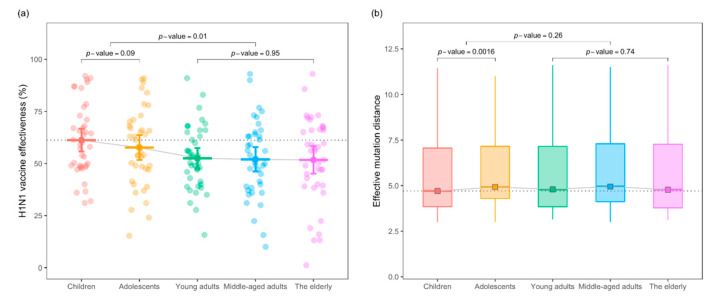
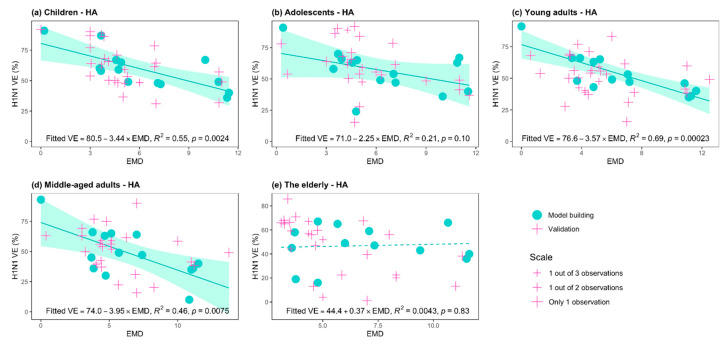
Assessment of influenza vaccine effectiveness (VE) and identification of relevant influencing factors are the current priorities for optimizing vaccines to reduce the impacts of influenza. To date, how the difference between epidemic strains and vaccine strains at genetic scale affects age-specific vaccine performance remains ambiguous. This study investigated the association between genetic mismatch on hemagglutinin and neuraminidase genes and A(H1N1)pdm09 VE in different age groups with a novel computational approach. We found significant linear relationships between VE and genetic mismatch in children, young adults, and middle-aged adults. In the children's group, each 3-key amino acid mutation was associated with an average of 10% decrease in vaccine effectiveness in a given epidemic season, and genetic mismatch exerted no influence on VE for the elderly group. We demonstrated that present vaccines were most effective for children, while protection for the elderly was reduced and indifferent to vaccine component updates. Modeling such relationships is practical to inform timely evaluation of VE in different groups of populations during mass vaccination and may inform age-specific vaccination regimens.
评估流感疫苗的有效性 (VE) 并确定相关影响因素是优化疫苗以减轻流感影响的当前重点。迄今为止,遗传水平上流行株与疫苗株之间的差异如何影响特定年龄组的疫苗性能仍不清楚。本研究采用新的计算方法,研究了血凝素和神经氨酸酶基因的遗传错配与不同年龄组的 A(H1N1)pdm09 VE 之间的关系。我们发现 VE 与儿童、青年和中年人群中基因错配之间存在显著的线性关系。在儿童组中,在给定的流行季节中,每 3 个关键氨基酸突变与疫苗效力平均降低 10%相关,而遗传错配对老年组的 VE 没有影响。我们证明,目前的疫苗对儿童最有效,而对老年人的保护作用降低且不受疫苗成分更新的影响。对这种关系进行建模对于在大规模接种疫苗期间及时评估不同人群的 VE 是实用的,并且可以为特定年龄的疫苗接种方案提供信息。