Zeppegno Patrizia, Krengli Marco, Ferrante Daniela, Bagnati Marco, Burgio Vincenzo, Farruggio Serena, Rolla Roberta, Gramaglia Carla, Grossini Elena
Psychiatry Institute, Department of Translational Medicine, University of "Piemonte Orientale" and University Hospital "Maggiore della Carità", Via Solaroli 17, 28100 Novara, Italy.
Radiation Oncology Division, Department of Translational Medicine, University of "Piemonte Orientale" and University Hospital "Maggiore della Carità", Via Solaroli 17, 28100 Novara, Italy.
Cancers (Basel). 2021 Apr 7;13(8):1752. doi: 10.3390/cancers13081752.
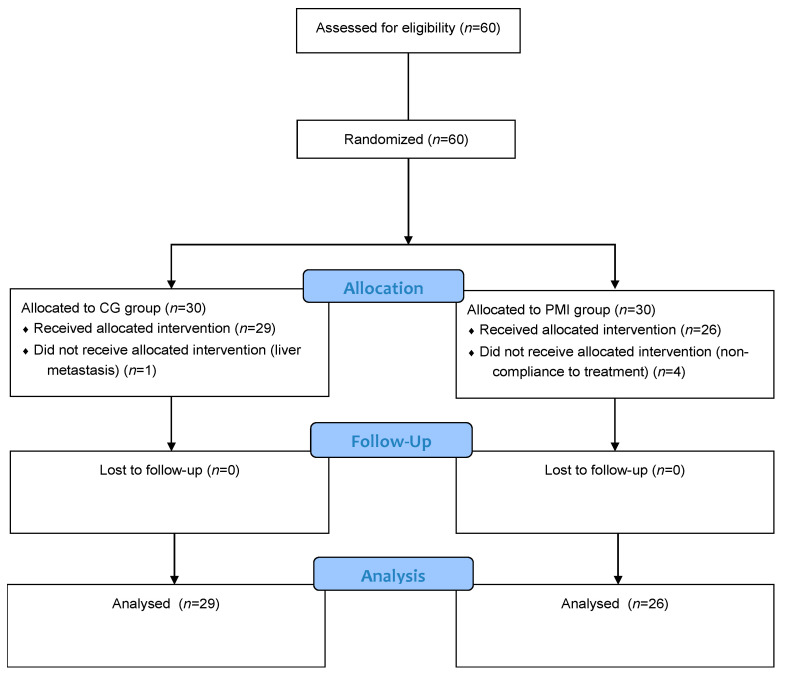
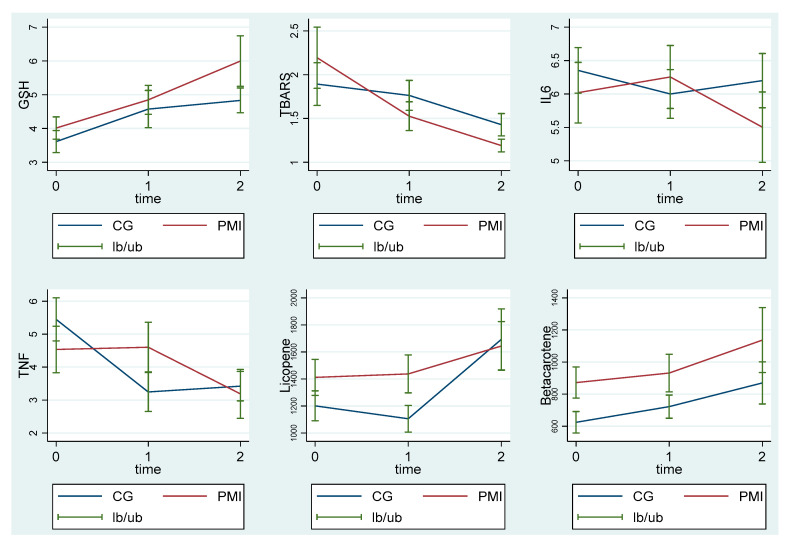
The aim of this study was to assess the effects of psychotherapy with music intervention (PMI) on anxiety, depression, redox status, and inflammation in breast cancer patients undergoing radiotherapy (RT). This monocentric randomized clinical trial recruited 60 patients who had a breast cancer operation and were undergoing postoperative RT. Eligible patients were randomized (1:1) in two groups: the control group (CG) received treatment as usual ( = 30), i.e., RT alone; the intervention group (PMI) received RT and psychotherapy with music intervention ( = 30), which was delivered in a group setting. Five patients were excluded after randomization. Assessments were performed at baseline (T0), at the end of RT (T1), and three months after the end of RT (T2). The main objectives of the study were the assessment of anxiety/depression, plasma glutathione (GSH), and thiobarbituric acid reactive substances (TBARS) in the two arms of the study. Our findings revealed a positive effect of PMI on anxiety, depression, resilience, and quality of life. Furthermore, a positive effect of PMI on redox status was found for the first time. Thus, in the PMI group, we found a significant increase of GSH (mean change 2.2 95%, CI 0.7 to 3.7) and a significant reduction of TBARS (mean change -1.1 95%, CI -1.8 to -0.3) at T2 vs. T0.
本研究旨在评估音乐干预心理治疗(PMI)对接受放射治疗(RT)的乳腺癌患者的焦虑、抑郁、氧化还原状态和炎症的影响。这项单中心随机临床试验招募了60名接受过乳腺癌手术且正在接受术后放疗的患者。符合条件的患者被随机(1:1)分为两组:对照组(CG)接受常规治疗(n = 30),即仅接受放疗;干预组(PMI)接受放疗和音乐干预心理治疗(n = 30),以小组形式进行。随机分组后排除了5名患者。在基线(T0)、放疗结束时(T1)以及放疗结束后三个月(T2)进行评估。本研究的主要目的是评估研究两组中的焦虑/抑郁、血浆谷胱甘肽(GSH)和硫代巴比妥酸反应性物质(TBARS)。我们的研究结果显示PMI对焦虑、抑郁、恢复力和生活质量有积极影响。此外,首次发现PMI对氧化还原状态有积极影响。因此,在PMI组中,与T0相比,T2时GSH显著增加(平均变化2.2,95%CI 0.7至3.7),TBARS显著降低(平均变化-1.1,95%CI -1.8至-0.3)。