Department of Orthopedic Surgery, Friedrich-Alexander-Universität (FAU) Erlangen-Nürnberg, Rathsberger Str. 57, 91054 Erlangen, Germany.
Center for Musculoskeletal Surgery Osnabrück (OZMC), Klinikum Osnabrück, Am Finkenhügel 1, 49076 Osnabrück, Germany.
Int J Environ Res Public Health. 2021 Apr 6;18(7):3798. doi: 10.3390/ijerph18073798.
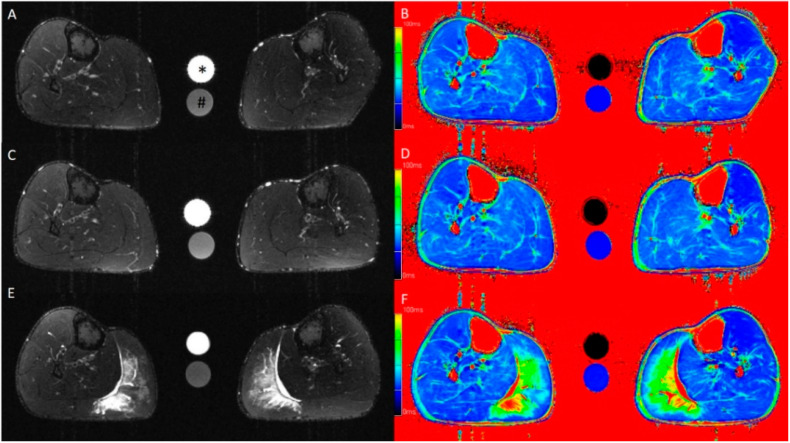
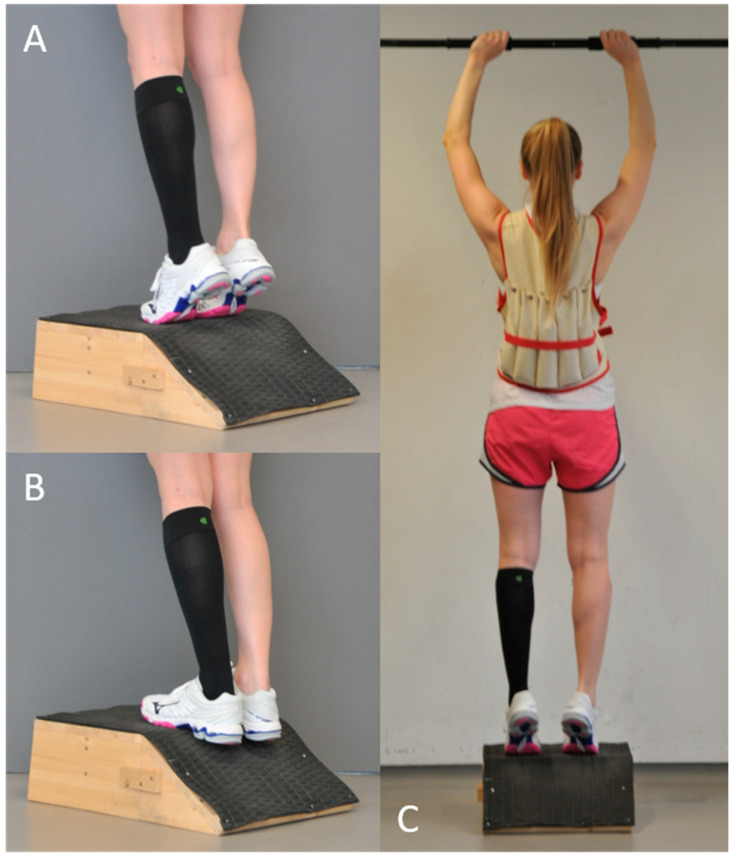
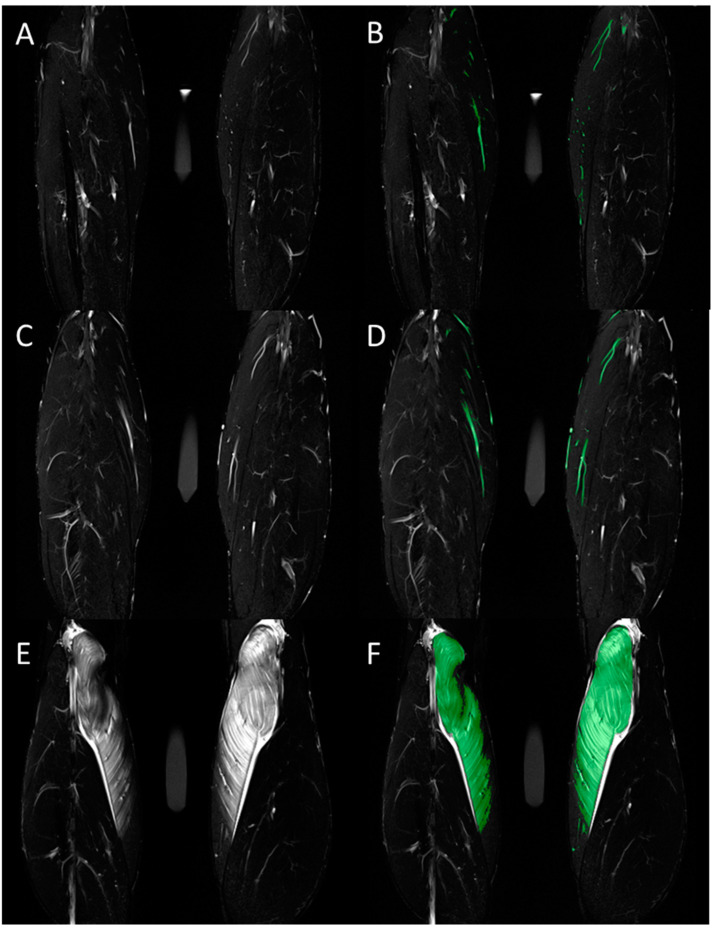
To investigate below-knee compression garments during exercise and a post-exercise period of 6 h on clinical, functional, and morphological outcomes in delayed-onset muscle soreness (DOMS). Eighteen volunteers (age: 24.1 ± 3.6, BMI 22.7 ± 2.7 kg/m) were enrolled. Measures were acquired at baseline, 6 h, and 48 h after eccentric and plyometric exercise, with wearing a compression garment (21-22 mmHg) on a calf during and for the first 6 h after exercise. 3T MRI was performed for quantification of intramuscular edema (T2 signal intensity (SI), T2 time, and manual volume segmentation); jump height, calf circumference, ankle dorsiflexion (DF), creatine kinase (CK), and muscle soreness were assessed. DOMS was confirmed in all participants after 48 h, with an increase in soreness ( < 0.001) and CK ( = 0.001), decrease in jump height ( < 0.01), and the presence of intramuscular edema ( < 0.01) in both the compressed and non-compressed limbs. No differences between the compressed and non-compressed limbs were observed for muscle soreness and jump height. MRI T2 SI, T2 time, soreness, and manual segmentation revealed no effect of the compression treatment. The assessment of calf circumference and DF showed no changes in either the compression or non-compression limb ( = 1.0). Wearing compression garments during combined eccentric and plyometric exercise and for 6 h post-exercise has no effect on clinical signs of DOMS, jump performance, or the development of intramuscular edema.
研究在运动中和运动后 6 小时穿着小腿压缩服对延迟性肌肉酸痛(DOMS)的临床、功能和形态学结果的影响。18 名志愿者(年龄:24.1 ± 3.6,BMI 22.7 ± 2.7 kg/m)参与了这项研究。在进行离心和增强式运动后 6 小时和 48 小时,以及在运动中和运动后 6 小时内穿着压缩服(21-22 mmHg)对小腿进行测量。使用 3T MRI 对肌肉内水肿(T2 信号强度(SI)、T2 时间和手动体积分割)进行定量评估;评估跳跃高度、小腿围、踝关节背屈(DF)、肌酸激酶(CK)和肌肉酸痛。所有参与者在 48 小时后均确认出现 DOMS,疼痛(< 0.001)和 CK(= 0.001)增加,跳跃高度(< 0.01)降低,并且在受压和未受压的肢体中均存在肌肉内水肿(< 0.01)。在肌肉酸痛和跳跃高度方面,受压和未受压肢体之间没有差异。MRI T2 SI、T2 时间、疼痛和手动分割显示压缩治疗没有效果。对小腿围和 DF 的评估显示,无论是在受压还是未受压的肢体中都没有变化(= 1.0)。在离心和增强式运动中和运动后 6 小时内穿着小腿压缩服对 DOMS 的临床体征、跳跃性能或肌肉内水肿的发展没有影响。