Noce Annalisa, Albanese Maria, Marrone Giulia, Di Lauro Manuela, Pietroboni Zaitseva Anna, Palazzetti Daniela, Guerriero Cristina, Paolino Agostino, Pizzenti Giuseppa, Di Daniele Francesca, Romani Annalisa, D'Agostini Cartesio, Magrini Andrea, Mercuri Nicola Biagio, Di Daniele Nicola
UOC of Internal Medicine-Center of Hypertension and Nephrology Unit, Department of Systems Medicine, University of Rome Tor Vergata, 00133 Rome, Italy.
Neurology Unit, Department of Systems Medicine, University of Rome Tor Vergata, 00133 Rome, Italy.
Pharmaceuticals (Basel). 2021 Apr 6;14(4):336. doi: 10.3390/ph14040336.
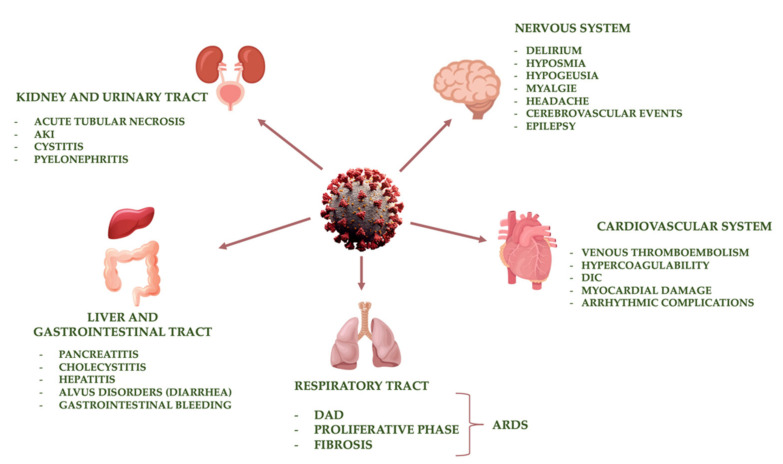
The Coronavirus Disease-19 (COVID-19) pandemic has caused more than 100,000,000 cases of coronavirus infection in the world in just a year, of which there were 2 million deaths. Its clinical picture is characterized by pulmonary involvement that culminates, in the most severe cases, in acute respiratory distress syndrome (ARDS). However, COVID-19 affects other organs and systems, including cardiovascular, urinary, gastrointestinal, and nervous systems. Currently, unique-drug therapy is not supported by international guidelines. In this context, it is important to resort to adjuvant therapies in combination with traditional pharmacological treatments. Among natural bioactive compounds, palmitoylethanolamide (PEA) seems to have potentially beneficial effects. In fact, the Food and Drug Administration (FDA) authorized an ongoing clinical trial with ultramicronized (um)-PEA as an add-on therapy in the treatment of Severe Acute Respiratory Syndrome Coronavirus-2 (SARS-CoV-2) infection. In support of this hypothesis, in vitro and in vivo studies have highlighted the immunomodulatory, anti-inflammatory, neuroprotective and pain-relieving effects of PEA, especially in its um form. The purpose of this review is to highlight the potential use of um-PEA as an adjuvant treatment in SARS-CoV-2 infection.
新型冠状病毒肺炎(COVID-19)大流行在短短一年内已在全球造成超过1亿例冠状病毒感染病例,其中有200万人死亡。其临床表现以肺部受累为特征,在最严重的病例中,最终会发展为急性呼吸窘迫综合征(ARDS)。然而,COVID-19会影响其他器官和系统,包括心血管、泌尿、胃肠和神经系统。目前,国际指南不支持单一药物治疗。在这种情况下,采用辅助疗法结合传统药物治疗很重要。在天然生物活性化合物中,棕榈酰乙醇胺(PEA)似乎具有潜在的有益作用。事实上,美国食品药品监督管理局(FDA)批准了一项正在进行的临床试验,将超微粒化(um)-PEA作为严重急性呼吸综合征冠状病毒2(SARS-CoV-2)感染治疗的附加疗法。为支持这一假设,体外和体内研究突出了PEA的免疫调节、抗炎、神经保护和止痛作用,尤其是其um形式。本综述的目的是强调um-PEA作为SARS-CoV-2感染辅助治疗的潜在用途。