Augustus Elien, Zwaenepoel Karen, Siozopoulou Vasiliki, Raskin Jo, Jordaens Stephanie, Baggerman Geert, Sorber Laure, Roeyen Geert, Peeters Marc, Pauwels Patrick
Center for Oncological Research Antwerp (CORE), Integrated Personalized & Precision Oncology Network (IPPON), University of Antwerp (UAntwerp), 2610 Wilrijk, Belgium.
Laboratory of Pathological Anatomy, Antwerp University Hospital (UZA), 2650 Edegem, Belgium.
Cancers (Basel). 2021 Apr 2;13(7):1675. doi: 10.3390/cancers13071675.
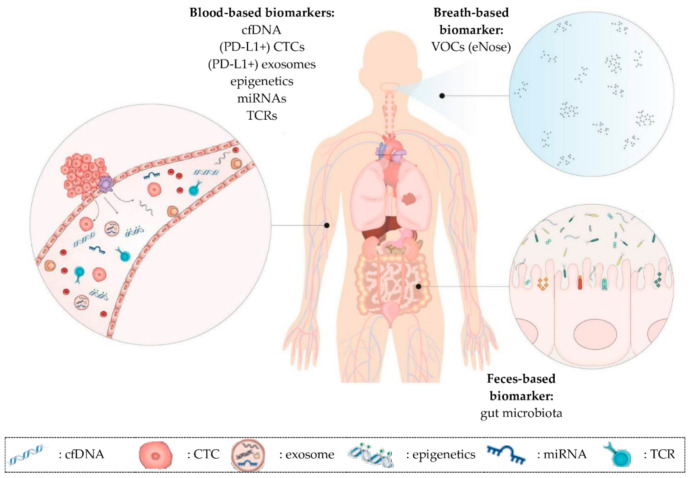
In the last decade, immunotherapy has been one of the most important advances in the non-small cell lung cancer (NSCLC) treatment landscape. Nevertheless, only a subset of NSCLC patients benefits from it. Currently, the only Food and Drug Administration (FDA) approved diagnostic test for first-line immunotherapy in metastatic NSCLC patients uses tissue biopsies to determine the programmed death ligand 1 (PD-L1) status. However, obtaining tumor tissue is not always feasible and puts the patient at risk. Liquid biopsy, which refers to the tumor-derived material present in body fluids, offers an alternative approach. This less invasive technique gives real-time information on the tumor characteristics. This review addresses different promising liquid biopsy based biomarkers in NSCLC patients that enable the selection of patients who benefit from immunotherapy and the monitoring of patients during this therapy. The challenges and the opportunities of blood-based biomarkers such as cell-free DNA (cfDNA), circulating tumor cells (CTCs), exosomes, epigenetic signatures, microRNAs (miRNAs) and the T cell repertoire will be addressed. This review also focuses on the less-studied feces-based and breath-based biomarkers.
在过去十年中,免疫疗法一直是非小细胞肺癌(NSCLC)治疗领域最重要的进展之一。然而,只有一部分NSCLC患者能从中受益。目前,美国食品药品监督管理局(FDA)唯一批准的用于转移性NSCLC患者一线免疫疗法的诊断测试是通过组织活检来确定程序性死亡配体1(PD-L1)状态。然而,获取肿瘤组织并非总是可行的,而且会使患者面临风险。液体活检是指存在于体液中的肿瘤衍生物质,它提供了一种替代方法。这种侵入性较小的技术能提供有关肿瘤特征的实时信息。本综述探讨了NSCLC患者中不同的基于液体活检的有前景的生物标志物,这些标志物能够筛选出能从免疫疗法中受益的患者,并在治疗期间对患者进行监测。还将探讨基于血液的生物标志物(如游离DNA(cfDNA)、循环肿瘤细胞(CTC)、外泌体、表观遗传特征、微小RNA(miRNA)和T细胞库)所面临的挑战和机遇。本综述还关注研究较少的基于粪便和基于呼吸的生物标志物。