Tiriveedhi Venkataswarup, Ivy Michael T, Myles Elbert L, Zent Roy, Rathmell Jeffrey C, Titze Jens
Department of Biological Sciences, Tennessee State University, 3500 John A Merritt Blvd, Nashville, TN 37209, USA.
Division of Pharmacology, Vanderbilt University, Nashville, TN 37212, USA.
Cancers (Basel). 2021 Apr 2;13(7):1690. doi: 10.3390/cancers13071690.
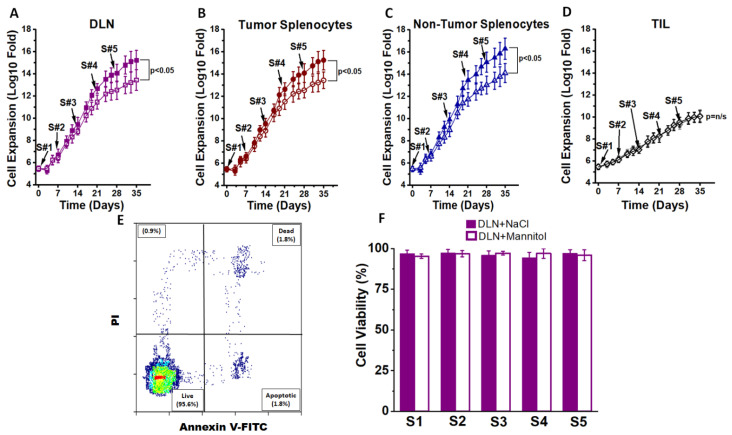
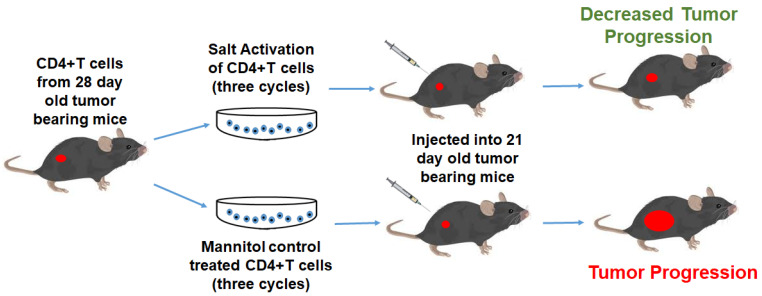
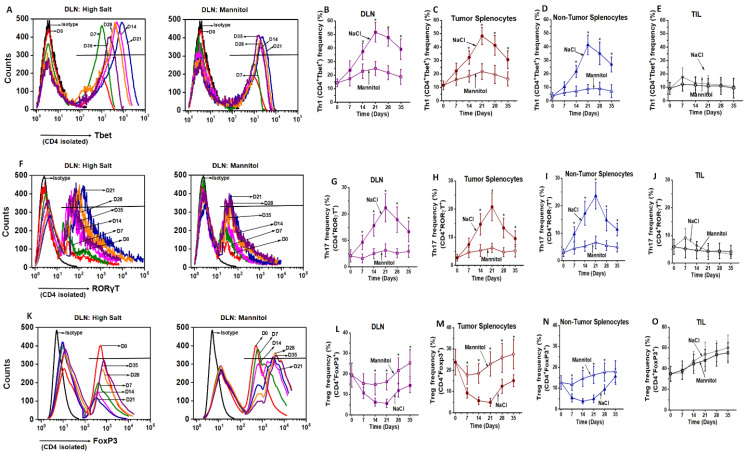
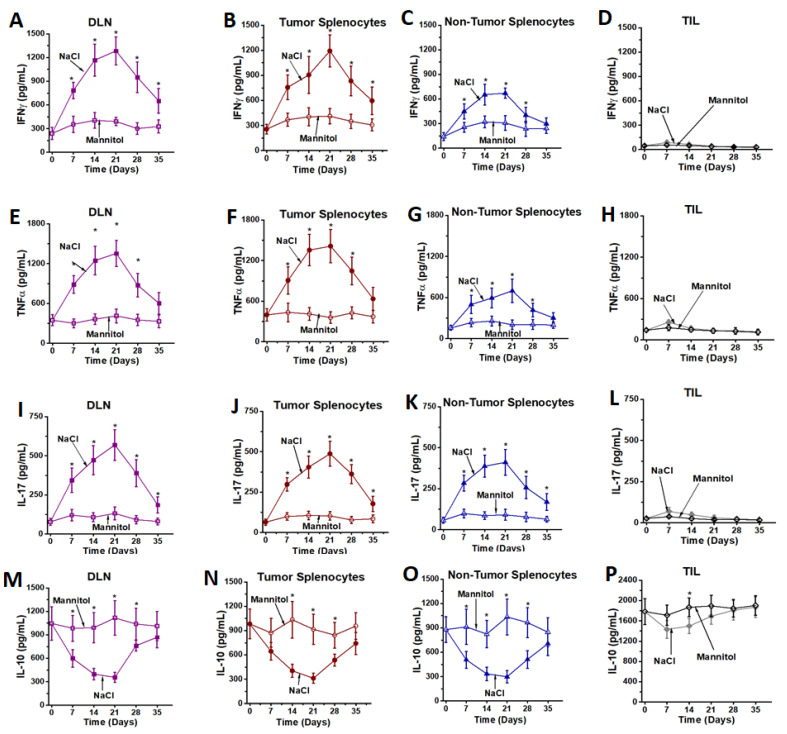
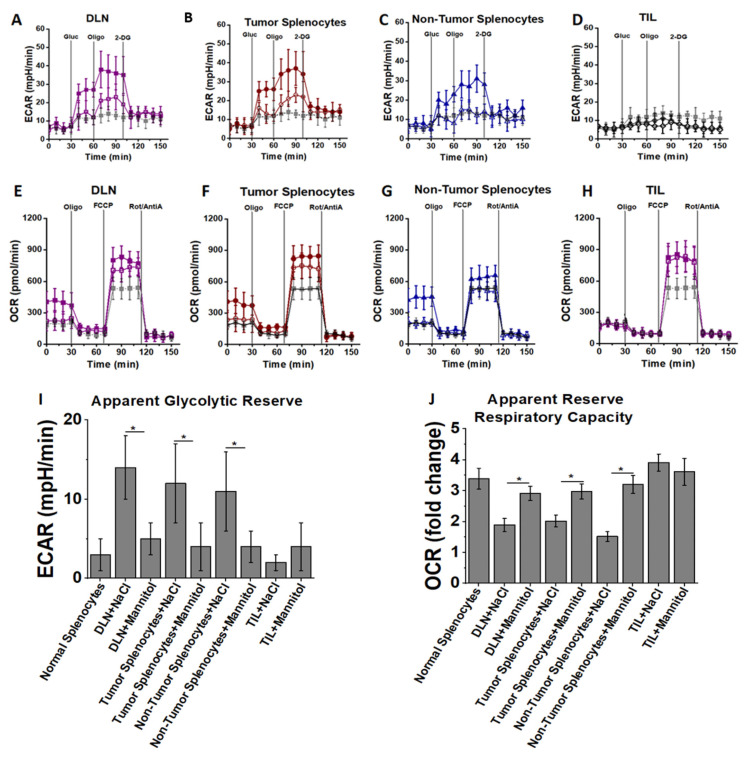
Cell based immunotherapy is rapidly emerging as a promising cancer treatment. A modest increase in salt (sodium chloride) concentration in immune cell cultures is known to induce inflammatory phenotypic differentiation. In our current study, we analyzed the ability of salt treatment to induce ex vivo expansion of tumor-primed CD4 (cluster of differentiation 4)+T cells to an effector phenotype. CD4+T cells were isolated using immunomagnetic beads from draining lymph nodes and spleens from tumor bearing C57Bl/6 mice, 28 days post-injection of Py230 syngeneic breast cancer cells. CD4+T cells from non-tumor bearing mice were isolated from splenocytes of 12-week-old C57Bl/6 mice. These CD4+T cells were expanded ex vivo with five stimulation cycles, and each cycle comprised of treatment with high salt (Δ0.035 M NaCl) or equimolar mannitol controls along with anti-CD3/CD28 monoclonal antibodies for the first 3 days, followed by the addition of interleukin (IL)-2/IL-7 cytokines and heat killed Py230 for 4 days. Ex vivo high salt treatment induced a two-fold higher Th1 (T helper type 1) expansion and four-fold higher Th17 expansion compared to equimolar mannitol treatment. Importantly, the high salt expanded CD4+T cells retained tumor-specificity, as demonstrated by higher in vitro cytotoxicity against Py230 breast cancer cells and reduced in vivo syngeneic tumor growth. Metabolic studies revealed that high salt treatment enhanced the glycolytic reserve and basal mitochondrial oxidation of CD4+T cells, suggesting a role of high salt in enhanced pro-growth anabolic metabolism needed for inflammatory differentiation. Mechanistic studies demonstrated that the high salt induced switch to the effector phenotype was mediated by tonicity-dependent transcription factor, TonEBP/NFAT5. Using a transgenic murine model, we demonstrated that CD4 specific TonEBP/NFAT5 knock out (CD4NFAT5) abrogated the induction of the effector phenotype and anti-tumor efficiency of CD4+T cells following high salt treatment. Taken together, our data suggest that high salt-mediated ex vivo expansion of tumor-primed CD4+T cells could induce effective tumor specific anti-cancer responses, which may have a novel cell-based cancer immunotherapeutic application.
基于细胞的免疫疗法正迅速成为一种有前景的癌症治疗方法。已知免疫细胞培养物中盐(氯化钠)浓度适度增加会诱导炎症表型分化。在我们当前的研究中,我们分析了盐处理诱导肿瘤致敏的CD4(分化簇4)+T细胞离体扩增为效应细胞表型的能力。使用免疫磁珠从接种Py230同基因乳腺癌细胞28天后的荷瘤C57Bl/6小鼠的引流淋巴结和脾脏中分离CD4+T细胞。从12周龄C57Bl/6小鼠的脾细胞中分离未荷瘤小鼠的CD4+T细胞。这些CD4+T细胞通过五个刺激周期进行离体扩增,每个周期包括在前3天用高盐(Δ0.035 M NaCl)或等摩尔甘露醇对照以及抗CD3/CD28单克隆抗体处理,随后添加白细胞介素(IL)-2/IL-7细胞因子和热灭活的Py230处理4天。与等摩尔甘露醇处理相比,离体高盐处理诱导的Th1(1型辅助性T细胞)扩增高出两倍,Th17扩增高出四倍。重要的是,高盐扩增的CD4+T细胞保留了肿瘤特异性,这通过对Py230乳腺癌细胞更高的体外细胞毒性和体内同基因肿瘤生长减少得以证明。代谢研究表明,高盐处理增强了CD4+T细胞的糖酵解储备和基础线粒体氧化,表明高盐在炎症分化所需的增强的促生长合成代谢中起作用。机制研究表明,高盐诱导的向效应细胞表型的转变由渗透压依赖性转录因子TonEBP/NFAT5介导。使用转基因小鼠模型,我们证明CD4特异性TonEBP/NFAT5敲除(CD4NFAT5)消除了高盐处理后CD4+T细胞效应细胞表型的诱导和抗肿瘤效率。综上所述,我们的数据表明,高盐介导的肿瘤致敏CD4+T细胞离体扩增可诱导有效的肿瘤特异性抗癌反应,这可能具有基于细胞的新型癌症免疫治疗应用。