Department of Sciences, Lafayette High School, Wildwood, MO 63011, USA.
Department of Biological Sciences, Tennessee State University, 3500 John A Merritt Blvd, Nashville, TN 37209, USA.
Cells. 2021 May 21;10(6):1285. doi: 10.3390/cells10061285.
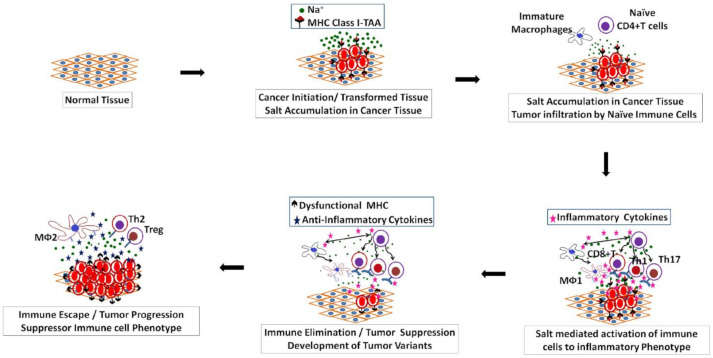
High-salt (sodium chloride) diets have been strongly associated with disease states and poor health outcomes. Traditionally, the impact of salt intake is primarily studied in cardiovascular diseases, hypertension and renal diseases; however, recently there has been increasing evidence demonstrating the role of salt in autoimmune diseases. Salt has been shown to modulate the inflammatory activation of immune cells leading to chronic inflammation-related ailments. To date, there is minimal evidence showing a direct correlation of salt with cancer incidence and/or cancer-related adverse clinical outcomes. In this review article, we will discuss the recent understanding of the molecular role of salt, and elucidate the apparent double-edged sword nature of the relationship between salt and cancer progression.
高盐(氯化钠)饮食与疾病状态和健康不良结局密切相关。传统上,盐摄入量的影响主要在心血管疾病、高血压和肾脏疾病中进行研究;然而,最近越来越多的证据表明盐在自身免疫性疾病中的作用。盐已被证明可调节免疫细胞的炎症激活,导致慢性炎症相关疾病。迄今为止,仅有很少的证据表明盐与癌症发病率和/或癌症相关不良临床结局之间存在直接相关性。在这篇综述文章中,我们将讨论盐的分子作用的最新理解,并阐明盐与癌症进展之间明显的双刃剑关系。