Ali Md Emran, Gunn Mackenzie, Stackhouse Tammy, Waliullah Sumyya, Guo Baozhu, Culbreath Albert, Brenneman Timothy
Department of Plant Pathology, University of Georgia, Tifton, GA 31793, USA.
USDA-ARS, Crop Genetics and Breeding Research Unit, Tifton, GA 31793, USA.
J Fungi (Basel). 2021 Apr 9;7(4):284. doi: 10.3390/jof7040284.
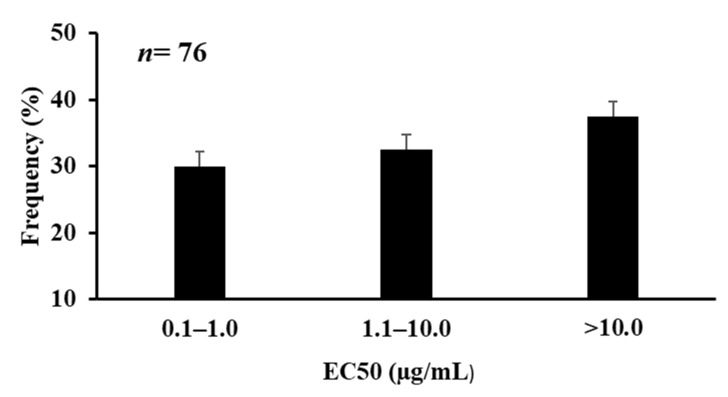
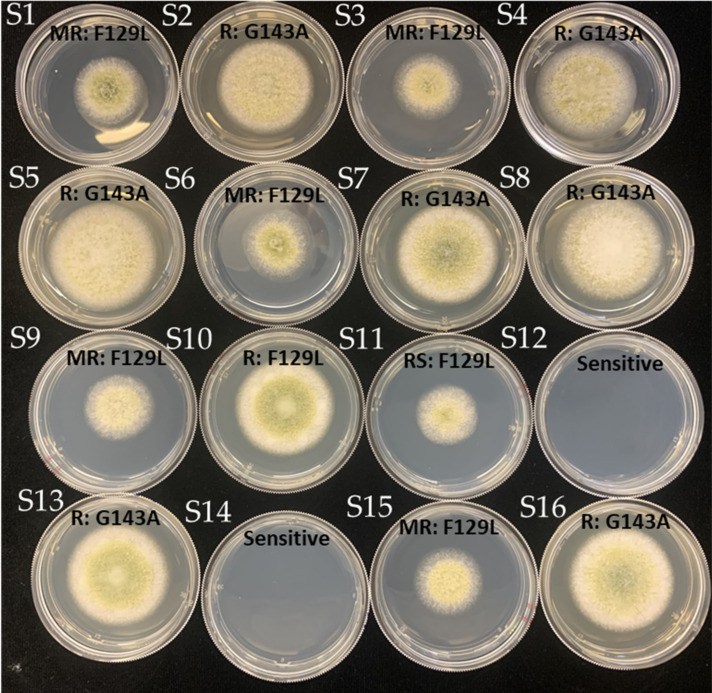
infects peanuts and produces a mycotoxin called aflatoxin, a potent human carcinogen. In infected peanuts, it can also affect peanut seed quality by causing seed rot and reducing seed viability, resulting in low germination. In 2020, peanut seeds in Georgia had lower than expected germination and a high frequency of contamination. A total of 76 isolates were collected from seven seed lots and their identity and in vitro reaction to QoI (quinone outside inhibitor) fungicide (azoxystrobin) were studied. The isolates were confirmed as by morphological characteristics and a PCR (polymerase chain reaction)-based method using species-specific primers. In vitro, these isolates were tested for sensitivity to azoxystrobin. The mean EC values ranged from 0.12 to 297.22 μg/mL, suggesting that some isolates were resistant or tolerate to this fungicide. The sequences of cytochrome b gene from these isolates were compared and a single nucleotide mutation (36.8% isolates) was found as Cyt B G143A, which was associated with the total resistance to the QoIs. Another single mutation (15.8% isolates) was also observed as Cyt B F129L, which had been documented for QoI resistance. Therefore, a new major single mutation was detected in the natural population in this study, and it might explain the cause of the bad seed quality in 2020. The high frequency of this new single nucleotide mutation exists in the natural population of and results in the ineffectiveness of using azoxystrobin seed treatment. New seed treatment fungicides are needed.
感染花生并产生一种名为黄曲霉毒素的霉菌毒素,黄曲霉毒素是一种强效的人类致癌物。在受感染的花生中,它还会通过导致种子腐烂和降低种子活力来影响花生种子质量,从而导致发芽率低。2020年,佐治亚州的花生种子发芽率低于预期且污染频率高。从七个种子批次中总共收集了76个分离株,并研究了它们的身份以及对QoI(醌外抑制剂)杀菌剂(嘧菌酯)的体外反应。通过形态学特征和使用物种特异性引物的基于PCR(聚合酶链反应)的方法确认了这些分离株。在体外,测试了这些分离株对嘧菌酯的敏感性。平均EC值范围为0.12至297.22μg/mL,表明一些分离株对这种杀菌剂具有抗性或耐受性。比较了这些分离株的细胞色素b基因序列,发现一个单核苷酸突变(36.8%的分离株)为Cyt B G143A,这与对QoIs的完全抗性相关。还观察到另一个单突变(15.8%的分离株)为Cyt B F129L,这已被记录为对QoI的抗性。因此,在本研究的自然种群中检测到一个新的主要单突变,它可能解释了2020年种子质量差的原因。这种新的单核苷酸突变在的自然种群中高频存在,导致使用嘧菌酯种子处理无效。需要新的种子处理杀菌剂。