Ugbolue Ukadike C, Yates Emma L, Ferguson Kerensa, Wearing Scott C, Gu Yaodong, Lam Wing-Kai, Baker Julien S, Dutheil Frédéric, Sculthorpe Nicholas F, Dias Tilak
Faculty of Sports Science, Ningbo University, Ningbo 315211, China.
Institute for Clinical Exercise & Health Science, School of Health and Life Sciences, University of the West of Scotland, South Lanarkshire G72 0LH, UK.
Healthcare (Basel). 2021 Apr 14;9(4):465. doi: 10.3390/healthcare9040465.
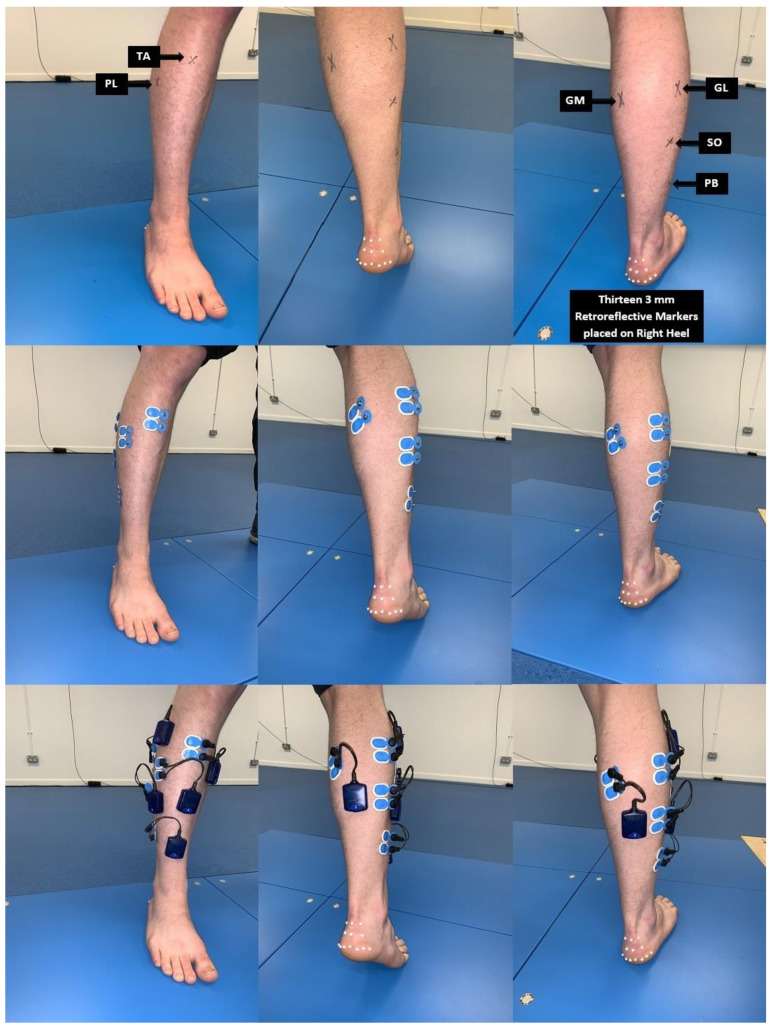
Only a small number of muscle activation patterns from lower limbs have been reported and simultaneous muscle activation from several lower limb muscles have not yet been investigated. The purpose of this study was to examine any gender differences in surface electromyography (EMG) activity from six recorded lower limb muscles of the dominant limb at baseline (i.e., with the foot placed flat on the floor and in the neutral position), and during concentric and eccentric phases when performing a heel raise task. In total, 10 females and 10 males performed a standing heel raise task comprising of three continuous phases: baseline, unloading (concentric muscle action), and loading (eccentric muscle action) phases. Muscle activation from six muscles (gastrocnemius medialis, gastrocnemius lateralis, soleus, tibialis anterior, peroneus longus, and peroneus brevis) were measured using the Myon 320 EMG System. Root mean squared values of each muscle were calculated for each phase. Descriptive and inferential statistics were incorporated into the study. Statistically significant values were set at 0.05. The results showed no significant differences between baseline, concentric, and eccentric phases with respect to each of the muscles investigated. Except for the gastrocnemius medialis at baseline and concentric phases, no significant differences were observed between genders or contractions. The data suggests that gender does not significantly influence the eccentric phase during the standing heel raise task.
仅少数关于下肢肌肉激活模式的研究被报道过,而多个下肢肌肉的同步激活情况尚未得到研究。本研究的目的是,在基线状态(即脚平放在地面且处于中立位)以及进行提踵任务的向心和离心阶段,检测优势侧下肢六条记录肌肉的表面肌电图(EMG)活动中是否存在性别差异。总共10名女性和10名男性进行了一项站立提踵任务,该任务包括三个连续阶段:基线、卸载(向心肌肉动作)和加载(离心肌肉动作)阶段。使用Myon 320 EMG系统测量六条肌肉(内侧腓肠肌、外侧腓肠肌、比目鱼肌、胫骨前肌、腓骨长肌和腓骨短肌)的肌肉激活情况。计算每个阶段每条肌肉的均方根值。研究纳入了描述性和推断性统计。统计学显著性水平设定为0.05。结果显示,在所研究的每条肌肉中,基线、向心和离心阶段之间均无显著差异。除了基线和向心阶段的内侧腓肠肌外,性别或收缩之间未观察到显著差异。数据表明,性别在站立提踵任务的离心阶段没有显著影响。