Sarmiento-García Ainhoa, Revilla Isabel, Abecia José-Alfonso, Palacios Carlos
Departamento de Construcción y Agronomía, Facultad de Agricultura y Ciencias Ambientales, Universidad de Salamanca, Av. de Filiberto Villalobos 119, 37007 Salamanca, Spain.
Area de Tecnología de los Alimentos, Escuela Politécnica Superior de Zamora, Universidad de Salamanca, Av. de Requejo 33, 49029 Zamora, Spain.
Animals (Basel). 2021 Apr 11;11(4):1090. doi: 10.3390/ani11041090.
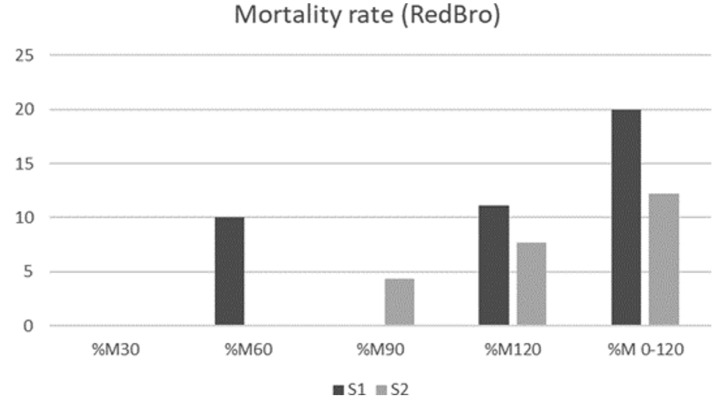
A total of 160 1-day-old medium-growing male chicks () were raised for 120 days in a certified organic farming system. A total of two strains were studied (Coloryield, CY; RedBro, RB). Overall, two weather periods were considered based on the outdoor temperature, being S1 colder than S2. In total, 40 chicks per strain were assigned to each period ( = 80). Chickens were fed ad libitum with the same organic feeds. In the first month, chickens were kept indoors and, from day 30, they had access to the pasture. Slaughter live weight (LW), average daily gains, (ADG), the feed conversion ratio (FCR), and mortality rates did not differ between the two strains. LW was ( < 0.05) higher in the S1 and a trend ( = 0.084) was observed for ADG, which was higher in S1. No differences were found for feed intake, FCR, and mortality rates between weather periods. There were no differences for coefficient of variation (CV) between the strains studied, nevertheless, CV for LW in S2 was increased. Differences in the productive performance between these strains raised in organic production systems were slight. However, chickens raised in S1 had a better performance. It would be preferable to raise chickens in these weather conditions whenever possible.
总共160只1日龄的中等生长速度雄性雏鸡在经过认证的有机养殖系统中饲养120天。共研究了两个品系(Coloryield,CY;RedBro,RB)。总体而言,根据室外温度考虑了两个气候期,S1比S2冷。每个品系共有40只雏鸡被分配到每个时期(n = 80)。鸡只自由采食相同的有机饲料。在第一个月,鸡只饲养在室内,从第30天起,它们可以进入牧场。两个品系之间的屠宰活重(LW)、平均日增重(ADG)、饲料转化率(FCR)和死亡率没有差异。S1期的LW较高(P < 0.05),并且观察到ADG有一个趋势(P = 0.084),S1期较高。在不同气候期之间,采食量、FCR和死亡率没有差异。所研究的品系之间变异系数(CV)没有差异,然而,S2期LW的CV增加。在有机生产系统中饲养的这些品系之间的生产性能差异很小。然而,在S1期饲养的鸡只表现更好。只要有可能,在这些气候条件下饲养鸡只将是更可取的。