Bergwerff Aldert A, Debast Sylvia B
Laboratory of Clinical Microbiology and Infectious Diseases, Isala Hospital, Dr. van Heesweg 2, NL-8025 AB Zwolle, The Netherlands.
Foods. 2021 Apr 11;10(4):832. doi: 10.3390/foods10040832.
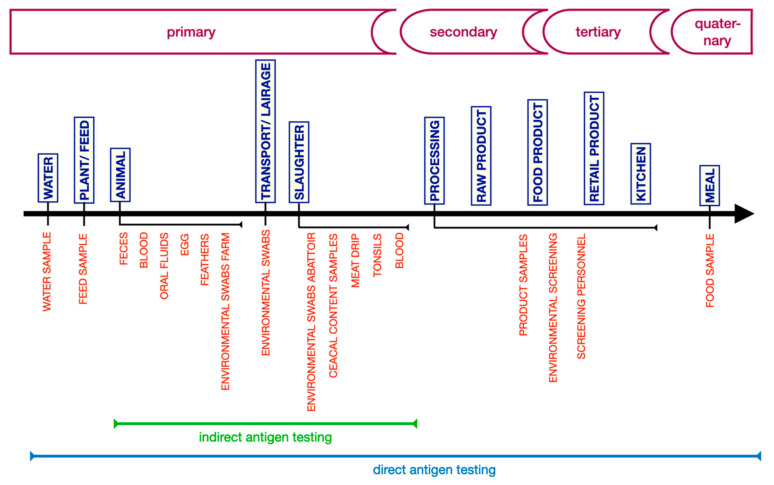
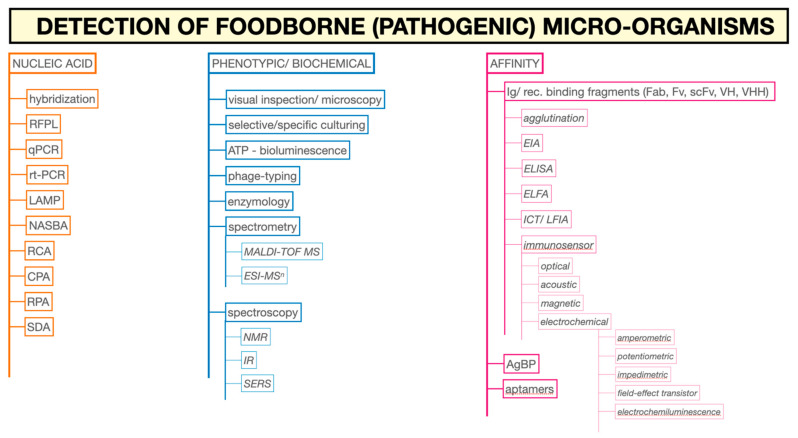
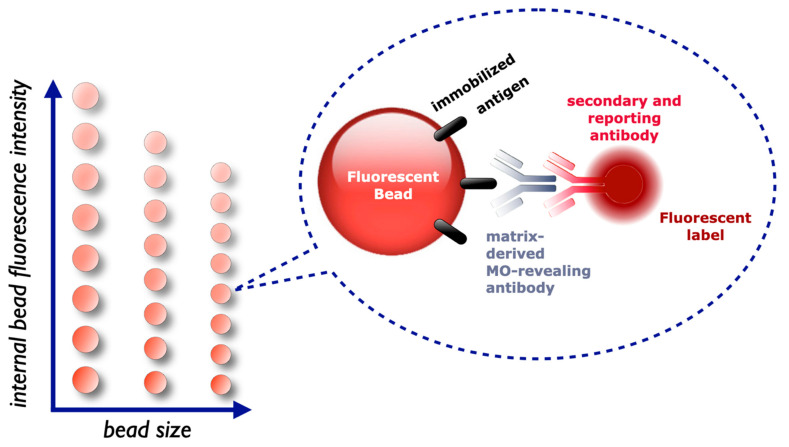
Food microbiology is deluged by a vastly growing plethora of analytical methods. This review endeavors to color the context into which methodology has to fit and underlines the importance of sampling and sample treatment. The context is that the highest risk of food contamination is through the animal and human fecal route with a majority of foodborne infections originating from sources in mass and domestic kitchens at the end of the food-chain. Containment requires easy-to-use, failsafe, single-use tests giving an overall risk score in situ. Conversely, progressive food-safety systems are relying increasingly on early assessment of batches and groups involving risk-based sampling, monitoring environment and herd/flock health status, and (historic) food-chain information. Accordingly, responsible field laboratories prefer specificity, multi-analyte, and high-throughput procedures. Under certain etiological and epidemiological circumstances, indirect antigen immunoaffinity assays outperform the diagnostic sensitivity and diagnostic specificity of e.g., nucleic acid sequence-based assays. The current bulk of testing involves therefore - and probing of humoral response to several pathogens. In this review, the inclusion of immunoglobulins against additional invasive micro-organisms indicating the level of hygiene and public health risks in tests is advocated. Immunomagnetic separation, immunochromatography, immunosensor, microsphere array, lab-on-a-chip/disc platforms increasingly in combination with nanotechnologies, are discussed. The heuristic development of portable and ambulant microfluidic devices is intriguing and promising. , many new platforms seem unattainable as the industry standard. Comparability of results with those of reference methods hinders the implementation of new technologies. Whatever the scientific and technological excellence and incentives, the decision-maker determines this implementation after weighing mainly costs and business risks.
食品微生物学领域充斥着大量不断增加的分析方法。本综述旨在描绘方法必须适应的背景,并强调采样和样品处理的重要性。背景情况是,食品污染的最高风险来自动物和人类粪便途径,大多数食源性感染源于食物链末端的大规模和家庭厨房中的源头。控制需要易于使用、万无一失的一次性测试,以便就地给出总体风险评分。相反,渐进式食品安全系统越来越依赖于对批次和群体的早期评估,包括基于风险的采样、监测环境以及畜群/禽群健康状况,还有(历史)食物链信息。因此,负责任的现场实验室更倾向于特异性、多分析物和高通量程序。在某些病因和流行病学情况下,间接抗原免疫亲和测定在诊断敏感性和诊断特异性方面优于例如基于核酸序列的测定。因此,当前的大量检测涉及——以及对几种病原体的体液反应进行探测。在本综述中,提倡在检测中纳入针对其他侵袭性微生物的免疫球蛋白,以表明卫生水平和公共卫生风险。文中讨论了免疫磁分离、免疫色谱、免疫传感器、微球阵列、芯片/盘上实验室平台,这些平台越来越多地与纳米技术相结合。便携式和可移动微流体设备的启发式开发既有趣又有前景。然而,许多新平台似乎无法成为行业标准。结果与参考方法结果的可比性阻碍了新技术的实施。无论科学技术多么卓越以及有多大激励,决策者在主要权衡成本和商业风险后决定是否采用新技术。