Pogorelić Zenon, Mihanović Jakov, Ninčević Stipe, Lukšić Bruna, Elezović Baloević Sara, Polašek Ozren
Department of Pediatric Surgery, University Hospital of Split, 21 000 Split, Croatia.
Department of Surgery, School of Medicine, University of Split, 21 000 Split, Croatia.
Children (Basel). 2021 Apr 19;8(4):309. doi: 10.3390/children8040309.
This prospective observational study aimed to evaluate the validity of appendicitis inflammatory response (AIR) score in differentiating advanced (perforated) from simple (non-perforated) appendicitis in pediatric patients.
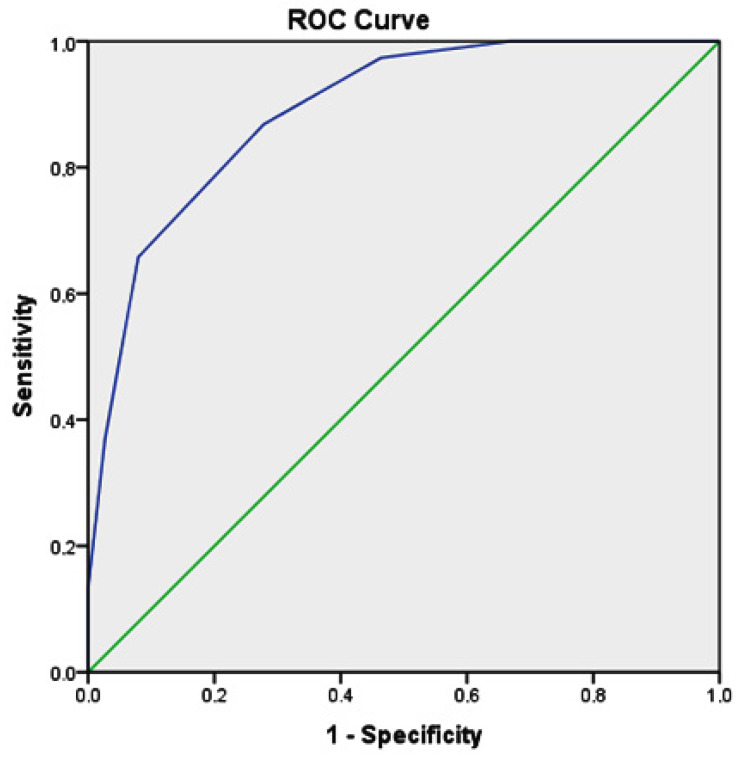
A single-center prospective cross-sectional study was conducted between 1 January 2019 until 1 May 2020 including 184 pediatric patients who underwent appendectomy. Based on the intraoperative finding of advanced ( = 38) or simple ( = 146) appendicitis the patients were divided into two groups. Recipient-operator curve (ROC), with calculation of sensitivity and specificity of best cutoff and the area under the curve (AUC), were used to measure the diagnostic value and the potential for risk stratification of the AIR score, among the patients with simple or advanced acute appendicitis.
The median value of the AIR score in the perforated and non-perforated groups was 10 (interquartile range, IQR 9, 11), and was 7 (IQR 6, 9), respectively ( < 0.001). Based on the calculated value of AIR score, the patients were classified with a high precision into low, indeterminate and high risk groups for acute appendicitis ( < 0.001). A cutoff value of ≥9 was demonstrated to serve as a reliable indicator of perforated appendicitis with a sensitivity and a specificity of 89.5% and 71.9%, respectively (AUC = 0.80; 95% CI: 0.719-0.871; < 0.001).
Acute appendicitis can be detected with a high level of sensitivity and specificity using the AIR score. Also, the AIR score may differentiate perforated from non-perforated appendicitis in pediatric patients with a high level of accuracy.
这项前瞻性观察性研究旨在评估阑尾炎炎症反应(AIR)评分在区分小儿患者的进展期(穿孔性)与单纯性(非穿孔性)阑尾炎方面的有效性。
于2019年1月1日至2020年5月1日进行了一项单中心前瞻性横断面研究,纳入了184例行阑尾切除术的小儿患者。根据术中发现的进展期(n = 38)或单纯性(n = 146)阑尾炎,将患者分为两组。采用受试者操作特征曲线(ROC),计算最佳截断值的敏感性和特异性以及曲线下面积(AUC),以衡量AIR评分在单纯性或进展期急性阑尾炎患者中的诊断价值和风险分层潜力。
穿孔组和非穿孔组的AIR评分中位数分别为10(四分位间距,IQR 9,11)和7(IQR 6,9)(P < 0.001)。根据计算出的AIR评分值,患者被高精度地分为急性阑尾炎的低、不确定和高风险组(P < 0.001)。≥9的截断值被证明是穿孔性阑尾炎的可靠指标,敏感性和特异性分别为89.5%和71.9%(AUC = 0.80;95% CI:0.719 - 0.871;P < 0.001)。
使用AIR评分可以高敏感性和特异性地检测急性阑尾炎。此外,AIR评分在区分小儿患者的穿孔性与非穿孔性阑尾炎方面可能具有较高的准确性。