Di Ianni Natalia, Musio Silvia, Pellegatta Serena
Unit of Immunotherapy of Brain Tumors, Department of Molecular Neuro-Oncology, Fondazione IRCCS Istituto Neurologico Carlo Besta, Via Celoria, 11, 20133 Milan, Italy.
Int J Mol Sci. 2021 Apr 24;22(9):4460. doi: 10.3390/ijms22094460.
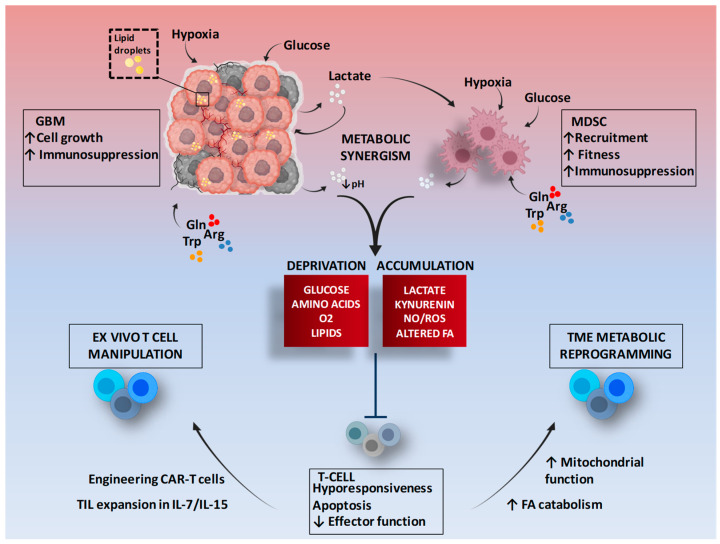
The metabolism of glioblastoma (GBM), the most aggressive and lethal primary brain tumor, is flexible and adaptable to different adverse conditions, such as nutrient deprivation. Beyond glycolysis, altered lipid metabolism is implicated in GBM progression. Indeed, metabolic subtypes were recently identified based on divergent glucose and lipid metabolism. GBM is also characterized by an immunosuppressive microenvironment in which myeloid-derived suppressor cells (MDSCs) are a powerful ally of tumor cells. Increasing evidence supports the interconnection between GBM and MDSC metabolic pathways. GBM cells exert a crucial contribution to MDSC recruitment and maturation within the tumor microenvironment, where the needs of tumor-infiltrating lymphocytes (TILs) with antitumor function are completely neglected. In this review, we will discuss the unique or alternative source of energy exploited by GBM and MDSCs, exploring how deprivation of specific nutrients and accumulation of toxic byproducts can induce T-cell dysfunction. Understanding the metabolic programs of these cell components and how they impact fitness or dysfunction will be useful to improve treatment modalities, including immunotherapeutic strategies.
胶质母细胞瘤(GBM)是最具侵袭性和致命性的原发性脑肿瘤,其代谢具有灵活性,能够适应不同的不利条件,如营养剥夺。除了糖酵解外,脂质代谢改变也与GBM进展有关。事实上,最近基于不同的葡萄糖和脂质代谢确定了代谢亚型。GBM的另一个特征是免疫抑制微环境,其中髓系来源的抑制细胞(MDSC)是肿瘤细胞的有力帮手。越来越多的证据支持GBM与MDSC代谢途径之间的相互联系。GBM细胞对肿瘤微环境中MDSC的募集和成熟起着关键作用,而具有抗肿瘤功能的肿瘤浸润淋巴细胞(TIL)的需求则被完全忽视。在这篇综述中,我们将讨论GBM和MDSC利用的独特或替代能量来源,探讨特定营养素的剥夺和有毒副产物的积累如何诱导T细胞功能障碍。了解这些细胞成分的代谢程序以及它们如何影响健康或功能障碍,将有助于改进治疗方式,包括免疫治疗策略。