Kiepura Anna, Stachyra Kamila, Olszanecki Rafał
Chair of Pharmacology, Faculty of Medicine, Jagiellonian University Medical College, 31-531 Krakow, Poland.
Biomedicines. 2021 Apr 24;9(5):467. doi: 10.3390/biomedicines9050467.
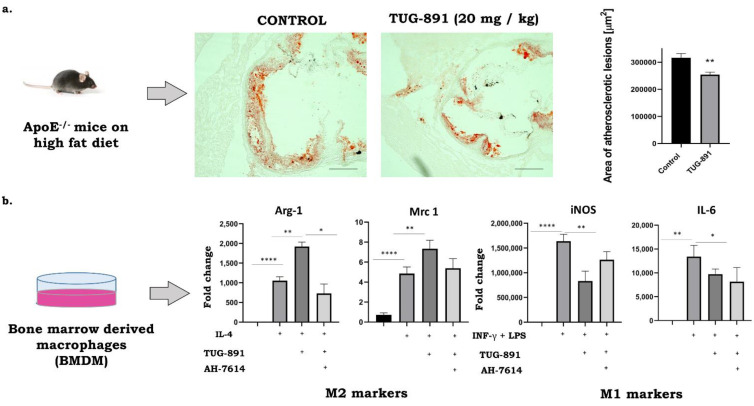
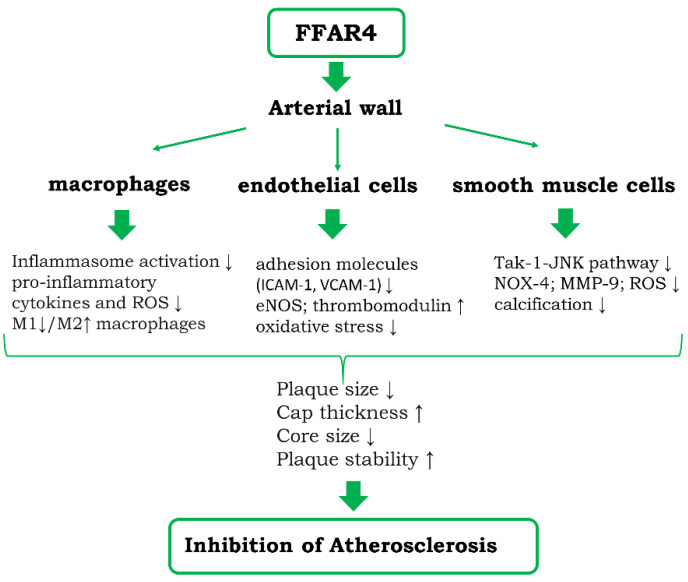
Fatty acids (FAs) are considered not only as a basic nutrient, but are also recognized as signaling molecules acting on various types of receptors. The receptors activated by FAs include the family of rhodopsin-like receptors: GPR40 (FFAR1), GPR41 (FFAR3), GPR43 (FFAR2), GPR120 (FFAR4), and several other, less characterized G-protein coupled receptors (GPR84, GPR109A, GPR170, GPR31, GPR132, GPR119, and Olfr78). The ubiquitously distributed FFAR4 can be activated by saturated and unsaturated medium- and long-chain fatty acids (MCFAs and LCFAs), as well as by several synthetic agonists (e.g., TUG-891). The stimulation of FFAR4 using selective synthetic agonists proved to be promising strategy of reduction of inflammatory reactions in various tissues. In this paper, we summarize the evidence showing the mechanisms of the potential beneficial effects of FFAR4 stimulation in atherosclerosis. Based partly on our own results, we also suggest that an important mechanism of such activity may be the modulatory influence of FFAR4 on the phenotype of macrophage involved in atherogenesis.
脂肪酸(FAs)不仅被视为一种基本营养素,还被公认为作用于各种类型受体的信号分子。被脂肪酸激活的受体包括视紫红质样受体家族:GPR40(FFAR1)、GPR41(FFAR3)、GPR43(FFAR2)、GPR120(FFAR4),以及其他几种特性较少的G蛋白偶联受体(GPR84、GPR109A、GPR170、GPR31、GPR132、GPR119和Olfr78)。广泛分布的FFAR4可被饱和和不饱和中链及长链脂肪酸(MCFAs和LCFAs)以及几种合成激动剂(如TUG - 891)激活。使用选择性合成激动剂刺激FFAR4被证明是减少各种组织中炎症反应的一种有前景的策略。在本文中,我们总结了显示FFAR4刺激在动脉粥样硬化中潜在有益作用机制的证据。部分基于我们自己的结果,我们还提出这种活性的一个重要机制可能是FFAR4对参与动脉粥样硬化形成的巨噬细胞表型的调节作用。